Executive summary
Our semi-automatic aluminum profile taping machine lays protective film on several faces of an extruded profile in one pass. The operator feeds the profile by hand; driven rollers carry it through film applicator rollers that are set to the angle of each face. It suits shops with many profile shapes and moderate volumes. Below we set up the rollers for a new profile, choose the film width per face, work out the film per profile and compare it with our automatic applicator at 10–12 pieces a minute.
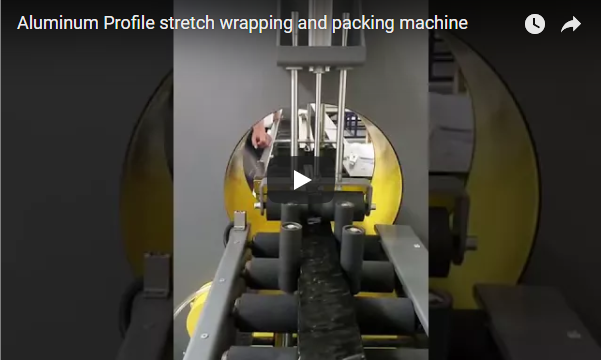
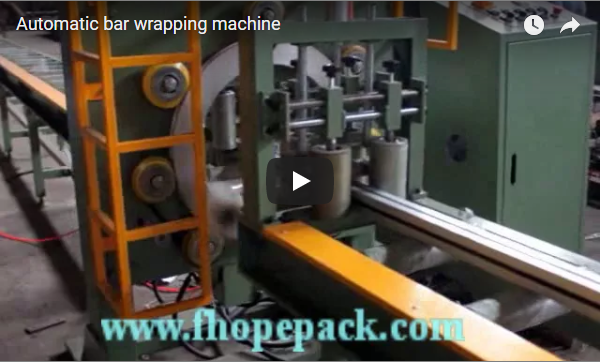
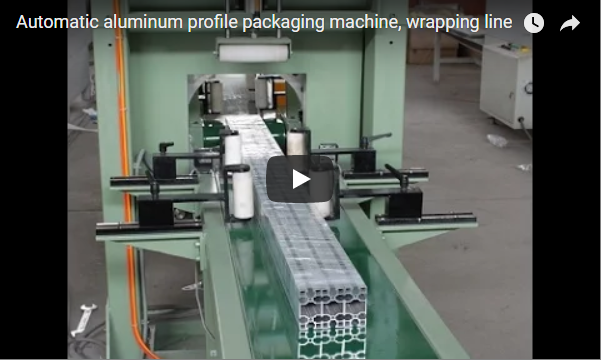
The semi-automatic taping machine is built on a heavy-duty steel frame with rubber-faced clamping rollers and positive-drive feed rollers. Mechanical guide rails maintain profile alignment through the taping zone, while spring-loaded linear slides hold the applicator heads firmly against each exterior surface. Finished profiles discharge from the out-feed conveyor with external visual faces fully shielded, leaving hollow internal chambers and mounting channels unobstructed for subsequent fabrication and drainage.
Table of Contents
- Why film the profile right after extrusion
- How the multi-face machine works
- Setting up for a new profile
- Film width per face
- Choosing the film
- Film per profile and per shift
- Semi-automatic or automatic?
- Selection checklist
- Safety
- Engineering FAQ
- Next step
- Related reading
- Sources
Why film the profile right after extrusion
Anodised and powder-coated faces scratch in stacking, cutting and transport, and a scratched visible face is a rejected profile. Protective film on the visible faces, applied before bundling, keeps them clean until the profile is installed.
Done completely by hand, profile taping typically requires two operators—one feeding and guiding the section, and a second applying tape or manually cutting the film at the ends [manufacturer rating]. In manual taping, film tension also varies, leading to edge lifting, wrinkles, or trapped air bubbles. A dedicated applicator lays the film flat at constant mechanical tension. Deploying an engineered taping unit streamlines the handling sequence and frees at least one operator for other line tasks [manufacturer rating].
How the multi-face machine works
- The operator places the profile at the entrance on the roller conveyor.
- The clamping rollers close on it, and the driven roller pulls it in.
- Each film applicator roller presses film onto its face as the profile passes.
- The film is cut at the profile end, and the profile leaves on the out-feed.
Several applicator units can work at once, so two, three or more faces are filmed in the same pass. Each unit is set to the angle of its face, which is what lets one machine handle many profile shapes.
Setting up for a new profile
- Set the clamping roller gap to the profile height.
- Set each applicator to its face angle and position.
- Fit a film roll of the right width on each unit.
- Run a short test piece and check that the film lies flat with no wrinkle at the edges.
Rubber-faced rollers grip the profile without marking the coated surface. The springs keep the pressure even when the profile has a small bow along its length.
Film width per face
Film width = face width + 2 × edge margin, where the margin carries the film round the face edge so it does not lift.
| Face width (example) | Edge margin (example) | Film width |
|---|---|---|
| 40 mm | 5 mm | 50 mm |
| 80 mm | 10 mm | 100 mm |
| 150 mm | 10 mm | 170 mm, use the next standard roll width |
Faces with a groove or a narrow return need a narrower film, so the film does not bridge the groove and tear when the profile is cut.
Choosing the film
The film is chosen by the surface it protects, not by the machine. Anodised, powder-coated and mill-finish faces each need a different adhesive tack. Too strong, and it leaves residue or lifts the coating when peeled. Too weak, and the film lifts at the edges in cutting and transport. Ask your film supplier for a grade matched to the finish and to the time the film will stay on, including outdoor storage.
Run a peel test on a coated sample before ordering. The film thickness and roll core size the applicator heads accept are confirmed at quote.
Film per profile and per shift
Film per profile = profile length × number of filmed faces. For a 6 m profile with 2 filmed faces:
| Check | Calculation | Result |
|---|---|---|
| Film per profile | 6 m × 2 | 12 m |
| Per shift, 1,000 profiles (example) | 1,000 × 12 m | 12,000 m |
| By film width | split by face, 50 mm and 100 mm | two roll types |
Order the film rolls by face and width; the roll length depends on the film supplier.
Semi-automatic or automatic?
| Item | Semi-automatic taping machine | Automatic profile film applicator |
|---|---|---|
| Feeding | by hand | profile fed from the roller conveyor, held by a driving device |
| Film cutting | at the profile end | pre-cut to the measured profile length, servo-controlled |
| Continuous line speed | set by manual feed rate; driven roller speed confirmed at quote | up to 40 m/min with matched conveyor [manufacturer rating] |
| Cycle rate | set by the operator’s feeding | 10–12 pieces a minute for 6 m profiles |
| Taping coverage | configurable multi-face units | top and bottom surface application [manufacturer rating] |
| Profile range | confirmed at quote | length 3,000–7,500 mm, width 10–200 mm, height 10–150 mm |
| Machine size | compact | L 3,500 × W 800 × H 1,500 mm |
| Power | confirmed at quote | 6.75 kW |
| Labor requirement | 1 operator feeding | eliminates secondary cutting labor [manufacturer rating] |
| Best for | many shapes, moderate volume | one extrusion line at full rate |
The automatic applicator measures each incoming profile length, pre-cuts the protective film to that exact length using servo-synced rotary cutters [manufacturer rating], and separates the taped profile from the trailing piece with a servo speed transition before transferring it to a gathering table.
Selection checklist
- Profile shapes, with drawings of the faces to protect.
- Profile lengths.
- Number of faces filmed per profile.
- Profiles per shift, and the heaviest profile per metre.
- Film type and widths.
- Manual feeding or a link to the extrusion line.
Safety
We design to EN ISO 12100:2010 for risk assessment, EN 415-10 for general packaging machine safety and EN 60204-1 for the electrical equipment. The nip between the driven rollers and the profile is the main hazard, so the in-feed is guarded to keep hands out of the nip and an emergency stop is within reach of the operator. Guarding and CE documents are agreed per project.
Engineering FAQ
Q: How many faces can it film at once? A: As many as there are applicator units fitted, each set to its own face angle and cross-sectional coordinate.
Q: Does it mark the profile? A: No. The clamping rollers are faced with non-marking industrial rubber to grip anodised or powder-coated surfaces firmly without leaving mechanical indentations or abrasions.
Q: How long does a change to a new profile take? A: It depends on how many applicator units move. Changing only the film width is a roll swap; a new cross-section means resetting the roller gap and every applicator angle, then running a test piece. Mark the settings for each profile you run often, so a repeat changeover is a re-set to known positions rather than a new set-up. The changeover time for your profile range is confirmed at quote.
Q: What is the faster option? A: Our automatic applicator, running at 10–12 pieces a minute for 6 m profiles with continuous conveying up to 40 m/min [manufacturer rating].
Q: Can it run tape as well as film? A: Yes, the applicators lay polyethylene film, paper masking tape, or specialist adhesive tapes up to the roll width fitted.
Next step
- Send your profile drawings, lengths and profiles per shift to info@fhopepack.com.
- We set the applicator layout and the film widths.
- We reply within 24 hours with a proposal and quotation.
Related reading
- Automatic profile taping machine (product)
- Automatic aluminum profile protective film applicator (product)
- Aluminum profile paper packing machine (product)
- Automatic aluminum profile tape applicator
- Automated aluminum profile taping, transfer and horizontal wrapping line
- Aluminum profile bundle bag packing machine
Sources
- FHOPE product page: Automatic profile film applicator machine (https://www.fhopepack.com/Aluminum/Automatic-profile-tapping-machine.html)
- FHOPE product page: Automatic aluminum profile protective film applicator (https://www.fhopepack.com/Aluminum/aluminum-profile-applicator.html)
- Safety standards: EN ISO 12100:2010; EN 415-10; EN 60204-1
- Factory engineering specifications: Semi-automatic multi-face profile taping system
Last reviewed: 2026-10-29