Executive summary We build paper packing machines for aluminum profiles in two forms: customized multi-lane lines that sleeve single profiles in paper as they move, as in our video, and bundle machines that fold a cut sheet around the bundle and tape it at 3–4 positions. On the bundle machine one operator runs feeding, covering, taping and outfeeding. Paper, PE sheet or board can be used as the covering material. This guide explains the station sequence, a roll-width sizing method and how to plan taping along a 6000 mm bundle.
Table of Contents
- Packing process
- Machine scope
- Paper roll width
- Taping layout
- Line position
- Safety
- Selection checklist
- Engineering FAQ
- Next step
- Related reading
- Sources
How the aluminum profile paper packing machine works, station by station
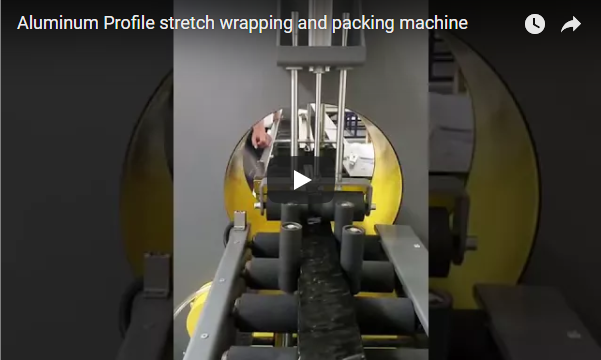
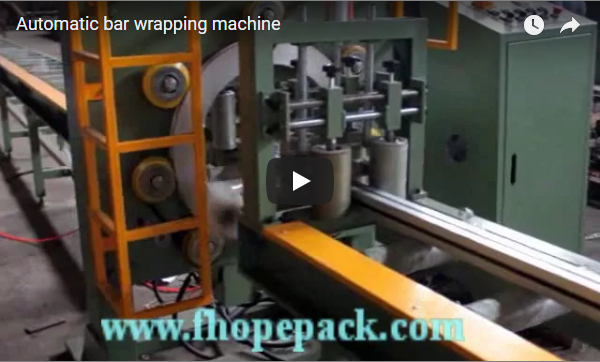
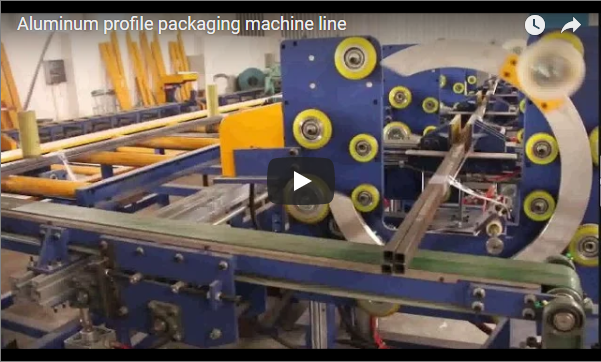
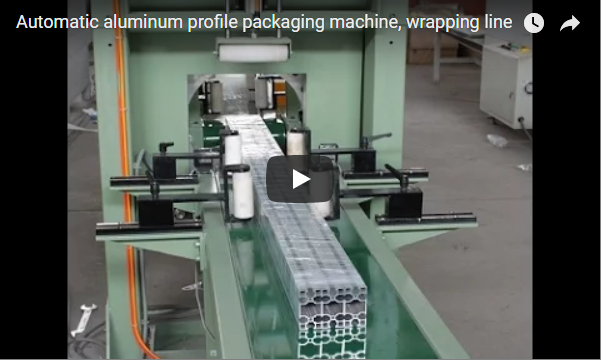
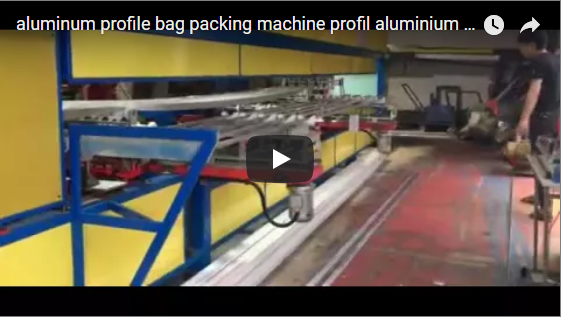
In this video our customized line runs single aluminum profiles on parallel lanes, one profile per lane. We build this line to the customer’s profile range rather than as a catalog model. Paper goes onto each profile as a continuous flat sleeve while the profile moves forward:
- 0–4 s, continuous sleeve. The profiles already carry the start of the paper sleeve. The paper runs as one continuous sleeve, not as a cut sheet per profile.
- 4–8 s, check before the run. A profile is checked on its lane before the line moves. Each lane carries one profile, so each profile gets its own sleeve.
- 8–24 s, multi-lane sleeving. The profiles move forward and the sleeve runs onto several lanes at the same time, controlled from the cabinet at the line side.
- 24 s onwards, steady running. Sleeving continues along the lanes while the profiles keep moving, with no stop per profile.
For profile bundles, our bundle paper packing machine repeats six stations instead:
- Feeding table. Profiles are gathered into a bundle and fed towards the covering station.
- Paper draw. A roll feeding device clamps the head of the paper and draws it to the far side of the station.
- Cut to length. The paper is cut at the length set on the panel, so each sheet matches the profile length.
- Bundle on paper. The bundle is fed onto the ready paper sheet.
- Folding. Belt holding devices rise and turn, folding the paper around the bundle.
- Taping and unloading. Tape fixes the paper at 3–4 positions; an unloading device then moves the packed bundle to the outfeed conveyor.
What the machine covers and which materials it runs
| Item | Our bundle paper packing machine |
|---|---|
| Product | Single aluminum profile or profile bundle |
| Covering material | Paper, PE sheet or board |
| Sheet length | Cut per length setting, matched to profile length |
| Fixing | Tape at 3–4 positions on the package surface |
| Unloading | Automatic transfer to the outfeed conveyor |
| Operators | 1 operator for feeding, covering, taping and outfeeding |
This table covers the bundle machine. The multi-lane sleeving line in the video is a separate, customized line for single profiles. The bundle machine replaces manual paper covering, which is labor-intensive and slow when every bundle must be wrapped by hand.
Paper roll width: size it from the bundle perimeter
The paper is drawn along the profile length and folded around the cross-section. So the roll width must cover the bundle perimeter plus a closing overlap:
- Rule: roll width ≥ 2 × (bundle width + bundle height) + overlap.
- Example: a 150 × 80 mm bundle has a 460 mm perimeter. With a 40 mm overlap, the roll must be at least 500 mm wide.
- Sheet length: set it to the profile length, so a 6000 mm bundle takes a 6000 mm sheet.
| Bundle cross-section | Perimeter | Overlap | Minimum roll width |
|---|---|---|---|
| 150 × 80 mm | 460 mm | 40 mm | 500 mm |
| 100 × 50 mm | 300 mm | 40 mm | 340 mm |
| 200 × 100 mm | 600 mm | 40 mm | 640 mm |
Standardize on a few roll widths that cover your bundle families, so changeovers stay short.
Taping layout along the bundle
The machine tapes the closed paper at 3–4 positions. Keep one tape close to each end, where the paper is most likely to open during handling, and spread the rest evenly. With tapes at both ends, spacing = bundle length ÷ (number of tapes − 1):
- 4 positions on a 6000 mm bundle gives about 2000 mm between tapes.
- 3 positions on the same bundle gives about 3000 mm between tapes.
We customise tape positions per customer and covering material. One layout we build puts two tapes near the head, two near the tail and one in the middle.
Where paper packing sits in an aluminum profile line
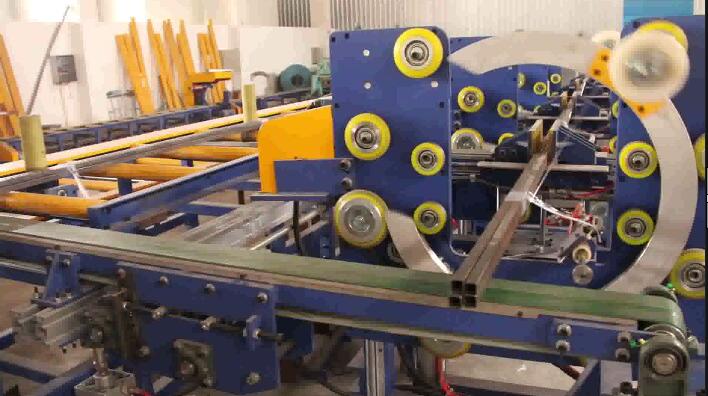
We place the paper packing machine after bundle forming and before final stacking or crating. Inline, the feeding table takes bundles from the upstream conveyor. Offline, an operator loads the feeding table. For bundles that also need film, our aluminum profile packing lines add a wrapping or bagging station after the paper.
Safety on a paper covering station
Moving belts, the paper cutter and the taping heads are the main hazards. Keep hands out of the folding zone during the cycle, and stop the machine before clearing a paper jam. The applicable standards depend on the destination market. For CE markets, ISO 12100 sets the risk-assessment method and EN 415-10 sets the general requirements for packaging machines.
Selection checklist for an aluminum profile paper packing machine
- Profile length range and bundle cross-section (width × height).
- Single profiles, bundles, or both.
- Covering material: paper, PE sheet or board, and the roll width you use today.
- Bundles per hour from the extrusion or finishing line.
- Inline connection or offline loading.
- Space for the feeding table, covering station and outfeed conveyor.
Engineering FAQ
Q: Can the machine pack single profiles as well as bundles? A: Yes. The bundle machine covers a single profile or a profile bundle, and our customized multi-lane line in the video sleeves single profiles continuously. Set the sheet length to the profile length, so a 6000 mm profile takes a 6000 mm sheet, and choose a roll width that covers the perimeter plus overlap.
Q: How wide must the paper roll be? A: Use 2 × (width + height) + overlap. A 150 × 80 mm bundle with a 40 mm overlap needs at least a 500 mm roll.
Q: How is the paper fixed after folding? A: By tape at 3–4 positions, with one tape near each end. On a 6000 mm bundle, 4 tapes sit about 2000 mm apart. Positions are customised per customer and material.
Q: Can we use PE sheet instead of paper? A: Yes. The covering station runs paper, PE sheet or board. The sizing method stays the same: a 150 × 80 mm bundle still needs at least 500 mm of sheet width, cut to the profile length.
Q: How many operators does the machine need? A: 1 operator runs profile feeding, paper covering, taping and outfeeding, provided the bundles arrive formed on the feeding table.
Next step
We size the paper packing machine to your profiles in three steps:
- Submit your layout drawing with length range, bundle cross-sections, covering material and bundles per hour to info@fhopepack.com.
- Receive a machine proposal within 48 hours, with roll-width selection, taping layout and line position.
- Book a site survey to fit the feeding table and outfeed into your packing area.
Related reading
- Automatic aluminum profile paper packing machine
- Aluminum profile packing lines
- Video: aluminum profile packing by machine with paper
- Video: paper and plastic sheet feeding for aluminum profile packing
- Video: automatic aluminum profile packaging line for paper packing and stacking
Sources
- Station sequence, materials, sheet cut-to-length, 3–4 tape positions, unloading: automatic aluminum profile paper packing machine page
- One-operator scope: aluminum profile paper sheet packing machine page
- Line view: our paper packing video on YouTube
- Standards scope: ISO 12100:2010, EN 415-10:2014
Last reviewed: 2026-10-03