Executive summary
Orbital stretch wrapping winds film or paper around a long product as it passes through a turning ring. It is the standard way to pack aluminium profiles, tubes and long bundles, because the wrap follows the product length and protects every face from scratches, dust and moisture. Our equivalent solution, the E600, takes products over 800 mm long, 200–600 mm across and 20–200 kg, with the ring at 10–90 r/min.
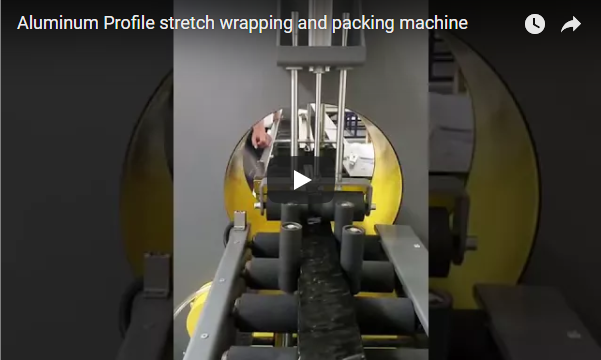
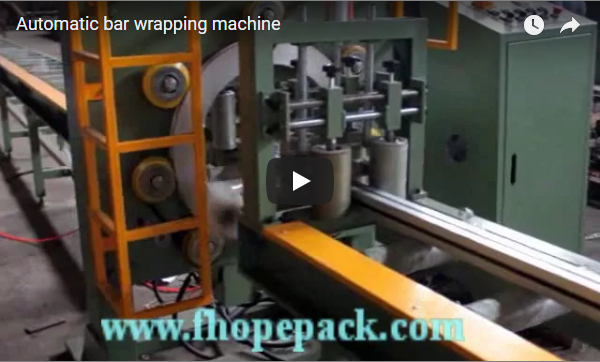
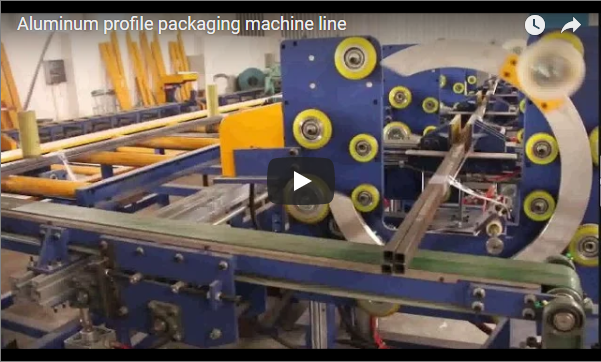
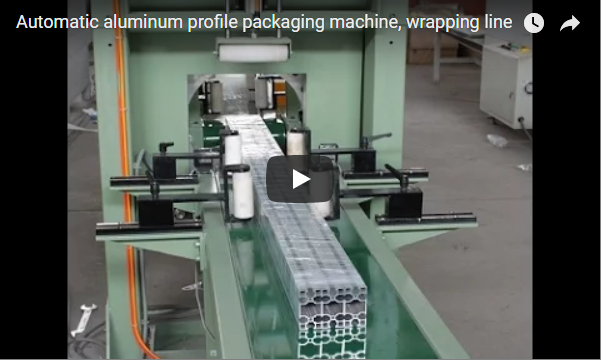
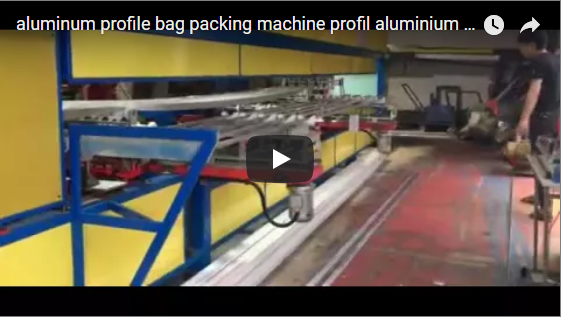
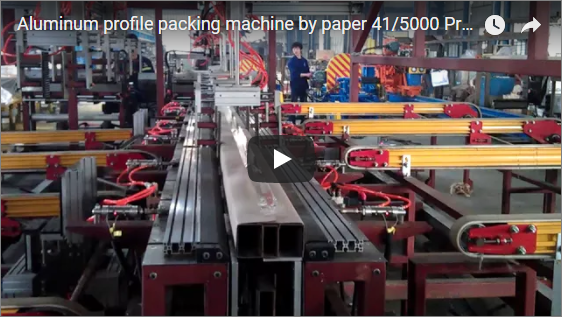
The line is in an aluminium profile plant. Profiles lie on orange and blue roller tables, workers prepare them at single-profile wrapping stations, and the finished bundle passes through a ring wrapper inside an orange guard frame, which winds brown paper around it.
Table of Contents
- How orbital stretch wrapping works
- Applications
- Film, paper or woven tape?
- Overlap, cycle time and material use
- Aluminium profile lines
- Selection checklist
- Safety: EN 415-10 and ISO 12100
- Engineering FAQ
- Next step
- Related reading
- Sources
How orbital stretch wrapping works
- Infeed. The product or bundle rides on the infeed conveyor towards the ring.
- Start. Position sensors detect the front end; the film tail is fixed to it.
- Wrap. The ring turns around the product while the conveyor carries it through, so the film spirals along the length. Press-down devices hold the bundle steady.
- End. At the rear end the ring stops, the film is cut and the tail is fixed.
- Outfeed. The wrapped product leaves on the outfeed conveyor.
The product does not turn. Only the ring turns, so long, flexible or loose bundles keep their shape.
Applications
| Product | Why orbital wrapping |
|---|---|
| Aluminium profiles and bundles | protects anodised or painted surfaces from scratches |
| Steel and plastic tubes | keeps bundles tight and clean |
| Timber, mouldings and boards | moisture and dust protection along the length |
| Doors, panels and furniture parts | full cover without a carton |
| Straight hose and cable bundles | tight wrap along the length |
Coils wrapped through the eye use a dedicated coil wrapper with an opening ring, not a pass-through bundle wrapper.
Film, paper or woven tape?
The E-series runs LLDPE stretch film, paper or woven tape. Main E600 data:
| Item | E600 |
|---|---|
| Product length | over 800 mm |
| Product size across | 200–600 mm |
| Product weight | 20–200 kg |
| Ring speed | 10–90 r/min |
| Material width | 150–300 mm |
| Conveyor speed | 3–12 m/min |
| Power | about 4.5 kW, AC 380 V, 50 Hz, 3 phase |
| Material | Use |
|---|---|
| Stretch film | tight, waterproof wrap; transparent so labels show |
| Paper | breathable; protects finished surfaces; easy to recycle |
| Woven tape | high strength for heavy or sharp-edged bundles |
Aluminium profiles are often wrapped in paper for surface protection, or film for waterproof shipping. Wrapping tension is adjustable for each package size; set it lower on painted or anodised profiles so the bundle edges are not marked.
Overlap, cycle time and material use
Pitch per ring turn = material width × (1 − overlap). Turns = bundle length ÷ pitch.
Worked example: a 300 × 200 × 6,000 mm profile bundle, 200 mm material, ring at 60 r/min. The bundle diagonal is √(300² + 200²) = 361 mm, inside the 600 mm limit of the E600. The perimeter is 2 × (0.3 + 0.2) = 1.0 m.
| Overlap | Pitch | Turns | Wrap time at 60 r/min | Conveyor speed | Material on the bundle |
|---|---|---|---|---|---|
| 50% | 100 mm | 6,000 ÷ 100 = 60 | 60 s | 0.1 × 60 = 6 m/min | 60 × 1.0 = 60 m |
| 30% | 140 mm | 6,000 ÷ 140 = 43 | 43 s | 8.4 m/min | 43 m |
The table covers the spiral along the body only. Add the programmed end turns at the front and rear, for example 2 + 2 = 4 turns, which is 4 s at 60 r/min, so the 50% cycle becomes about 60 + 4 = 64 s, plus ring start and stop.
Result. Cutting the overlap from 50% to 30% saves about 28% of material and time, at the cost of fewer layers. Both conveyor speeds sit inside the 3–12 m/min range. The overlap is set from 10% to 90% on the panel.
Aluminium profile lines
For full profile packing lines we combine the wrapper with bundle forming and timber feeding. Our aluminium profile packing line handles bundles from 70 mm high × 450 mm wide × 5,650 mm long up to 300 × 450 × 6,500 mm, in standard lengths of 5,650, 6,000 and 6,500 mm, with one operator at the infeed. Timber blocks are fed under the bundle at the final stage of wrapping. Finishes include film covering, partial wrapping, six-side wrapping and wood feeding.
Selection checklist
- Product or bundle length, width, height and weight.
- Surface finish to protect.
- Film, paper or woven tape.
- Overlap and number of layers.
- Bundles per hour.
- Manual feeding or link to the bundling line.
Safety: EN 415-10 and ISO 12100
Wrapping machines are covered by EN 415-10, with the risk assessment to ISO 12100:2010. The turning ring is the main hazard. A guard frame closes the ring zone, as on the line shown, and access doors are interlocked. Guarding and CE documents are agreed per project.
Engineering FAQ
Q: Does the bundle turn during wrapping? A: No. Only the ring turns; the bundle moves straight through on the conveyor.
Q: Can the same machine wrap with film and paper? A: Yes. The E-series runs stretch film, paper or woven tape.
Q: How long can the product be? A: Over 800 mm on the E600; profile lines handle 6,500 mm bundles and more.
Q: How do I cut material cost? A: Lower the overlap, as in the example above, while keeping enough layers for protection.
Q: What air and power are needed? A: The E600 uses about 4.5 kW at 380 V; the profile packing line uses air at 6–8 bar.
Next step
- Send your product sizes, weights, finish and output to info@fhopepack.com.
- We choose the ring size, material and line layout.
- We reply within 24 hours with a proposal and quotation.
Related reading
- E600 horizontal stretch wrapping machine (product)
- Aluminium profile packing line (product)
- Fully automatic film and paper wrapping machine for aluminium profile
- Aluminium horizontal wrapping machine with spacer feeder
- Horizontal ring orbital stretch wrapping machine
- Aluminium profile stretch wrapping machine
Sources
- FHOPE product pages: E600 and E1000 horizontal stretch wrappers; aluminium profile packing line
- FHOPE project correspondence on aluminium profile finishes
- EN 415-10; ISO 12100:2010
- The profile wrapping line shown above
Last reviewed: 2026-10-19