Executive summary An automatic aluminium profile film applicator covers the faces of each profile with protective film or tape after extrusion. Our clip, about 78 s long, shows a worker feeding profiles, a long roller conveyor and a finished profile with printed film on its sides. Our applicator packs 10 to 12 pieces per minute for 6 m profiles, and it saves one operator.
Table of Contents
- What the clip shows, in order
- Cycle time on the clip
- How the film applicator works
- Aluminium profile film applicator specifications
- Takt check
- Selection checklist for a film applicator
- Controls and safety
- Engineering FAQ
- Next step
- Related reading
- Sources
What the clip shows, in order
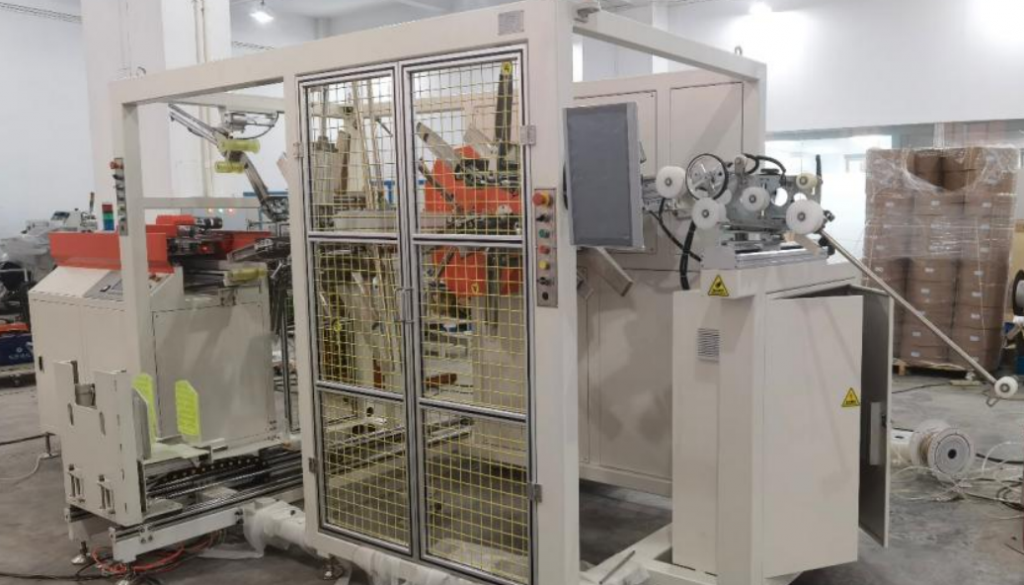
The machine has a white control cabinet with a screen and buttons, and blue-green drive rollers at its entrance. It sits at the end of a long orange frame fitted with white rollers. Stacks of profiles fill the hall behind it.
- 0 to about 6 s. A worker in blue overalls feeds a long silver aluminium profile into the entrance of the applicator from the left.
- About 9 s. The camera moves quickly, and the frame is blurred.
- About 12 to 42 s. Dark grey coated profiles lie side by side on the orange roller conveyor and travel to the right. The worker walks in the background.
- About 45 to 72 s. More profiles run along the conveyor, with no one beside the line. The camera moves closer to the outfeed end.
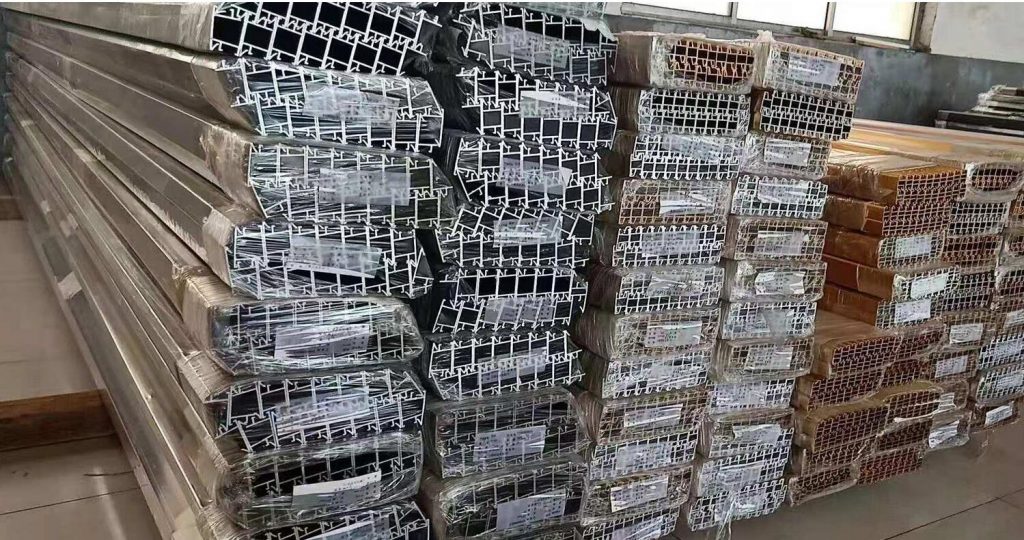
- About 78 s. A close view shows packed profiles standing on an orange rack. White film with red and black print covers their sides.
Cycle time on the clip
| Step on the clip | Time window | Duration |
|---|---|---|
| Manual infeed of a profile | 0 to about 6 s | about 6 s |
| Profiles on the roller conveyor | about 12 to 42 s | about 30 s |
| Profiles running to the outfeed | about 45 to 72 s | about 27 s |
| Packed profiles on the rack | about 78 s | single view |
The times come from frames 3 s apart. They show how the profiles move along the line, not the speed of a single piece through the applicator.
How the film applicator works
The operator feeds each profile from the roller conveyor into the entrance of the applicator. A driving device presses down to hold the profile and moves it through the film applicators.
As the profile enters, the machine checks its length and cuts the film to that length in advance. The film is pressed onto the profile surface as it passes the applicators. A servo drive then moves the profile out at a different speed, so each packed profile separates from the applicator.
| Part | What it does |
|---|---|
| Infeed roller conveyor | Carries profiles to the entrance |
| Press-down driving device | Holds the profile and moves it through |
| Film cutting device | Checks profile length and pre-cuts the film |
| Film applicators | Press film or tape onto the profile faces |
| Servo outfeed drive | Separates the packed profile |
| Outfeed conveyor and gathering table | Collect packed profiles for unloading |
Packed profiles then pass from the outfeed conveyor to the gathering table for unloading. The usual manual method needs two people, one feeding and one cutting film, so the applicator saves one operator.
Aluminium profile film applicator specifications
| Film applicator | Specification |
|---|---|
| Machine size | 3,500 × 800 × 1,500 mm (L × W × H) |
| Profile length | 3,000 to 7,500 mm |
| Profile width | 10 to 200 mm |
| Profile height | 10 to 150 mm |
| Packing speed | 10 to 12 pieces per minute for 6 m profiles |
| Total power | 6.75 kW |
| Covering material | Protective film or tape |
| Film length | Pre-cut to the measured profile length |
Takt check
For an illustrative extrusion output of 600 profiles of 6 m per hour, the takt is 3,600 ÷ 600 = 6 s per profile. At 10 to 12 pieces per minute, the applicator needs 5 to 6 s per piece, so it keeps pace.
At 10 pieces per minute it has no spare time. Where output runs higher, we plan a buffer on the infeed conveyor, so the operator can keep feeding without a gap.
Selection checklist for a film applicator
- Profile length, against 3,000 to 7,500 mm.
- Profile width and height, against 10 to 200 mm and 10 to 150 mm.
- Faces to cover, and film or tape for each face.
- Profiles per hour, against 10 to 12 pieces per minute.
- Space for the infeed conveyor, outfeed conveyor and gathering table.
Controls and safety
On the clip, a worker feeds a profile by hand into the entrance, close to the driven rollers and the press-down device. Hands near the infeed nip point are the move to design out. We guard the entrance so the profile goes in from the conveyor, with no hand inside the nip.
Stop, isolate and lock out the applicator before anyone clears a jam, changes a film roll or reaches past the entrance guard. The cutting device and the servo outfeed stay locked out until the guard is closed again.
The standards that apply depend on the destination market. For CE markets, ISO 12100 sets the risk-assessment method, and EN 415-10 covers general requirements for packaging machines, which fixes guarding and the stop arrangement.
Engineering FAQ
Q: Which profile sizes does the applicator take? A: Lengths from 3,000 to 7,500 mm, widths from 10 to 200 mm and heights from 10 to 150 mm.
Q: How fast does it pack? A: 10 to 12 pieces per minute for 6 m profiles.
Q: How does it cut the film to length? A: It checks the length of each profile as it enters and pre-cuts the film to that length in advance. A servo drive then separates the packed profile at the outfeed.
Next step
We size an aluminium profile film applicator in three steps:
- Submit your layout drawing with the profile sections, lengths, faces to cover and output, to info@fhopepack.com.
- Receive a proposal within 48 hours, with the applicator layout, the film set-up and the speed check.
- Book a site survey so we confirm the extrusion line, the conveyor space and the guarded infeed.
Related reading
- Automatic aluminium profile film applicator
- Automatic profile taping machine
- Aluminium profile packing line
Sources
- Machine specifications: aluminium profile applicator product page
- Clip timing: frame timings taken from our clip, 3 s between frames
- Machine in action: our video on YouTube
- Standards scope: ISO 12100:2010, EN 415-10:2014
Last reviewed: 2026-10-05