> **Executive summary**
>
> Window, door and furniture profiles are sold on their finish, and the finish is what the installer sees. An individual film bag keeps each profile clean and unmarked from the press to the building site. Our aluminum profile bagging machine forms film round each profile as it runs through, seals it along the length and closes the ends, so the profile is fully covered in one pass.
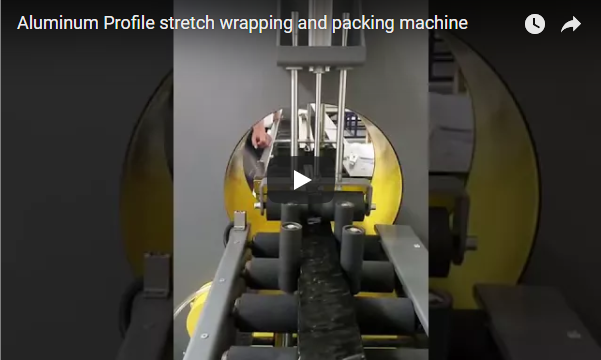
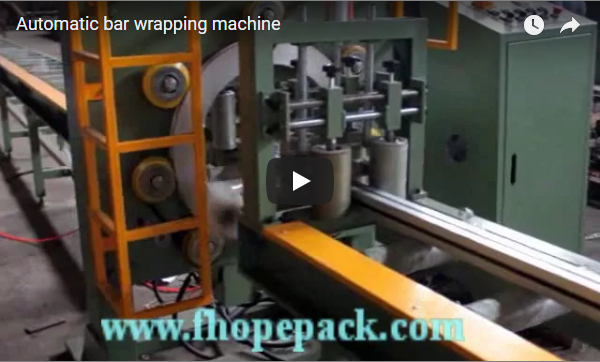
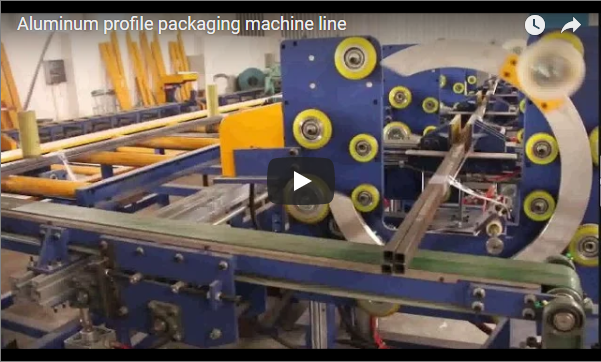
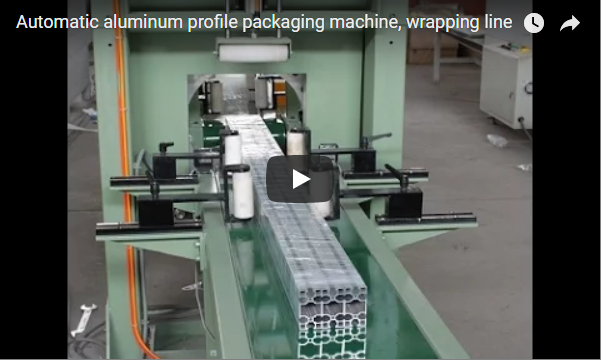
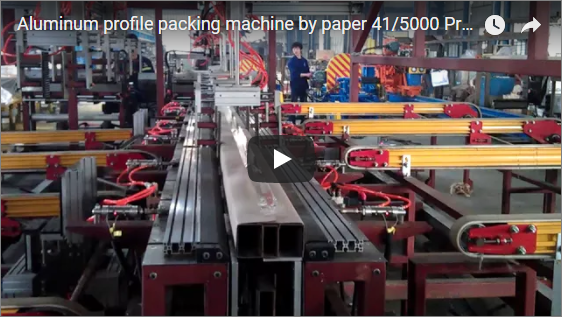
Long profiles run along the conveyor of a yellow and blue bagging machine with red guide rollers. An operator at the in-feed lines each profile up and guides it into the forming section, and a second worker checks the bagged profiles at the out-feed.
Table of Contents
- Why bag each profile
- Bagging sequence
- Machine data
- Bag size from the profile perimeter
- BOPP or PE
- Output
- Selection checklist
- Safety
- Engineering FAQ
- Next step
- Related reading
- Sources
Why bag each profile
Protective tape covers only the visible faces and must be peeled off on site. A bag covers the whole profile, comes off in one pull and keeps mortar, dust and fingerprints off the finish during installation. On the bundle, bagged profiles do not rub metal on metal.
Bagging sequence
1. The profile is placed on the in-feed conveyor.
2. A sensor detects the profile and starts the film feed.
3. The film is formed into a tube round the profile.
4. The long seam is sealed.
5. The ends are sealed and cut at the profile ends.
6. The bagged profile runs out for bundling.
Machine data
| Item | Value |
| :--- | :--- |
| Profile length | up to 6,000 mm |
| Bagging speed | about 10–50 m/min |
| Film | BOPP or PE |
| Film thickness | 30–60 micron |
| Film roll | OD 100–200 mm, ID 75 mm |
| Air supply | 5–7 bar |
| Power | 380 V, 3 phase, 60 Hz |
| Control | PLC with inverters and sealing temperature control |
Profile cross-section limits are confirmed at quote.
Bag size from the profile perimeter
A profile is not round, so the bag is sized from its outline:
**Lay-flat width ≥ (profile perimeter ÷ 2) + clearance**
Example only: a 60 × 40 mm rectangular profile has a perimeter of 2 × (60 + 40) = 200 mm, so the bag lay-flat must be over 100 mm before clearance and seal. Profiles with fins or open channels are measured round their outer outline, not along every face.
BOPP or PE
BOPP is stiff and clear, seals cleanly and shows the finish well, which suits retail and window profiles. PE is softer and tougher against tears on sharp profile edges. The sealing temperature is set per film type in the control.
Output
**Profiles per minute ≈ bagging speed ÷ profile length**
Example only: at 24 m/min with 6 m profiles, 24 ÷ 6 = 4 profiles per minute, or 240 per hour, before gaps between profiles.
With a gap between profiles the net rate is **speed ÷ (profile length + gap)**. Example only: a 0.5 m gap at the same speed gives 24 ÷ 6.5 ≈ 3.7 profiles per minute, about 220 per hour. Gap, former changeover time and cross-section limits are confirmed at quote.
Selection checklist
1. Profile drawings and largest cross-section.
2. Length range.
3. Profiles per hour.
4. BOPP or PE film.
5. Manual or automatic in-feed.
6. Bundling after bagging.
Safety
We design to EN ISO 12100:2010 for risk assessment, EN 415-10 for packaging machine safety and EN 60204-1 for the electrical equipment. The sealing jaws are guarded, and sensor and mechanical stops plus motor over-current protection guard the line.
Engineering FAQ
Q: Can one machine bag different profiles?
A: Yes, within its range; the former and bag width are set per profile.
Q: How fast is it?
A: About 10–50 m/min.
Q: Which film is clearer?
A: BOPP.
Q: Can it feed a bundling line?
A: Yes, confirmed at quote.
Next step
1. **Send your profile drawings, lengths and output** to info@fhopepack.com.
2. **We set** the former, film and line layout.
3. **We reply within 24 hours** with a proposal and quotation.
Related reading
- [Pipe and profile bagging machine (product)](https://www.fhopepack.com/Pipe-packing-machine/bagging-machine.html)
- [Aluminum profile bundle bag packing machine](https://www.fhopepack.com/videos/aluminum-profile-bundle-bag-packing-machine-2/)
- [Automatic aluminum profile packing line](https://www.fhopepack.com/videos/automatic-aluminum-profile-packing-line/)
- [High speed steel tube pipe single bagging packing line machine](https://www.fhopepack.com/videos/high-speed-steel-tube-pipe-single-bagging-packing-line-machine/)
Sources
- FHOPE product page: bagging machine
- EN ISO 12100:2010; EN 415-10; EN 60204-1
Last reviewed: 2026-10-20