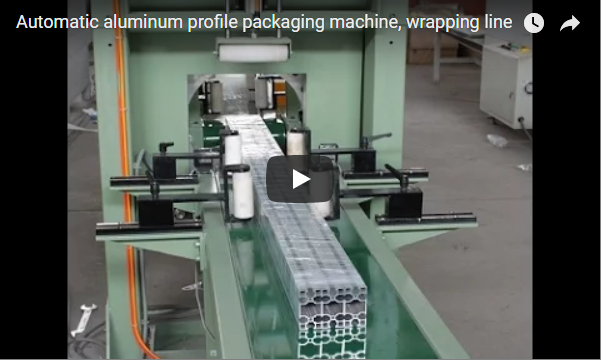
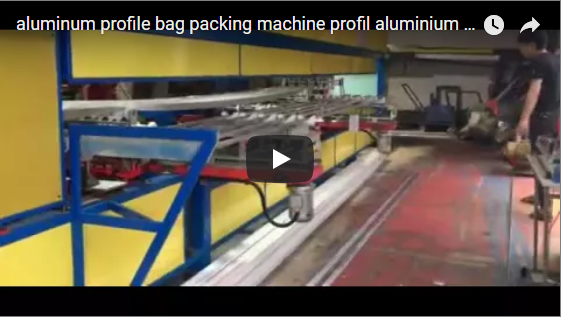
Executive summary Finished aluminum profiles scratch when they slide over each other or are carried by hand. Our line in this video carries the profiles on conveyors, transfers them with a robot arm above the line and covers them in film, keeping each profile level from start to end. Tape and film use follow from the profile length and the profiles per bundle. We set both per project.
Table of Contents
- Inline taping, robotic transfer and continuous wrapping
- How the profile line works
- Protective tape use per bundle
- Line configuration rules
- Integration into an existing profile line
- Controls, installation and safety
- Selection checklist for an aluminum profile packing line
- Engineering FAQ
- Next step
- Related reading
- Sources
Inline taping, robotic transfer and continuous wrapping
Manual handling and inter-profile friction are where most surface damage starts in extrusion packaging. This line integrates inline protective tape, a robot transfer and continuous wrapping so profiles stay oriented, separated and level from infeed to output, without stopping the line for each bundle.
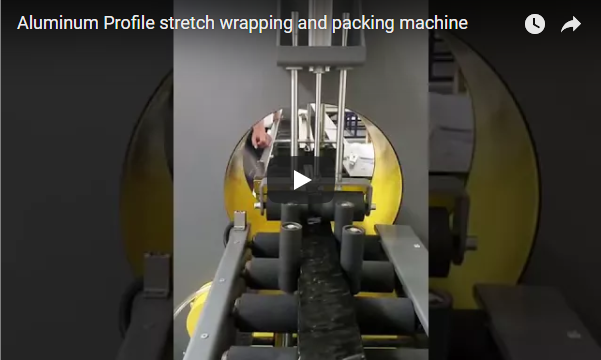
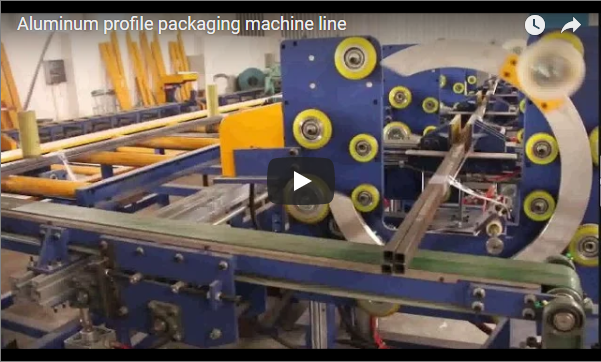
The video walks through that sequence in order: infeed on the conveyor, robotic transfer in step with the line, tape and film application, and a level exit at the far end.
How the profile line works
| Step | What happens |
|---|---|
| Feed | Profiles enter on the conveyor |
| Transfer | The robot arm picks and places them in step with the line |
| Tape | Yellow units along the line apply the protective tape |
| Cover | Profiles move on, covered in clear film |
| Output | Profiles leave the far end, still level |
Keeping the profiles level and spaced means no profile slides over another, which is where most surface marks start.
Protective tape use per bundle
Illustrative example with two strips of protective tape along each profile:
| Item | Value |
|---|---|
| Profile length (illustrative) | 6,000 mm |
| Strips per profile (illustrative) | 2 |
| Tape per profile, 2 × 6 m | 12 m |
| Profiles per bundle (illustrative) | 20 |
| Tape per bundle, 20 × 12 m | 240 m |
Add the lead-in at each end of a strip when you plan tape rolls.
Line configuration rules
| Requirement | Configuration | Selection rule |
|---|---|---|
| Visible faces only | Decorative-face taping | When unexposed faces need no film; selection per project |
| Full cover | Film over the whole profile | For long-distance or open transit; selection per project |
| Variable lengths | Conveyor and robot set to the length range | Sized to the mill’s cutoff length spectrum |
| High output | Second robot arm or wrapping station | When mill throughput exceeds one station’s cycle time |
The line can also add a protective film applicator ahead of the conveyor. Tell us the profile shapes and lengths, and we lay out the conveyor, robot and wrapping stations around them.
Integration into an existing profile line
The line is built to join an existing extrusion or finishing output, so finished profiles can feed straight in instead of being carried by hand. Two details keep it running across bundle sizes:
- Self-adjusting rollers. The rollers open and close to take different bundle widths without stopping the line.
- Fast film change. A film roll change is set up for a quick swap, so a long run is not interrupted for material.
If you need the complete station set, the line combines with sub-bundle tying, sub-bundle wrapping, a stacker, a case sealer and the main-track wrapping station, all on the same line control.
Controls, installation and safety
The robot arm moves over the conveyor and profiles travel along the line. Keep people out of the robot’s reach while the line runs, and clear a profile only with the line stopped.
The standards that apply depend on the destination market. For CE markets, ISO 12100 sets the risk-assessment method and EN 415-10 sets general requirements for packaging machines.
Selection checklist for an aluminum profile packing line
- Profile shapes, lengths and weights.
- Faces that need tape or film.
- Profiles per bundle.
- Profiles per hour.
- Line length and floor space.
- Infeed from the extrusion or finishing line.
Engineering FAQ
Q: How are profiles transferred? A: A robot arm above the conveyor picks and places them in step with the line.
Q: How much tape does a bundle take? A: About 240 m net for 20 profiles of 6,000 mm with two strips each in our example, before lead-in at the strip ends.
Q: Do the profiles turn over on the line? A: No. They stay level and in the same direction from infeed to output.
Q: Can the line tape only the visible faces? A: Yes. It can tape the decorative faces only or cover the whole profile in film.
Q: Can the line take different lengths? A: Yes, when the conveyor and robot are set to your length range.
Q: Where is the line controlled? A: At the main control cabinet with the signal tower at the infeed end of the line.
Q: How does the conveyor adapt to different profile bundle widths? A: Self-adjusting rollers open and close automatically to match bundle width, without stopping the line.
Q: What downstream equipment can integrate with this line? A: Sub-bundle tying, sub-bundle wrapping, a stacker, a case sealer and the main-track wrapping station, all on the same line control.
Next step
We plan your aluminum profile packing line in three steps:
- Submit your layout drawing with profile shapes, lengths and output to info@fhopepack.com.
- Receive a proposal within 48 hours, with the tape and film plan.
- Book a site survey to check the line layout and floor space.
Related reading
- Aluminum profile packing
- Video: aluminum horizontal wrapping machine with spacer feeder
- Video: automatic aluminum profile packaging line for paper packing and stacking
- Video: aluminum profile packing machine and wrapping line: stations and pace
- Video: automatic aluminum film applicator: inline taping of profiles
Sources
- Line content: FHOPE engineering team, 2026-10-04
- Tape example: our worked example, illustrative values
- Machine in action: our video on YouTube
- Standards scope: ISO 12100:2010, EN 415-10:2014
Last reviewed: 2026-10-09