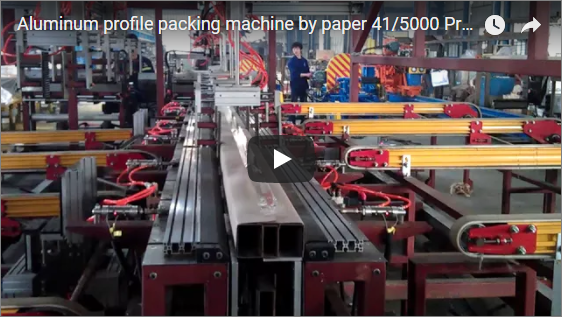
Executive summary We wrap single bars and small bar bundles on a small orbital wrapper, where the bar runs on a conveyor through a turning ring and never rotates. Our S200 takes bars from 10 mm to 200 mm across and from 300 mm long. Longer and heavier bar bundles go to our rod wrapping machine, with up to 10 m length. Film coverage comes from the ratio of conveyor speed to ring speed.
Table of Contents
- Which machine
- Bar wrapping cycle
- Film pitch and overlap
- Bar length and conveyors
- Centring the bar
- Film and materials
- Controls
- Safety
- Selection checklist
- Engineering FAQ
- Next step
- Related reading
- Sources
Which bar wrapping machine: small orbital wrapper or rod wrapper
| Parameter | S200 small orbital wrapper | Rod wrapping machine |
|---|---|---|
| Bar or bundle size across | 10–200 mm | 200–500 mm |
| Length | > 300 mm | 2000–10000 mm |
| Weight | 10–100 kg | sized to the bundle |
| Ring speed | 20–120 r/min | 30–60 r/min |
| Conveying or wrapping speed | 4–12 m/min | 2–12 m/min |
| Power | about 2.1 kW | 6.8 kW |
| Film | LLDPE stretch film, 120–200 mm wide | PE, stretch film, knit belt, VCI paper |
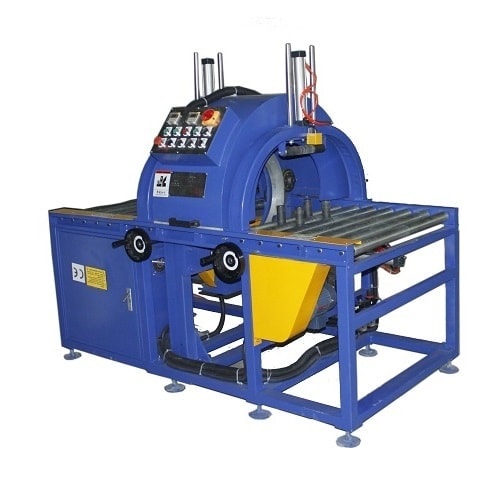
S200 has 2000 mm motor-driven infeed and outfeed conveyors and runs on AC 380 V, 60 Hz. The rod wrapping machine runs on AC 380 V, 50 Hz, or to your requirement. For automatic operation with an automatic cutter and feeder, our E200 takes packages of 50–200 mm across and over 1000 mm long.
How the bar wrapping cycle runs
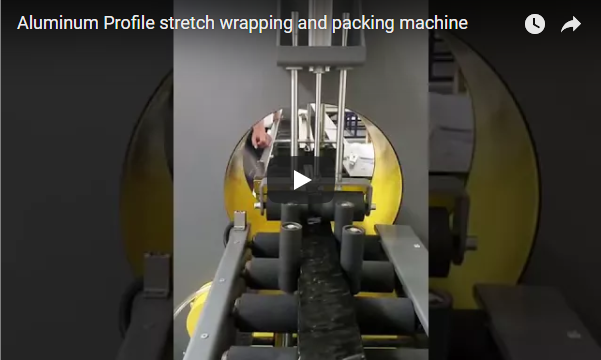
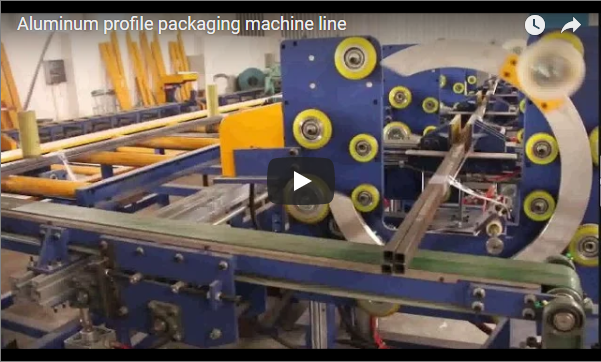
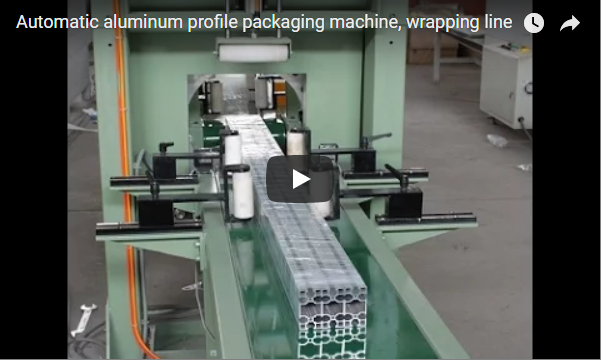
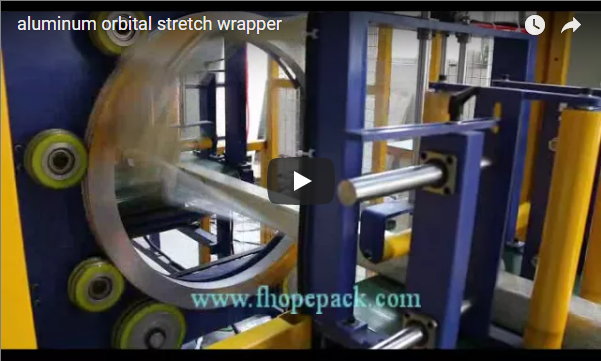
We built the small orbital wrapper in this video to wrap long metal bars one at a time on a roller conveyor:
- 0–8 s, start. The operator places the bar on the infeed conveyor and starts the cycle at the control cabinet. A photocell sets the wrapping start position.
- 8–40 s, wrap. The motor-driven conveyor carries the bar through the ring. The ring turns around the bar and lays stretch film in a spiral along its length. Adjustable plates with vertical guide rollers keep the bar on the ring centre.
- 40–44 s, discharge. The wrapped bar leaves on the outfeed conveyor, and the operator takes it off at the end.
The bar does not rotate during wrapping. That keeps a long, thin bar straight and stops it whipping on the conveyor.
Film pitch and overlap on a bar wrapper
Each ring turn moves the bar forward by one pitch. We set the coverage with three numbers:
- Pitch = conveyor speed ÷ ring speed. At 6 m/min and 60 r/min, the pitch is 100 mm.
- Overlap = 1 − pitch ÷ film width. With 200 mm film, a 100 mm pitch gives 50% overlap, or two layers.
- Wrap time = bar length ÷ conveyor speed. A 6 m bar at 6 m/min takes 60 s, and at 12 m/min it takes 30 s.
At the 120 r/min top ring speed of S200, a 100 mm pitch allows the full 12 m/min conveyor speed. Overlap is adjustable from 20% to 90% on the rod wrapping machine.
Bar length and conveyor length
A bar must bridge the infeed and outfeed conveyors while it passes the ring. That is why each model has a minimum length:
- S200: over 300 mm, with 2000 mm conveyors on both sides.
- E200: over 1000 mm, with 2000 mm motor-driven conveyors.
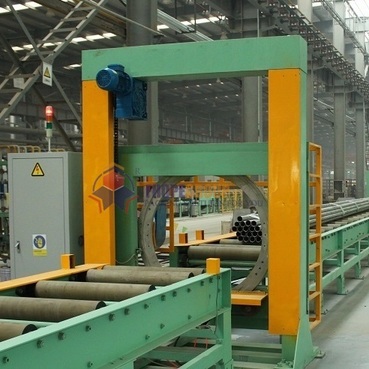
- Rod wrapping machine: 2000–10000 mm, on a powered roller table.
For bars longer than the conveyors, we extend the conveyor length, which is an option on S200. The powered roller table of the rod wrapper has free and powered rubber-coated rollers, with adjustable speed through a geared motor.
Centring the bar in the ring
The film tension pulls evenly only when the bar sits on the ring centre. On S200, the centring plates move up and down to suit bundles of different sizes. The rod wrapping machine uses a pneumatic movement to hold the master bundle in the ring centre during wrapping, so the film goes on evenly and tight.
Tension is adjusted by a brake device on the film carriage. A thin bar needs less tension than a heavy bundle.
Film and packing materials for bars
S200 runs LLDPE stretch film rolls 120–200 mm wide, 150–200 mm in diameter, on a 50 mm core. The rod wrapping machine also runs knit belt and VCI paper:
- Stretch film for a clean, moisture-proof wrap on finished bars.
- VCI paper under film for steel bars that need rust protection in transit.
- Knit belt where the bars need a tougher wrap for handling.
Controls and automation
S200 uses a PLC program with an HMI. A converter controls the ring speed, the ring has soft start and soft stop, and alarms show on a fault. It can connect to a production line, and an automatic film cutter and feeder is an option for online wrapping.
The rod wrapping machine works online or offline, with converter speed control and automatic adjustment of the packing position.
Safety on a small orbital wrapper
The turning ring and the conveyor nip points are the main hazards. S200 has guardrails around the ring and double rings and wheels for stable running. The ring in this video sits behind a guard frame.
The standards that apply depend on the destination market. For CE markets, ISO 12100 sets the risk-assessment method and EN 415-10 sets general requirements for packaging machines.
Selection checklist for a bar wrapping machine
- Bar or bundle size across, including the largest diagonal.
- Shortest and longest bar length.
- Weight per bar or bundle.
- Bars per hour and target conveyor speed.
- Film type: stretch film, VCI paper or knit belt.
- Standalone or inline with a cutting or bundling line.
Engineering FAQ
Q: What is the smallest bar the small orbital wrapper can take? A: S200 takes bars from 10 mm across and over 300 mm long, up to 100 kg. Below 300 mm, the bar cannot bridge the two conveyors.
Q: How fast can a 6 m bar be wrapped? A: Wrap time is length ÷ conveyor speed. At 12 m/min, a 6 m bar takes 30 s, if the ring runs fast enough to keep the pitch.
Q: What overlap should I set for bars? A: Start at 50%, which gives two layers. With 200 mm film that is a 100 mm pitch, for example 6 m/min at 60 r/min.
Q: When do I need the rod wrapping machine instead? A: When the bundle is over 200 mm across or the bars run 2000–10000 mm long. It takes bundles up to 500 mm across.
Q: Can the bar wrapper run inline? A: Yes. S200 can connect to the production line, and an automatic film cutter and feeder is available for online wrapping.
Next step
We size the bar wrapping machine to your bars in three steps:
- Submit your layout drawing with bar size, length range, weight, bars per hour and film type to info@fhopepack.com.
- Receive a machine proposal within 48 hours, with the model, conveyor lengths and pitch check.
- Book a site survey to place the wrapper at your bar line.
Related reading
- Semi-auto Horizontal Wrapper
- Automatic Horizontal Stretch Wrapper
- Customize Orbital Wrapper
- Rod Orbital Wrapper and Bar Wrapping Machine: Complete Guide
- Automatic Bar Wrapping Machine
Sources
- S200 ranges, conveyors, film, controls: S200 semi-auto horizontal orbital wrapper page
- E200 package range and conveyors: E200 horizontal stretch wrapper page
- Rod wrapper ranges, roller table, centring: rod wrapping machine page
- Machine in action: our bar wrapping and small orbital wrapper video on YouTube
- Standards scope: ISO 12100:2010, EN 415-10:2014
Last reviewed: 2026-10-03