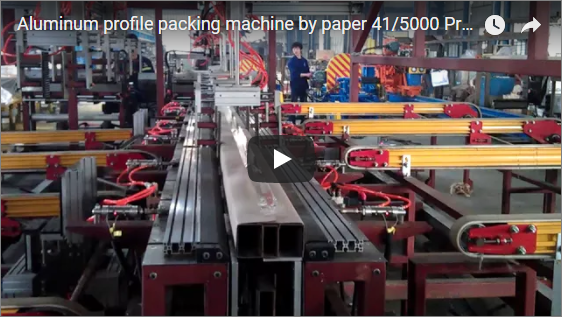
Executive summary Aluminum profile packaging that relies on hand banding and loose stacking risks surface damage, edge deformation and rejected deliveries. An orbital stretch wrapper passes long profiles through a rotating film ring, wrapping the full length in an overlapping spiral with repeatable tension. Profile length and cross-section, ring speed and film pre-stretch are sized per project.
Table of Contents
- Why extrusions need a wrapper
- How the orbital ring wraps
- Key components
- Typical configuration
- Film and pre-stretch setup
- Placing it on the line
- Machine selection checklist
- Controls and safety
- Engineering FAQ
- Next step
- Related reading
- Sources and standards
Why extrusions need a wrapper
Architectural trim, window frames and structural sections are sold on surface finish. A scratch on an anodized or powder-coated face is a reject, and bundles that loosen in transit let profiles shift and rub against each other.
Hand banding holds a bundle together, but tension varies with the operator. Orbital stretch wrapping removes that variable: film is applied in an even spiral with a set tension, holding the whole bundle tight and covering its surface from edge to edge. The result is a stable, stackable unit that reaches the customer clean and square.
How the orbital ring wraps
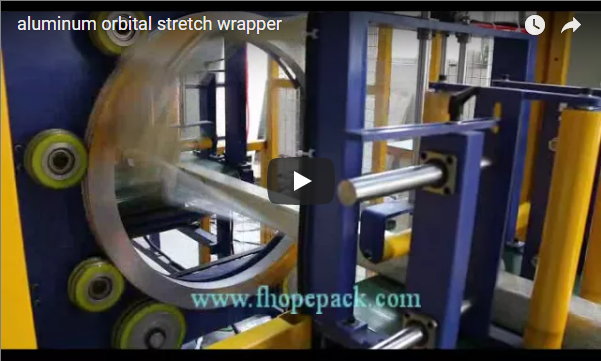
Profiles run straight through a rotating ring on a conveyor. The ring carries the film roll around the bundle, and the combination of ring rotation and conveyor travel lays film in an overlapping spiral from one end to the other. A clamp grips the film at the start and a cutter separates it at the end.
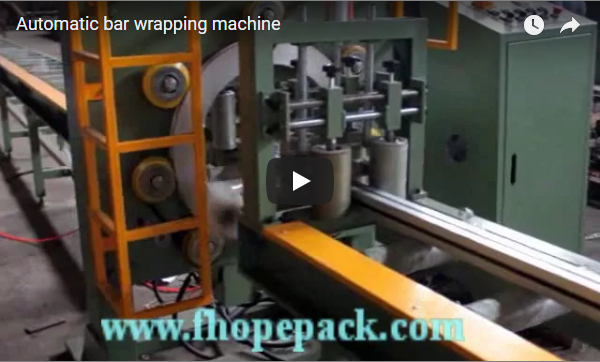
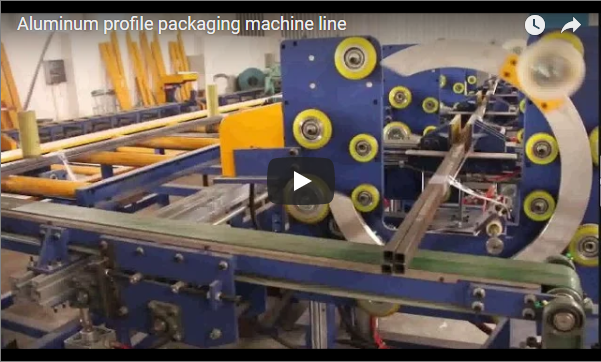
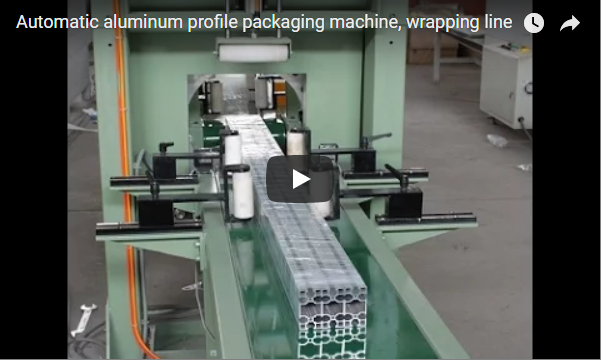
Because the bundle stays straight and never spins, long lengths wrap in one continuous pass without extra handling between sections. The clip embedded above shows this pass-through pattern on a shop-floor demonstration; in our machine designs we size conveyor length, ring rotation speed and film delivery to your profile dimensions per project.
Key components
| Component | Role |
|---|---|
| Rotating film ring | carries the film roll around the bundle |
| Conveyor infeed | aligns the bundle and feeds it into the ring |
| Film carriage and pre-stretch | controls tension and film elongation |
| Clamp and cutting unit | grips film at start, cuts and holds the tail on finish |
| Control panel | stores recipes and sets speed, wrap and tension |
Typical configuration
Numbers below are common starting envelopes for this machine class and are sized to the bundle per order.
| Parameter | Typical range, sized per project |
|---|---|
| Profile length | 1 to 12 m machine section |
| Profile cross-section | 10 × 10 mm up to 150 × 150 mm |
| Ring rotation speed | 10 to 30 RPM |
| Film pre-stretch | 200 to 300 percent |
| Electrical supply | 380 V three phase 50 Hz as standard; 220 V single phase for lighter duty, selected per project to the plant supply |
Film and pre-stretch setup
- Stretch film in a clear, high-tensile grade suits extrusion packaging; width and thickness are set to the bundle.
- Pre-stretch elongates the film before it reaches the bundle, covering more length per roll and cutting film cost.
- Overlap between spiral layers is set by balancing ring speed against conveyor speed; a higher overlap grips heavier bundles more tightly.
- Recipe storage on the panel lets one machine switch between different trim dimensions without re-teaching the pattern.
Placing it on the line
- The wrapper needs straight line room in front of and behind the ring so the full length passes through.
- Reserve access space on both sides for film loading and maintenance.
- Confirm three-phase power where the machine will sit; a single-phase machine is an option for lighter duties.
- A buffer conveyor between the aging oven and the wrapper evens out flow so the ring is not starved or flooded.
Machine selection checklist
| Question | Confirm per project |
|---|---|
| Longest profile | section length the machine must pass end to end |
| Widest cross-section | ring opening that clears your thickest bundle |
| Bundle weight | conveyor and ring capacity at your line rate |
| Film program | pre-stretch range, width and roll size |
| Changeover need | recipes for the trim sizes you actually run |
| Electrical supply | voltage, phase and frequency on site |
Controls and safety
The panel holds the recipe per profile, with conveyor and ring speed, wrap overlap and film tension set per bundle. Operators load and unload while the ring rotates inside its guarding. Keep clear of the ring while it runs, keep the guard in place, and stop the line with the emergency stop before opening guarding. Film loading follows the machine manual.
Engineering FAQ
Q: Does one operator run the line? A: Yes. Loading the bundle, starting the cycle and removing the wrapped end can be handled by one operator.
Q: What limits the bundle length? A: Length is governed by the conveyor support beds, not the ring itself. For profiles beyond the standard section we add infeed and outfeed conveyor extensions, selected per project.
Q: What film does it use? A: A clear stretch film, with width, thickness and pre-stretch set to the bundle and confirmed per project.
Q: How much overlap is applied? A: Overlap is set by ring speed against conveyor speed; a higher overlap holds heavy bundles more tightly and uses more film.
Q: Does pre-stretch really save film? A: Yes, it elongates the film before wrapping, so each roll covers more length. The usable range depends on film type and is confirmed per project.
Next step
- Email us at info@fhopepack.com with your longest profile, widest bundle and line rate.
- We send ring sizes, film settings and a layout drawing within 48 hours.
- We arrange a site survey to confirm the wrapper fits your line.
Related reading
- Horizontal orbital stretch wrapper for aluminum profile
- Semi automatic aluminum profile stretch wrapping machine
- Aluminum profile paper packing machine
- Automatic aluminum profile packaging machine wrapping line
- FHOPE packing machinery product lines
Sources and standards
- ISO 12100:2010 — Safety of machinery. General principles for design, risk assessment and risk reduction
- EN 415-10:2014 — Safety of packaging machines. General requirements
- EN ISO 13849-1:2023 — Safety of machinery. Safety-related parts of control systems
- FHOPE aluminum profile orbital wrapping demonstration video. Footage reviewed as a general demonstration; envelope and settings confirmed per project.
Last reviewed: 2026-10-10