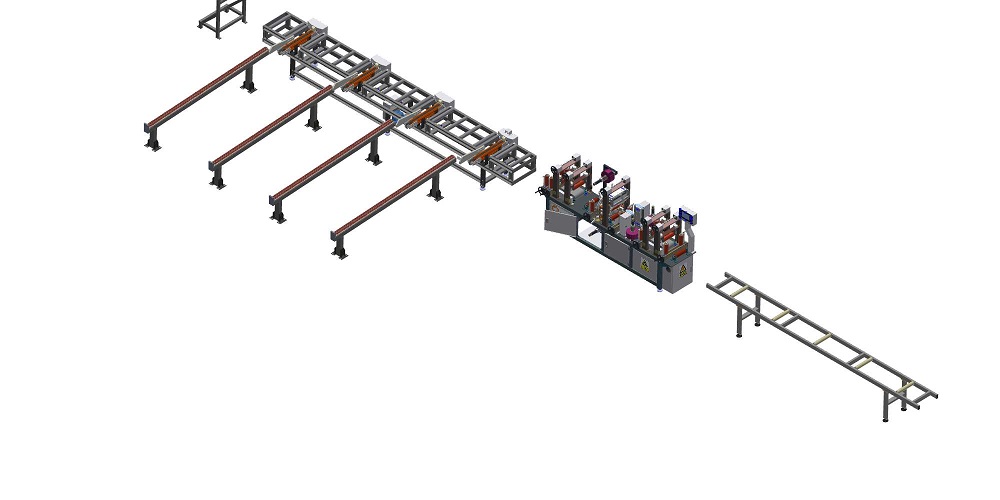
Executive summary Our aluminum profile bundle tying machine ties sub-bundles with film bands at 3–4 stations. Each station’s ring holds a film roll on a clutch mandrel that keeps tension constant until the roll is finished. We set the stations to your profile lengths and pass the tied bundles on to wrapping.
Table of Contents
- How bundle tying works
- Where the ties go
- Film tension and roll-out
- Cycle settings
- What happens after tying
- Utilities and safety
- Selection checklist
- Engineering FAQ
- Next step
- Related reading
- Sources
How bundle tying works
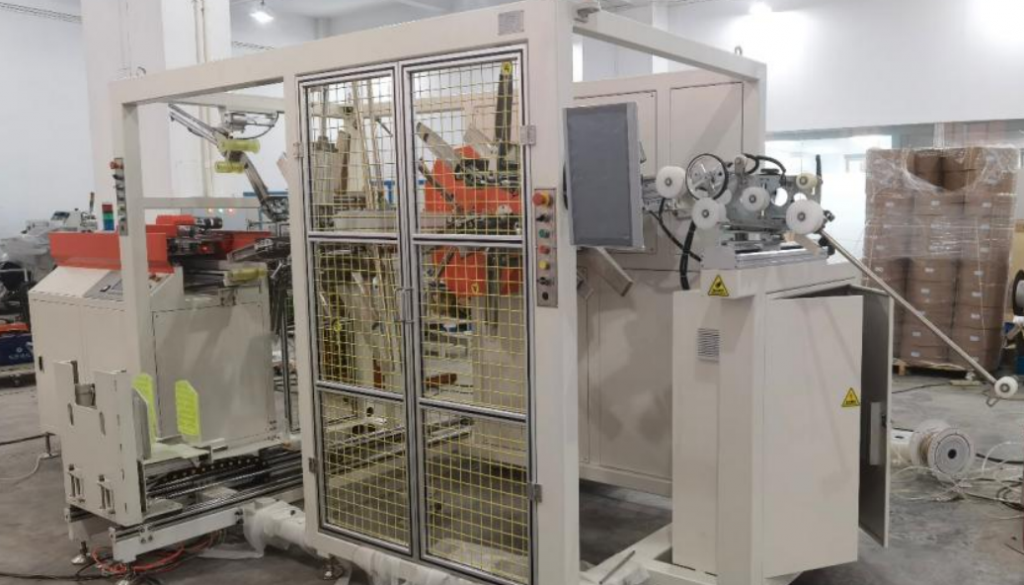
Workers load the profile bundle onto the platform, and the machine positions it automatically before tying. At each station, a ring rotates around the bundle and lays a band of film. A blade cuts the film at the end of each cycle, because the stations run in start-and-stop mode.
After tying, a lifter takes the bundles off one by one. In our video, the profiles stop at a row of tying stations, each with its own film roll, before moving on.
Where the ties go
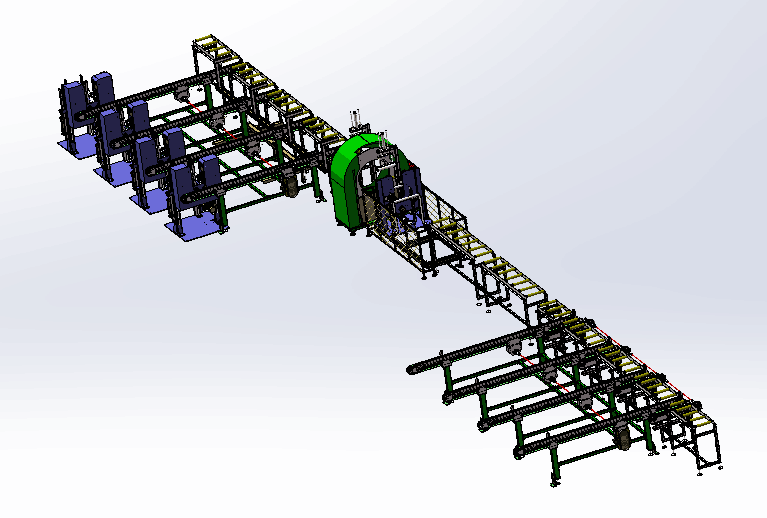
The machine has 3–4 tying stations. Depending on the layout, the stations either tie several points on one bundle or work side by side on separate bundles. Illustrative tie spacing for a 6 m bundle, with ties a short way in from each end:
| Ties per bundle | Positions | Spacing |
|---|---|---|
| 3 | ends and middle | just under 3 m |
| 4 | ends and two inner points | just under 2 m |
Longer or more flexible profiles usually need the fourth tie. For mixed lengths, we set the positions on your length list.
Film tension and roll-out
Each ring holds the film roll on a mandrel with a special clutch. The clutch keeps the tension constant until the roll is finished, so the last bands are as tight as the first.
| Item | Detail |
|---|---|
| Ring speed | regulated by an electronic inverter |
| Film tension | constant, by clutch on the mandrel |
| Roll run-out or film tear | automatic stop and operator warning |
| Film cut | blade at the end of each cycle |
| Cycle times | set to your needs |
Cycle settings
The stations run in start-and-stop mode, and the times can be set to your needs. Illustrative example: if one tying cycle takes 20 s and loading takes 20 s, a station finishes a bundle every 40 s, or 90 bundles per hour. When stations work side by side on separate bundles, output scales with the number of stations.
We confirm the real tying time on your bundle in the proposal.
What happens after tying
| Step | Equipment |
|---|---|
| Lift off | lifter loads the bundles one by one |
| Transfer | reinforced transfer belts carry sub-bundles to the wrapper’s infeed roller table |
| Centering | centering rollers keep the profiles centred before the ring |
| Wrapping | spiral wrapping machine, paper or film |
| End taping | tape banding synchronised with wrapping |
Utilities and safety
We design each line to the plant’s real situation, so power and air are listed in the proposal. The automatic stop on film tear or roll run-out protects the bundle and warns the operator. The standards that apply depend on the destination market. For CE markets, ISO 12100 sets the risk-assessment method and EN 415-10 sets general requirements for packaging machines.
Selection checklist for bundle tying
- Profile lengths and bundle sizes.
- Ties per bundle and bundles per hour.
- Manual loading or automatic transfer.
- Wrapping and end taping after tying.
- Layout drawing with floor space.
Engineering FAQ
Q: How many tying stations do we need? A: The machine has 3–4 stations. We choose the count and layout from your lengths and output.
Q: Does tension drop as the film roll runs down? A: No. A clutch on the mandrel keeps the tension constant until the roll is finished.
Q: What happens if the film tears? A: The machine stops completely and warns the operator.
Q: Can we set the tying time? A: Yes. The stations run start-and-stop cycles, and the cycle times are set to your needs on the line.
Q: Where do the tied bundles go? A: A lifter takes them off one by one, and transfer belts carry them to the wrapper.
Next step
We plan your bundle tying stations in three steps:
- Submit your layout drawing with profile lengths and bundle sizes to info@fhopepack.com.
- Receive a proposal within 48 hours, with the station count, positions and layout.
- Book a site survey to fit the stations to your line.
Related reading
- Automatic aluminum wrapping and taping machine
- Automatic aluminum profile packing line
- Aluminum profile sub-bundle wrapping machine
- Video: aluminum profile packing machine and wrapping line
- Video: aluminum profile stretch wrapping machine
Sources
- Tying stations, tension and transfer: automatic aluminum wrapping and taping machine page
- Line sequence: automatic aluminum profile packing line page
- Machine in action: our aluminum profile bundle tying video on YouTube
- Standards scope: ISO 12100:2010, EN 415-10:2014
Last reviewed: 2026-10-04