Executive summary An orbital stretch wrapper lets a bundle run through on a conveyor while a ring lays film around it, so long bundles are wrapped without being lifted or turned. Our economic model wraps a bundle of dark pipes on a roller conveyor, inside a blue mesh guard, with a white control cabinet beside it. Whether a bundle fits follows from its diagonal, not just its width. We check it per project.
Table of Contents
- What the video shows
- How the economic orbital wrapper works
- Sizing the ring opening from the bundle diagonal
- Spiral film per bundle and the top sheet
- Controls and safety
- Selection checklist for an orbital bundle wrapper
- Engineering FAQ
- Next step
- Related reading
- Sources
What the video shows
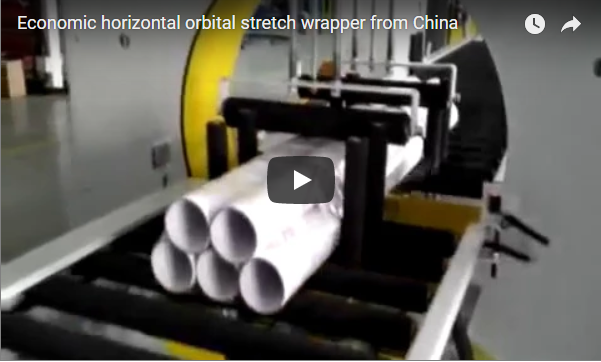
A long bundle of dark, pipe-like pieces runs on the roller conveyor into our blue orbital wrapper. Part of the bundle is already in clear film, and a white sheet lies along its top face.
The ring turns around the still-moving bundle and the film carriage on the ring lays film over the top and sides. Blue mesh guarding closes the sides and front of the machine, and the white control cabinet stands to the right.
How the economic orbital wrapper works
| Step | What happens |
|---|---|
| Infeed | The bundle runs in on the roller conveyor |
| Film start | The film end is fixed to the bundle |
| Wrap | The ring turns and lays a spiral of film as the bundle moves |
| Finish | The film is cut and the tail fixed |
| Outfeed | The wrapped bundle leaves on the conveyor |
The bundle never turns, so loose pipes stay in place. The ring does the moving, as on our horizontal ring orbital stretch wrapper with press-down devices.
Sizing the ring opening from the bundle diagonal
The ring passes around the bundle’s corners, so the diagonal sets the size, not the width. Illustrative example for a 400 × 300 mm bundle:
| Item | Value |
|---|---|
| Bundle width × height | 400 × 300 mm |
| Diagonal, √(400² + 300²) | 500 mm |
| Clearance all round (illustrative) | 50 mm |
| Opening needed, 500 + 2 × 50 | 600 mm |
Send us the largest bundle you run. We check its diagonal against the ring opening before we confirm the model.
Spiral film per bundle and the top sheet
Illustrative example for the same 400 × 300 mm bundle, 6 m long, with 250 mm film at half overlap:
| Item | Value |
|---|---|
| Bundle perimeter, 2 × (400 + 300) | 1,400 mm |
| Advance per turn, half of 250 mm | 125 mm |
| Turns, 6,000 ÷ 125 | 48 |
| Film laid, 48 × 1.4 m | about 67 m |
This is film laid on the bundle; pre-stretch means the roll pays out less.
In our video a white sheet lies on top of the bundle under the film. A sheet like this keeps the film off the top face and shields it from light and dirt.
Controls and safety
The ring turns at speed inside the blue mesh guard. Keep people outside the guard while it runs, and fix or cut the film only when the ring has stopped.
The standards that apply depend on the destination market. For CE markets, ISO 12100 sets the risk-assessment method and EN 415-10 sets general requirements for packaging machines.
Selection checklist for an orbital bundle wrapper
- Bundle width, height and length, smallest to largest.
- Heaviest bundle.
- Bundles per shift (for overlap and ring speed, see our rod orbital wrapper and bar wrapping machine).
- Film only, or film over a top sheet.
- Conveyor length in and out.
- Floor space and power supply.
Engineering FAQ
Q: Why check the diagonal? A: The ring passes the bundle’s corners. A 400 × 300 mm bundle has a 500 mm diagonal, so it needs about 600 mm of opening with clearance in our example.
Q: Does the bundle turn? A: No. It runs straight through on the conveyor while the ring turns around it.
Q: How much film does a bundle take? A: About 67 m for a 400 × 300 mm, 6 m bundle at half overlap in our example.
Q: Why do the pipes not shift during wrapping? A: The bundle runs straight through on the conveyor without being lifted or turned; only the ring moves.
Q: What is the white sheet on top? A: A cover sheet under the film that keeps the top face clean and shaded.
Q: Is the machine guarded? A: Yes. Blue mesh guarding closes the sides and front.
Next step
We plan your orbital wrapper in three steps:
- Submit your layout drawing with bundle sizes and output to info@fhopepack.com.
- Receive a proposal within 48 hours, with the ring size and film plan.
- Book a site survey to check the conveyor layout and floor space.
Related reading
- Video: economic horizontal orbital stretch wrapper for pipe and tube
- Video: automatic horizontal orbital wrapper for tube bundles
- Horizontal orbital stretch wrapper
Sources
- Machine content: FHOPE engineering team, 2026-10-04
- Fit and film examples: our worked examples, illustrative values
- Machine in action: our video on YouTube
- Standards scope: ISO 12100:2010, EN 415-10:2014
Last reviewed: 2026-10-04