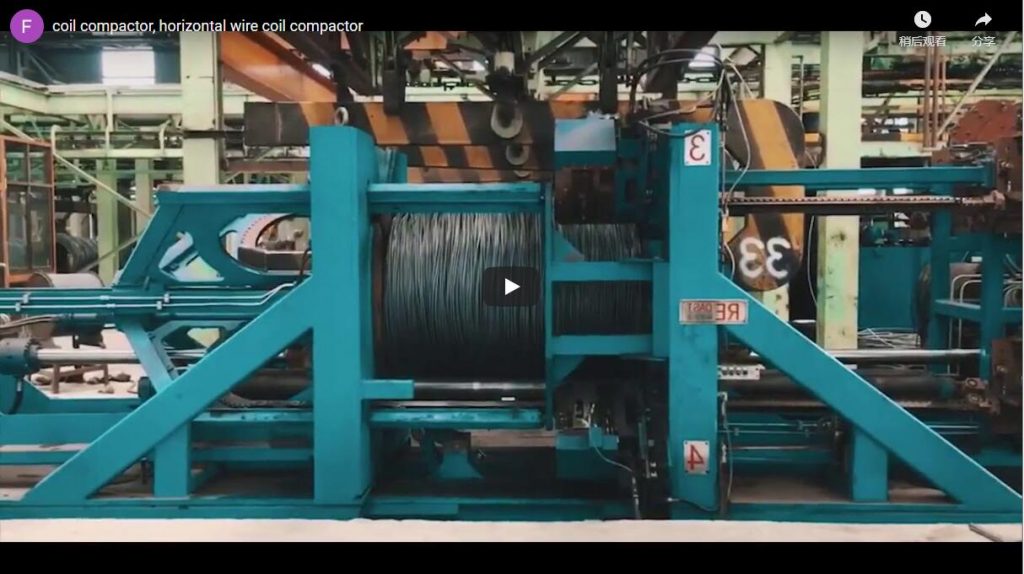
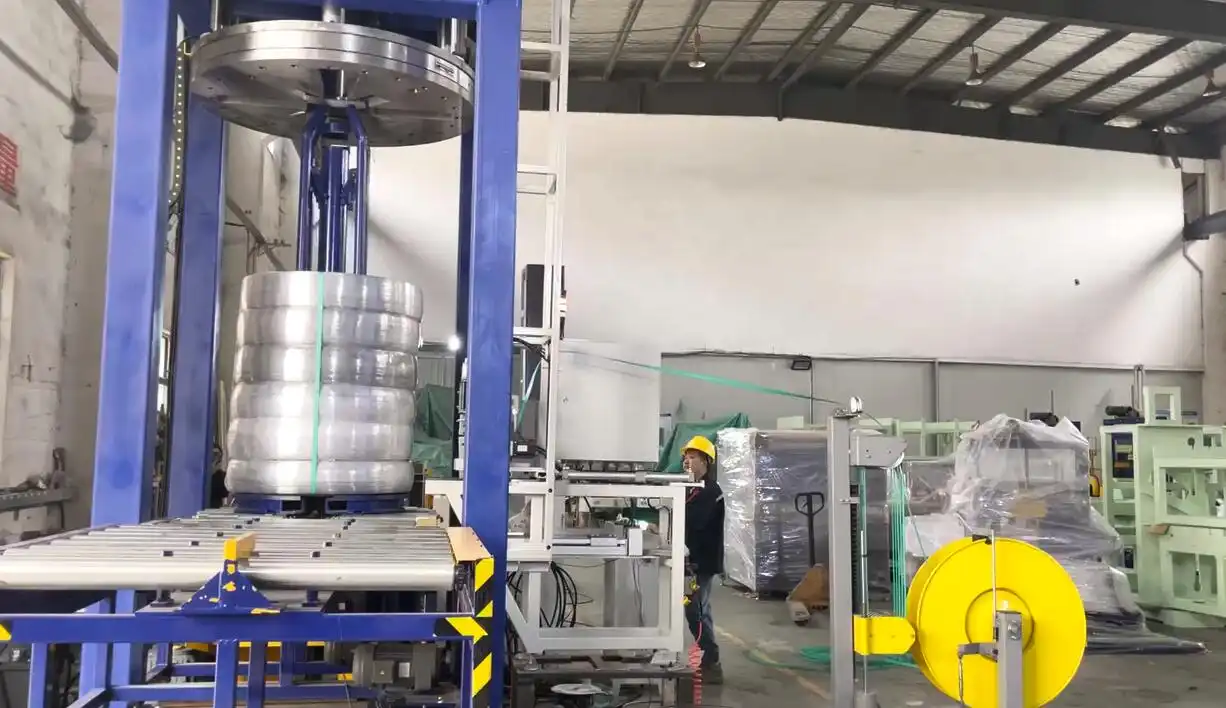
Executive Summary: In modern wire drawing and processing mills, unstable coil geometries, high spring-back forces, and manual bundling bottlenecks compromise packaging safety and warehouse utilization. Transitioning directly from manual packaging to a fully robotic strapping cell can often be cost-prohibitive or operationally rigid for plants running varied wire diameters and batch sizes. A semi-automatic wire coil compactor bridges this gap. By utilizing hydraulic compression forces adjustable up to 20T [manufacturer rating] along an integrated conveyor rack, it secures dimensional stability and reduces coil volume prior to manual or automated tie-off. This engineering guide details the operating sequence, structural mechanics, tooling considerations, and the technical roadmap for transitioning to high-throughput automation.
1. The Packaging Bottleneck: Why Pre-Compaction Is Critical
Drawn carbon steel, alloy wire, and wire rod exit take-up units in loose axial configurations. Without dedicated mechanical pre-compression, these coils present severe processing liabilities:
- Spring-Back & Strap Loosening: When steel coils are banded manually without axial hydraulic force, the internal elastic strain energy remains unresolved. As soon as handling equipment lifts the bundle, micro-shifts cause straps to slacken, risking dislodged wire loops.
- Low Volumetric Efficiency: Loose coils waste 25% to 40% of cargo volume in domestic freight beds and ISO maritime containers [derived].
- Safety Hazards in High-Bay Storage: Non-compacted wire coils deform irregularly under stack loads, creating tilt angles that violate warehouse safety protocols.
Implementing a semi-automatic wire coil compactor ensures each bundle reaches a uniform axial density, establishing repeatable baseline dimensions before secondary packaging or downstream handling.
+------------------+      +-------------------+      +------------------+
| Loose Wire Coil  | ---> | Axial Hydraulic   | ---> | Controlled Strap |
| (Rack / Basket)  |      | Compaction (≤20T) |      | Manual / Auto    |
+------------------+      +-------------------+      +------------------+
                                                       |
                                                       v
                                            +--------------------+
                                            | Safe Storage &     |
                                            | Transport Density  |
                                            +--------------------+
2. Step-by-Step Semi-Automatic Operation Sequence
A semi-automatic workstation combines robust hydraulic pressing with manual tying flexibility. It integrates directly with upstream conveyors or crane stations:
Step 1: Coil Positioning & Infeed
Coils mounted on carrier racks, carriers, or walking-beam stems enter the machine envelope along the powered roller conveyor. Operators align the coil eye with the central clamping axis.
Step 2: Symmetrical Hydraulic Compaction
The operator engages the cycle via a dual-hand safety console:
- Hydraulic rams advance symmetrically toward the coil faces.
- Compaction thrust is dialled between 5T and 20T [manufacturer rating], depending on the wire yield strength and gauge.
- Dwell Time Control: The platen maintains peak axial load for 3 to 5 seconds [derived]. This dwell phase allows wire strands to overcome inter-loop friction and settle, minimizing post-compression spring-back.
Step 3: Strapping & Radial Tying
While the hydraulic platen holds the coil under steady force, circumferential clearance slots allow operators easy manual access:
- High-tensile steel strapping or heavy-duty PET strapping is fed through the inner coil core.
- Pneumatic hand tools tension, seal, and cut the strap, locking in the dense geometry.
- Depending on wire thickness, 2 to 4 radial straps are applied symmetrically.
Step 4: Decompression & Conveyor Discharge
Once strapping is verified, hydraulic pressure vents smoothly, the compaction head retracts, and the locked bundle moves downline for tagging or stretch wrapping.
3. Engineering Specification Matrix: Semi-Auto vs. Heavy-Duty Automation
To determine whether a semi-automatic station or a high-tonnage automated system fits your mill output, review the operational parameters below:
| Engineering Parameter | Semi-Automatic Compactor (K1 Baseline) | Heavy-Duty Wire Rod Compactor (K3 Benchmarking) |
|---|---|---|
| Drive / Power System | Hydraulic power unit (adjustable to 20T) [manufacturer rating] | 150 kW electro-hydraulic station [manufacturer rating] |
| Max Compacting Force | Up to 20T (approx. 196 kN) [manufacturer rating] | 60–400 kN infinitely adjustable [manufacturer rating] |
| Operating Pressure | 120–160 bar [derived] | 210 bar (Hydraulic) / 5.0–6.0 bar (Pneumatic) [manufacturer rating] |
| Coil OD Compatibility | 800–1400 mm [derived] | 1000–1800 mm [manufacturer rating] |
| Applicable Coil Weight | 300–1200 kg [derived] | 500–2000 kg [manufacturer rating] |
| Packaging Cycle Time | 90–150 seconds (manual strap dependent) [derived] | 30–40 seconds / coil [manufacturer rating] |
| Strapping Media | Steel strap or PET strapping [manufacturer rating] | 6.3–8.0 mm wire tie (380–450 MPa, 28%–32% elongation) [manufacturer rating] |
| Throughput Capacity | 15–25 coils / hour [derived] | Up to 60 coils / hour [manufacturer rating] |
| Quality & Compliance | CE Certified / ISO 9001 / 2-Year Warranty [manufacturer rating] | CE Certified / Industry 4.0 PLC Interfaced [manufacturer rating] |
4. Operational Best Practices: Preventing Coil Surface Defects
During semi-automatic compaction, high compressive loads risk scratching or bruising finished wire grades (such as bright annealed or galvanized products). Engineering teams should enforce the following safeguards:
- Platen Contact Liners: Fit the compression jaws with sacrificial high-density polyethylene (HDPE) or polyurethane (PU) wear plates. This prevents direct steel-on-steel scuffing on the side loops.
- Proportional Pressure Ramping: When handling soft copper, aluminum, or fine carbon wire, tune hydraulic relief valves down to 30–50 kN [derived] to prevent localized wire notching.
- Accurate Centerline Alignment: Misaligned coils cause asymmetric compaction, resulting in “banana-shaped” bent stacks that jam downline payoff equipment. Always verify conveyor roller centering guides.
5. Transitioning to Full Automation: The Upgrade Pathway
For growing plants handling basket line coils or continuous output exceeding 30 bundles per hour, the semi-automatic unit functions as an invaluable pilot cell. Plant managers can systematically upgrade their line to an automatic wire coil compactor and strapping machine without disrupting shop floor layouts:
[Semi-Automatic Unit] (Conveyor + Manual Strapping)
        │
        ▼ (Upgrade Step 1: Automatic Indexing Table)
[Intermediate Automation] (Hydraulic Press + Automatic Indexer)
        │
        ▼ (Upgrade Step 2: Integrated Rotary Strapping Heads)
[Fully Automatic Cell] (Rotary Head + 60 coils/h + Zero Manual Intervention)
Upgrading to an automated compacting cell integrates dual hydraulic cylinders, rotary strapping heads, and automatic indexing arms, enabling full cycle completion in 30–40 seconds [manufacturer rating] while fully satisfying OSHA and CE LOTO safety protocols.
6. Technical Checklist & Project RFQ
Need to determine the exact hydraulic tonnage and conveyor footprint for your wire packaging bay? Prepare the following baseline parameters:
- Wire Material & Grade: (e.g., low-carbon, high-carbon spring wire, stainless, copper)
- Coil Dimensions: Inside Diameter (ID), Outside Diameter (OD), and Uncompressed Axial Height (mm)
- Target Compressed Height & Max Weight: (kg/bundle)
- Target Line Speed: Coils per hour
- Strapping Media Preference: PET, Steel Strap, or Wire Tie Rod
Engineering Response Guarantee: Send your product dimensional data to our technical engineering department. Our design team will return a customized compaction simulation, layout CAD drawing, and cycle time calculation within 24 to 48 hours. Contact Fhopepack Engineering Support for equipment consultation and RFQ analysis.