Executive summary A bundle of carton boxes is wide, rectangular and easy to knock out of square, so it is wrapped on a conveyor rather than spun on a turntable. Our horizontal orbital wrapper runs a film ring around the bundle as the roller conveyor carries it through, laying the film in a spiral. Overlap on our orbital range is adjustable from 20% to 90%, and the ring turns at 20–60 r/min. The ring size, conveyor and controls are configured per project to the bundle you ship.
Table of Contents
- What the video shows
- Why orbital for carton bundles
- Setting overlap and conveyor speed
- Film choice for carton bundles
- Orbital range data
- Guarding and controls
- Selection checklist
- Engineering FAQ
- Next step
- Related reading
- Sources
What the video shows
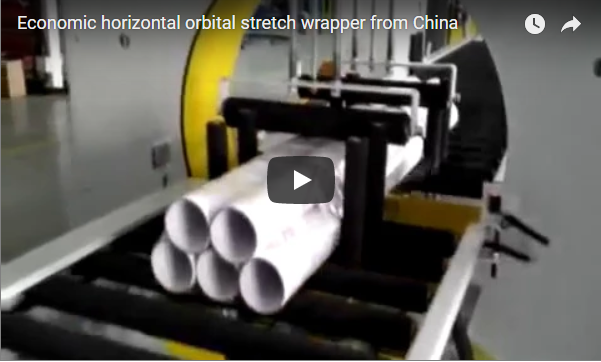
A large rectangular bundle of brown carton boxes rides in on a roller conveyor with a yellow edge guide. Inside the wrapping station the orbital ring turns around the bundle and lays clear film on it in a spiral, and the wrapped bundle then carries on out along the conveyor. The station sits inside a grey mesh safety cage with a door, and a red emergency stop is on the control panel.
The bundle never turns. The film goes round the load, so a stack of loose cartons keeps its shape all the way through the wrap.
Why orbital for carton bundles
| Question | Turntable wrapper | Our orbital wrapper |
|---|---|---|
| What moves | The load spins | The ring spins, the load travels straight |
| Film coverage | Sides only, top needs a sheet | All four long faces in one pass |
| Loose carton stacks | Spinning can shift the top layer | Stack stays still on the conveyor |
| Line fit | Load must be lifted on and off | Inline on the conveyor |
The orbital wrap covers all four long faces of the bundle, which is what keeps dust and damp off the cartons in export containers.
Setting overlap and conveyor speed
The conveyor speed that gives the overlap you want follows from the film width and the ring speed:
Conveyor speed = film width × (1 − overlap) × ring speed
Illustrative example with 500 mm film at 50% overlap and the ring at 20 r/min:
| Item | Value |
|---|---|
| Film width | 500 mm |
| Overlap | 50% |
| Advance per ring turn, 500 × 0.5 | 250 mm |
| Ring speed | 20 r/min |
| Conveyor speed, 250 mm × 20 | 5 m/min |
| Conveyor travel for a 3,000 mm bundle | 36 s |
The 36 s is conveyor travel only; the film start and cut add to the cycle. The 5 m/min result sits inside our 2–10 m/min wrapping range. Higher overlap gives more layers, so it uses more film and gives the bundle more protection. On a carton bundle, the overlap is usually set by how tightly the stack has to be held together, not by how strong the film needs to be.
Film choice for carton bundles
Our orbital range takes PE film, stretch film, knit belt and VCI paper. For carton bundles, clear stretch film is the usual choice, because the box markings stay readable through it and it seals out dust. Film tension is adjustable, and it should be set low enough that the film does not crush the box corners.
Orbital range data
| Item | Value |
|---|---|
| Bundle size through the ring (diagonal) | 800–2,000 mm |
| Bundle length | 2,000–6,000 mm |
| Bundle weight | 100–2,000 kg |
| Ring speed | 20–60 r/min |
| Wrapping speed | 2–10 m/min |
| Overlap | 20–90% |
| Wrapping materials | PE film, stretch film, knit belt, VCI paper |
| Power | 6.5 kW |
These figures cover our standard horizontal orbital range. For a rectangular bundle, the size that has to clear the ring is the diagonal, √(width² + height²). The machine in the video is configured for its bundle, and yours is sized the same way.
Guarding and controls
The PLC and HMI run the wrap automatically or manually, and a frequency converter sets the ring and conveyor speeds. When a fault occurs, an alert shows on the screen. In the video, a mesh cage closes off the ring, and the emergency stop sits on the panel.
The standards that apply depend on the destination market. For CE markets, ISO 12100 sets the risk-assessment method and EN 415-10 sets general requirements for packaging machines.
Selection checklist for a carton bundle orbital wrapper
- Bundle width, height and length.
- Bundle weight.
- Number of layers and whether the stack is strapped first.
- Dust cover only, or a moisture-tight export wrap.
- Bundles per hour.
- Existing conveyor height and direction.
- Local power supply.
Engineering FAQ
Q: Why use an orbital wrapper rather than a turntable for carton bundles? A: The ring turns around the bundle, so the stack stays still on the conveyor and all four long faces are wrapped in one pass.
Q: How do I set the overlap? A: Overlap is adjustable from 20% to 90%. Conveyor speed equals film width × (1 − overlap) × ring speed.
Q: How long does one bundle take? A: In our worked example, a 3,000 mm bundle at 5 m/min takes 36 s of conveyor travel, plus the film start and cut.
Q: What film can it use? A: PE film, stretch film, knit belt or VCI paper. Clear stretch film keeps the carton markings readable.
Q: What bundle sizes fit? A: Our standard range takes bundles with an 800–2,000 mm diagonal and 2,000–6,000 mm length. Other sizes are configured per project.
Next step
We plan your carton bundle orbital wrapper in three steps:
- Submit your layout drawing with bundle sizes, weights and output to info@fhopepack.com.
- Receive a proposal within 48 hours, with the ring size and wrap settings.
- Book a site survey to check the conveyor line and floor space.
Related reading
- Horizontal orbital stretch wrapper
- E300 horizontal stretch wrapper
- Video: horizontal stretch wrapper for light paper products
Sources
- Orbital range data and control features: horizontal orbital stretch wrapper page
- Machine in action: our orbital wrapper video on YouTube
- Speed example: our worked example, illustrative values
- Standards scope: ISO 12100:2010, EN 415-10:2014
Last reviewed: 2026-10-04