> **Executive summary**
> Our door wrapping machine passes each door through a rotating ring that spirals stretch film around it. The E1400 window takes packages **300–1,400 mm** wide, **50–1,000 mm** high and 1,000–3,000 mm long. We size the line from door dimensions, film overlap and the doors per hour you need.
Table of Contents
- How door wrapping works
- Does the door fit the window
- Overlap and line speed
- Doors per hour
- Controls and film handling
- Utilities and safety
- Selection checklist
- Engineering FAQ
- Next step
- Related reading
- Sources
How door wrapping works
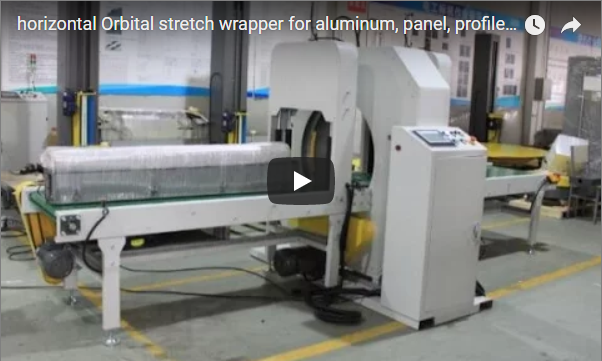
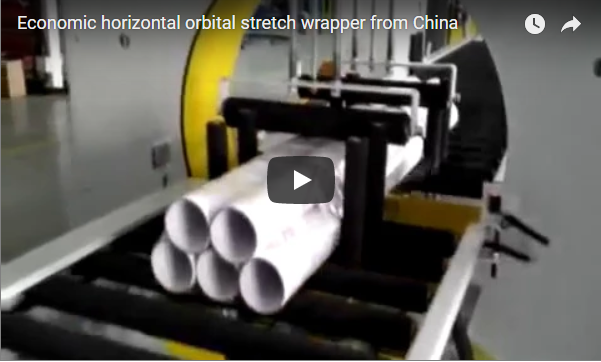
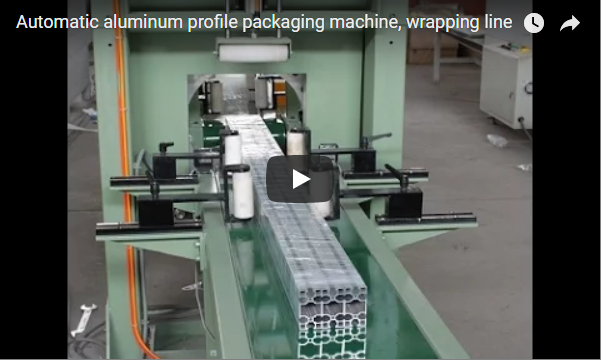
The door lies flat on the infeed conveyor and moves through the ring. The ring turns around the door and lays film in a spiral as the door advances. Photocell sensors detect the door position, so the PLC starts and stops the wrap at preset points.
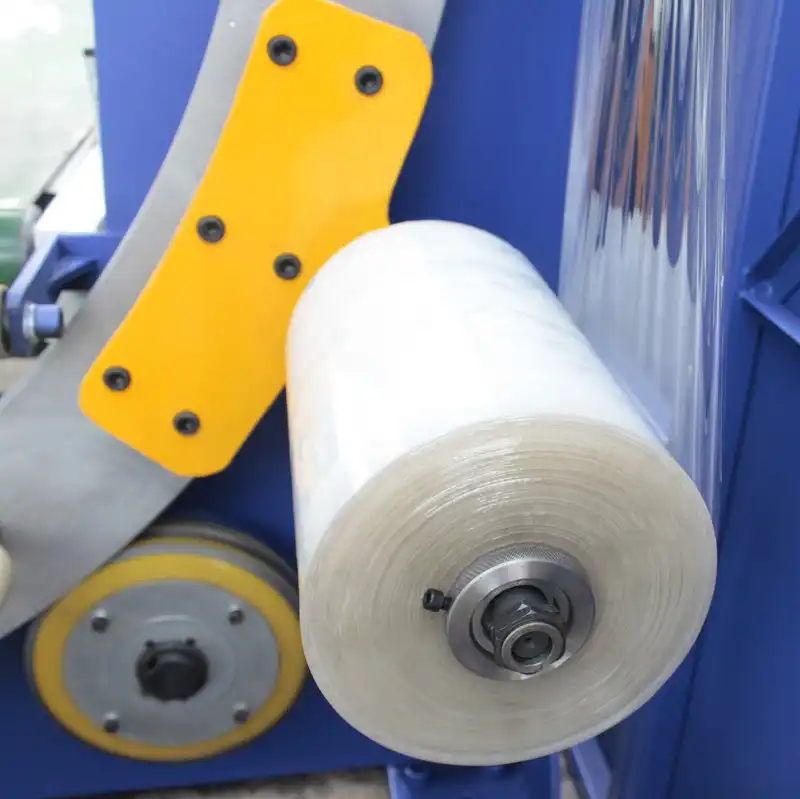
On our door orbital wrapper, a solid cast aluminium ring runs on four PU wheels for steady motion. Ring speed is adjustable, and so is the friction between the driving wheels and the ring. In our video, a wood-grain door passes through the ring under a hold-down frame.
A spiral wrap covers the four long faces of the door. Tell us if the door ends need protection too, and we include that in the proposal.
Does the door fit the window?
The E1400 is our horizontal wrapper for wide packages such as doors, sheets and floor boards.
| Parameter | E1400 |
|---|---|
| Package length | 1,000–3,000 mm |
| Package width | 300–1,400 mm |
| Package height | 50–1,000 mm |
| Infeed and outfeed conveyors | 2,000 mm each |
| Conveyor speed | 4–15 m/min |
| Ring speed | 10–60 r/min |
Illustrative example: a 2,100 × 900 × 40 mm door is within the length and width ranges. At 40 mm it is below the listed 50 mm minimum height. We either wrap two doors as one 80 mm stack or confirm a single-door setup on your drawing. A 2,100 × 1,000 mm double-leaf pack also fits the 1,400 mm width.
Overlap and line speed
Overlap is adjustable from 10% to 90%. Each ring turn advances the film band by the film width times the uncovered share. Illustrative example with 300 mm film and 50% overlap:
| Ring speed | Advance per turn | Line speed |
|---|---|---|
| 60 r/min | 150 mm | 9.0 m/min |
| 30 r/min | 150 mm | 4.5 m/min |
Both line speeds sit inside the 4–15 m/min conveyor range. The conveyor speed is set on the touch screen to match the wrapping speed, so the door never stalls in the ring.
Doors per hour
Illustrative example for a 2,100 mm door, with 20 s to load and unload:
| Step | 9.0 m/min | 4.5 m/min |
|---|---|---|
| Wrap travel | 14 s | 28 s |
| Load and unload (illustrative) | 20 s | 20 s |
| Total cycle | 34 s | 48 s |
| Doors per hour | about 105 | 75 |
These are run-time figures before film start, film cut and film roll changes. A heavier export wrap uses more overlap, which lowers line speed at the same ring speed.
Controls and film handling
| Item | Door orbital wrapper |
|---|---|
| Control | PLC with touch screen |
| Wrap start and stop points | set on the touch screen |
| Position sensing | photocell sensors |
| Film start and tie | automatic mechanical hand, sensor and PLC controlled |
| Overlap | 10–90% |
The mechanical hand feeds and ties the film without an operator, so one person can load doors while the machine wraps. The E1400 takes film 300 or 500 mm wide on rolls of 200–300 mm OD. Materials include LLDPE, PE, PVC and paper.
Utilities and safety
| Utility | E1400 |
|---|---|
| Power supply | AC 380 V, 60 Hz, 3 phase |
| Power | about 4.5 kW |
The standards that apply depend on the destination market. For CE markets, ISO 12100 sets the risk-assessment method and EN 415-10 sets general requirements for packaging machines.
Selection checklist for a door wrapping line
- [ ] Door length, width and thickness, single or stacked.
- [ ] Doors per hour needed.
- [ ] Overlap for domestic or export shipping.
- [ ] Door finish, so we can set film tension for lacquered or veneered faces.
- [ ] End protection needed, yes or no.
- [ ] Film type and width, 300 or 500 mm.
- [ ] Manual loading or connection to your line.
- [ ] Local power supply.
Engineering FAQ
Q: Can the machine wrap a single thin door?
A: The listed E1400 minimum package height is 50 mm. Thinner doors are wrapped as a stack, or we confirm a single-door setup on your drawing.
Q: How many doors per hour can we wrap?
A: About 75–105 doors of 2,100 mm in our illustrative example, with 20 s handling.
Q: Can we set where the wrap starts and stops?
A: Yes. The start and stop points are set on the touch screen.
Q: Does an operator have to tie the film?
A: No. An automatic mechanical hand feeds and ties the film.
Q: Can the wrapper join our production line?
A: Yes. The door orbital wrapper can be integrated into an existing line.
Next step
We plan your door wrapping line in three steps:
1. **Submit your layout drawing** with door sizes and doors per hour to **info@fhopepack.com**.
2. **Receive a proposal within 48 hours**, with the model, overlap and conveyor layout.
3. **Book a site survey** to fit the wrapper to your line.
Related reading
- [Door packing machines](https://www.fhopepack.com/door-packing-machine/)
- [Door horizontal orbital wrapping machine](https://www.fhopepack.com/door-packing-machine/Door-Horizontal-Orbital-Wrapping-Machine.html)
- [E1400 horizontal stretch wrapper](https://www.fhopepack.com/Automatic-horizontal-stretch-wrapper/E1400-horizontal-stretch-wrapper.html)
- [Video: horizontal ring orbital stretch wrapping machine](https://www.fhopepack.com/videos/horizontal-ring-orbital-stretch-wrapping-machine/)
- [Video: horizontal wrapping machine and spiral wrapper for furniture](https://www.fhopepack.com/videos/horizontal-wrapping-machine-and-spiral-wrapper-for-furniture/)
Sources
- Door wrapper features: [door horizontal orbital wrapping machine page](https://www.fhopepack.com/door-packing-machine/Door-Horizontal-Orbital-Wrapping-Machine.html)
- E1400 data: [E1400 horizontal stretch wrapper page](https://www.fhopepack.com/Automatic-horizontal-stretch-wrapper/E1400-horizontal-stretch-wrapper.html)
- Machine in action: [our door wrapping machine video on YouTube](https://www.youtube.com/watch?v=fa_m0b8IbLU)
- Standards scope: [ISO 12100:2010](https://www.iso.org/standard/51528.html), [EN 415-10:2014](https://www.nen.nl/en/nen-en-415-10-2014-en-191845)
Last reviewed: 2026-10-04