Executive Summary
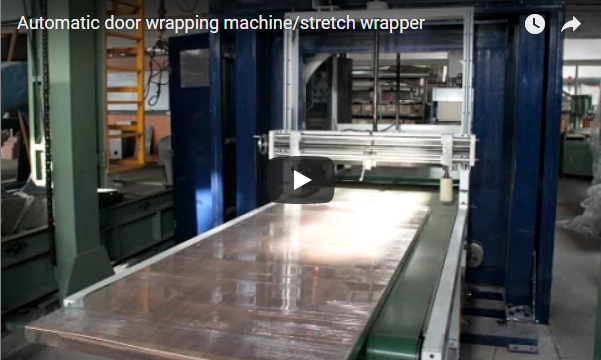
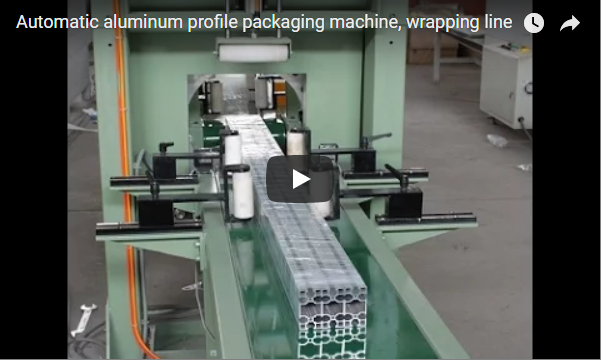
Preparing sawn lumber, kiln-dried timber, and engineered wood packs for transport requires two sequential operations: an all-weather cover against moisture and road grime, and high-tension strapping to consolidate the pack. Our automated horizontal timber packing line executes both on a continuous heavy-duty roller conveyor — orbital stretch wrapping combined with overhead vertical compression and PET/steel strapping heads. Ring diameter, roller throat width, compression stroke, and strap positions are engineered per project to your bundle dimensions.
Table of Contents
- System Overview & Working Principle
- The Line, Station by Station
- Why Wrap Before Strapping: Mechanical Advantages
- Film Consumption & Overlap Engineering
- Engineering Sizing Parameters
- Controls and Safety Compliance
- Selection Checklist for Timber Packaging Lines
- Engineering FAQ
- Project Planning & Next Steps
- Related Solutions
- Technical References
System Overview & Working Principle
The horizontal timber packing system consolidates, protects, and unitizes timber stacks on a pass-through powered roller bed:
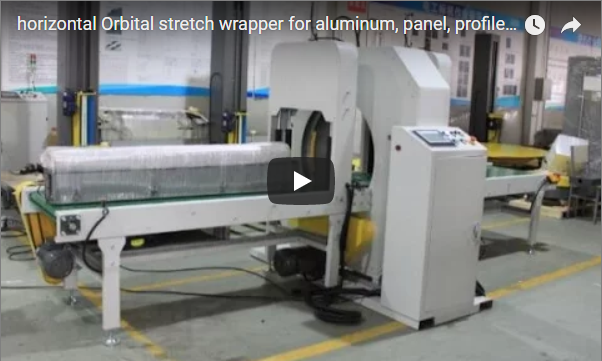
[Timber Infeed] ──> [Top Sheet Covering] ──> [Orbital Ring Wrapping] ──> [Top Compression & Strapping] ──> [Outfeed][Timber Infeed] ──> [Top Sheet Covering] ──> [Orbital Ring Wrapping] ──> [Top Compression & Strapping] ──> [Outfeed]- Continuous Spiral Wrapping: The bundle enters the orbital ring, where stretch film is applied in a synchronized, overlapping helical wrap as the bundle advances. The conveyor halts momentarily at the leading and trailing ends for multi-layer reinforcement wraps.
- In-Line Consolidation: The wrapped bundle moves to the integrated strapping station, where an overhead press beam clamps the pack to remove internal voids and counter pack relaxation.
- Automated Strapping: Under continuous vertical compression, automated strapping heads index around the pack to feed, tension, and friction-weld heavy-duty PET or steel strapping.
The Line, Station by Station
| Station | Mechanical Function | Engineering Advantage |
|---|---|---|
| Top Film Covering | Applies PE protective sheeting over the bundle top face | Provides full 5-sided weather protection against rain infiltration |
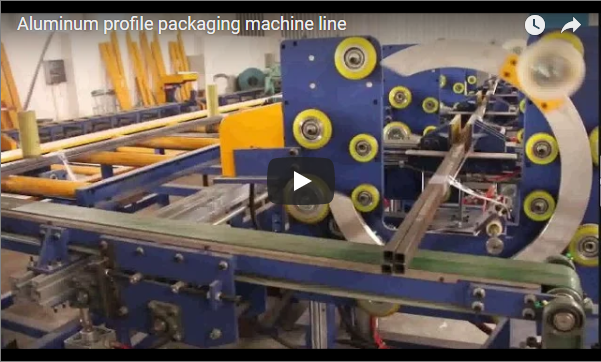
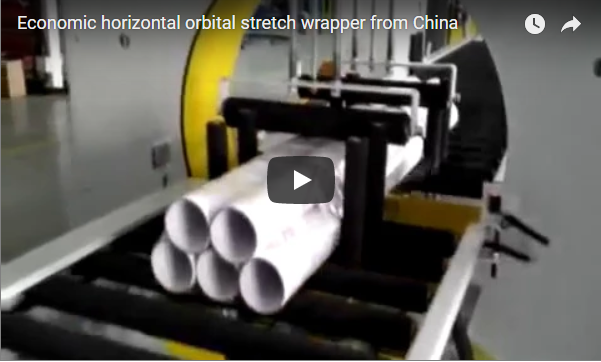
| Orbital Wrapping | High-speed ring wraps stretch film in a continuous spiral | Seals perimeter, prevents board shifting, eliminates manual taping |
| Powered Conveying | Heavy-duty polyurethane/steel powered rollers advance packs | Continuous horizontal motion prevents sagging and manual lifting |
| Overhead Pressing | Hydraulic/pneumatic beam applies vertical downforce | Pre-compresses timber bundle to eliminate internal voids before strapping |
| Automatic Strapping | Indexes strapping band around pack, tensions, and friction-welds | Secures load stability for handling, lifting, and ocean/flatbed freight |
The timber stack stays horizontal through the whole line, so long boards (up to 6,000 mm or longer) transfer linearly without secondary cranes or bundle rotation.
Why Wrap Before Strapping: Mechanical Advantages
Applying film before strapping delivers clear advantages over strapping-only procedures:
- Tension Preservation through Bundle Settling: Freshly sawn or kiln-dried packs settle in transit. Compressing the bundle before strapping lets the straps pull tight against already-densified timber, while the film prevents vibration-induced slackening.
- Surface Protection from Band Cutting: High-tension PET or steel strapping crushes soft timber edges. The stretch film distributes those forces, protecting planed and tongue-and-groove boards; automatic edge boards can be added for premium finishes.
- Hermetic and Dust-Proof Sealing: Straps applied over the film anchor it against highway wind shear, keeping rain, road salt, and dirt off the timber.
Film Consumption & Overlap Engineering
Film usage per timber bundle is governed by bundle perimeter, usable film web width, overlap percentage, and pre-stretch carriage ratio.
For a standard pack measuring 2,440 mm (L) × 1,220 mm (W) × 600 mm (H) wrapped with 500 mm wide film and a 50% overlap, each ring turn covers its 3.64 m perimeter while advancing 250 mm along the length, giving about 14 turns — head and tail reinforcement included — and roughly 51 m of film on the bundle. Raising the overlap to 70% advances the film only 150 mm per turn and raises applied film to about 76 m. A powered 200% pre-stretch carriage cuts actual roll consumption to roughly 17 m.
The selected overlap ratio should match transport conditions: 50% for standard closed-curtain trucks, and 70% or higher for open flatbed transport and export shipping.
Engineering Sizing Parameters
Because timber mills process diverse cut lists, critical machine dimensions must be specified around the project envelope:
Because timber mills process diverse cut lists, critical machine dimensions are specified around the project envelope:
- Ring Internal Diameter — matched to the diagonal cross-section of the largest timber pack, with at least 250 mm clearance.
- Conveyor Roller Width — maximum bundle width plus 150 mm allowance.
- Conveyor Bed Length — set to the longest board spec, with roller spacing at most a third of the shortest board length to maintain three-point support.
- Press Beam Stroke — sized to clear the tallest pack while still reaching the lowest clamp height.
- Strapping Head Throat — matched to the wrapper pass-through dimensions.
- Wrapping Substrates — PE stretch film (standard), woven PE (heavy duty), or VCI film (anti-corrosion).
Line throughput and conveyor speeds depend on bundle size, strap counts, and upstream mill output.
Controls and Safety Compliance
Industrial timber packing equipment operates under high rotational forces and heavy vertical clamping loads, so comprehensive safeguarding is standard:
- Dual-Zone Optical Light Curtains — interlocked safety grids detect intrusion at the wrapper ring infeed/outfeed and press beam zones.
- Perimeter Hard Guarding — steel mesh fencing encloses the orbital path and strapping track.
- Pneumatic / Hydraulic Lockout — anti-drop rod locks or dual-check safety valves prevent beam drop during air loss.
- Control Architecture — centralized PLC with industrial HMI for manual setup, recipe storage per pack profile, and interlocked emergency stops.
Design follows ISO 12100 for machinery risk reduction and EN 415-10 for packaging machine safety, with Lockout/Tagout provisions per OSHA 29 CFR 1910.147 for maintenance.
Selection Checklist for Timber Packaging Lines
Prior to finalizing a system specification, review these packaging parameters:
- Board Dimensions: Minimum and maximum board length, width, and thickness.
- Bundle Dimensions: Cross-sectional envelope — minimum and maximum (W × H).
- Total Bundle Weight: Maximum weight (kg) for roller load and drive motor sizing.
- Protection Level: Basic perimeter wrap, 5-sided weather protection (top sheet + spiral wrap), or fully sealed ends.
- Strapping Requirements: Number of straps, type (PET or steel), and band width (typically 16 mm to 19 mm).
- Timber Moisture Content: Kiln-dried vs. green wood (green wood may need breathable wrap or slotted profiles to avoid fungal growth).
- Throughput Target: Bundles per hour, to decide whether parallel or index-shuttle strapping is needed.
Engineering FAQ
Q: Does the timber stack rotate or flip during orbital wrapping?
A: No. The bundle stays horizontal on the conveyor bed while the orbital ring rotates 360° around it; the helical pitch comes from advancing the conveyor through the ring.
Q: Why is vertical pressing required immediately before strapping?
A: Loose boards retain internal air gaps. Without mechanical downforce, transit vibration settles the boards and leaves the strapping slack. The press squeezes the pack into a densified unit so the strapping keeps full retention tension.
Q: What determines the orbital wrapper ring diameter?
A: The ring diameter follows the diagonal of the largest bundle cross-section, plus a minimum clearance allowance of 250 mm for the rotating film carriage.
Project Planning & Next Steps
Integrating an automated timber wrapping and strapping line into an operational sawmill or planermill involves three design phases:
- Envelope & Output Specification: Send timber cut lists, bundle size ranges, and target hourly output to info@fhopepack.com.
- Layout & Station Proposal (Within 48 Hours): Our packaging engineers supply a 2D layout with conveyor lengths, ring sizing, press stroke, and strap positions.
- Engineering Review & Site Integration: Layout verification optimizes feed height, electrical drop points, pneumatic supply, and infeed/outfeed transfers.
Related Solutions
- Horizontal Orbital Wrapper for Timber & Wooden Products
- Custom Horizontal Orbital Stretch Wrapping Systems
- Heavy-Duty Bundle Wrapping & Strapping Application Video
Technical References
- System Engineering & Mechanics: FHOPE Industrial Systems Technical Group.
- Packaging Material Substrates: Horizontal Stretch Wrapper Engineering Guide.
- Video Reference: Automated Timber Wrapping and Strapping Machine in Production.
- Safety Harmonization: ISO 12100:2010 Machinery Safety Guidelines; EN 415-10:2014 Safety Requirements for Packaging Machines.