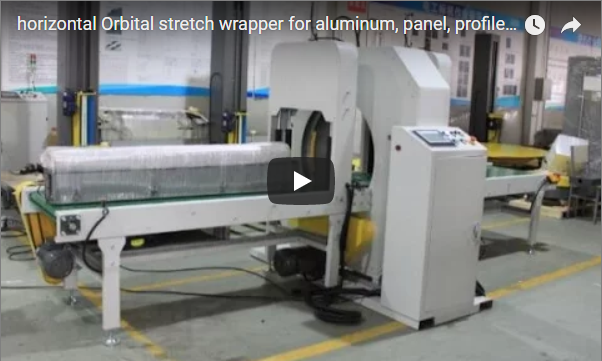
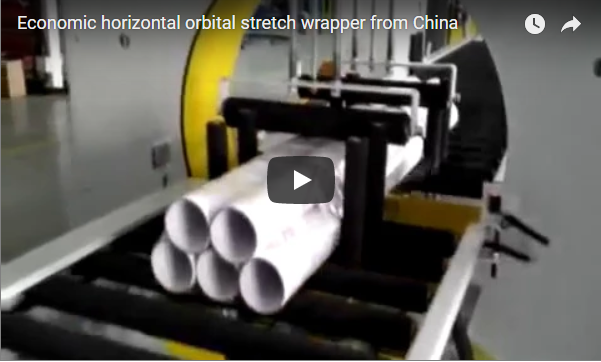
Executive summary Our economic horizontal orbital stretch wrapper is the entry model for wrapping pipe and tube bundles. Bundles of 50 to 200 mm OD ride PU-covered conveyors through a turning ring that spirals stretch film round them. The operator loads the film and starts each bundle, so the machine stays simple and low in cost. A worked example shows how ring speed sets the lowest overlap the conveyor allows.
Table of Contents
- Who the economic model is for
- Where the saving comes from
- Economic model specifications
- Economic, S200 or S300: picking a pipe wrapper
- Worked example: ring speed and the overlap floor
- Protecting pipe ends and surfaces
- Selection checklist: what to send us
- Safety and EN 415-10
- Engineering FAQ
- Next step
- Related reading
- Sources
Who the economic model is for
Plastic pipe extruders, tube mills and stockholders often bundle pipe by hand with tape or stretch film. Hand wrapping is slow on long lengths, and the wrap is loose at one end and tight at the other. A fully automatic line is more than many smaller plants need.
The economic model sits between the two. It gives a machine-tight spiral wrap at a set overlap, while the operator still handles the film start and the bundle loading. It suits plants packing a few shifts of pipe a day rather than a non-stop extrusion line.
Where the saving comes from
We keep the price down by keeping the machine short and simple:
- Short conveyors. The infeed and outfeed conveyors are 1,000 mm each, motor driven. Long pipe rests on your own idler stands beyond them, set to the conveyor height so the motors do not drag the pipe.
- One wrapping ring. A single ring turns on adjustable friction drive wheels, with ring speed set by inverter.
- Manual film start. The operator fits the film roll on the carriage and fixes the tail to the bundle. No clamp-and-cut unit is needed.
- Simple controls. Soft start and stop, a resettable ring start point and adjustable film tension cover what most pipe packing needs. On our S-series, a brake device sets the tension and the film rolls sit on a 50 mm core.
What stays is the part that protects the pipe. PU-covered conveyor rolls keep the pipe surface clean, and the overlap is adjustable from 10% to 90%.
Economic model specifications
| Item | Economic semi-auto orbital wrapper |
|---|---|
| Bundle OD | 50–200 mm |
| Length | over 1,500 mm |
| Infeed and outfeed conveyors | 1,000 mm each, motor driven |
| Conveyor speed | 4–15 m/min, by inverter |
| Ring speed | 20–100 r/min, by inverter |
| Overlap | 10%–90% |
| Power | about 1.5 kW |
| Supply | AC 380 V, 60 Hz |
| Materials | LLDPE stretch film, PE, HDPE |
Economic, S200 or S300: picking a pipe wrapper
| Point | Economic model | S200 | S300 |
|---|---|---|---|
| Bundle OD | 50–200 mm | 10–200 mm | 50–300 mm |
| Minimum length | 1,500 mm | 300 mm | 1,000 mm |
| Conveyors | 1,000 mm each | 2,000 mm each | 2,000 mm each |
| Ring speed | 20–100 r/min | 20–120 r/min | 100 r/min |
| Film handling | manual start | automatic cutter optional | automatic clamp and cut |
| Power | about 1.5 kW | about 2.1 kW | about 1.5 kW |
Choose the economic model for pipe from 1,500 mm long where an operator is at the machine anyway. Pick the S200 for short or thin tube down to 10 mm OD. The S300 suits bundles up to 300 mm OD and plants that want the film cut without an operator.
Worked example: ring speed and the overlap floor
Take six PVC pipes of 50 mm OD, 6,000 mm long, bundled 2 × 3. These are illustrative customer figures.
Fit check. Support rollers hold the bundle steady so it does not shake or turn while the ring wraps it. The bundle measures 100 × 150 mm. Its diagonal is √(100² + 150²) = 180 mm, inside the 200 mm OD limit.
Overlap. Each ring turn moves the film along the bundle by the conveyor speed divided by the ring speed. Take 120 mm film as an example width; our S300 runs 120 mm and the S200 takes 120–200 mm. We confirm the roll size for the economic carriage when we quote. A 50% overlap then means 60 mm per turn.
- At 100 r/min: conveyor speed = 60 × 100 = 6,000 mm/min, or 6 m/min
- Wrap time for the 6,000 mm bundle: 6 ÷ 6 = 1 min
The overlap floor. The conveyor cannot run slower than 4 m/min. At 20 r/min that means 4,000 ÷ 20 = 200 mm per turn, wider than the 120 mm film, so the wrap would leave gaps. To hold 50% overlap at the slowest conveyor speed, the ring must turn at least 4,000 ÷ 60 = 67 r/min. Run the ring near the top of its range when you need heavy overlap.
Film on the bundle. One turn round the 100 × 150 mm bundle uses about 2 × (100 + 150) = 500 mm of film. The 6,000 mm bundle takes 6,000 ÷ 60 = 100 turns, so about 50 m of film on the bundle. That is a nominal figure; brake tension stretches the film a little, so slightly less comes off the roll.
Protecting pipe ends and surfaces
Spiral wrap covers the length, but pipe ends stay open. Cap the ends first if dirt or insects inside the bore matter, as with potable water pipe. Printed PVC pipe keeps its marking legible through clear LLDPE film. HDPE film or woven tape adds abrasion resistance for steel tube loaded by crane.
Selection checklist: what to send us
- Pipe or tube OD and wall, and how many per bundle.
- Bundle length range.
- Bundle weight.
- Bundles per shift.
- Film or tape you want to use.
- Whether an operator will stay at the machine.
- Power supply at site.
Safety and EN 415-10
We design the wrapper to EN 415-10 for packaging machines and assess risks to ISO 12100. The turning ring is the main hazard. A guard encloses the ring, and an emergency stop sits on the control panel. Where a person could reach the ring through the conveyor openings, we fit interlocked fencing or muting light curtains, so a pipe can pass but a person stops the machine.
Engineering FAQ
Q: Can the economic model join an extrusion line? A: It can sit after the saw, with the operator starting each bundle. For hands-off running choose a model with automatic clamp and cut.
Q: Why does overlap change when I change the conveyor speed? A: Each ring turn lays one band of film. A faster conveyor spreads those bands further apart, so overlap drops.
Q: What film width should I use? A: We match it to your bundle size and overlap target when we quote.
Q: Which safety standards apply? A: ISO 12100 for the risk assessment and EN 415-10 for the machine, in CE markets.
Next step
- Email your pipe sizes, bundle lengths and bundles per shift to info@fhopepack.com.
- We reply within 24 hours with a proposal naming the model and film.
- We send a layout drawing showing conveyors and pipe stands.
Related reading
- Economic horizontal orbital stretch wrapper
- S200 semiauto horizontal orbital wrapper
- S300 semiauto orbital wrapping machine
- Economic type orbital wrapper
- Horizontal ring orbital stretch wrapping machine
- Horizontal orbital wrapping machine for steel tubes
- Automatic horizontal orbital wrapping machine for pipes and bundles
Sources
- Specifications: FHOPE economic semi-auto orbital wrapper, S200 and S300 product pages
- Machine video: economic orbital wrapper on YouTube
- Overlap and film use: our worked example, illustrative pipe figures
- Standards: EN 415-10 (packaging machines, general safety); ISO 12100:2010
Last reviewed: 2026-10-17