> **Executive summary**
> Our carpet packing machine seals each roll into a PE film envelope as it passes the sealing station. It takes products up to **450 mm** high, seals three sides or the full package, and feeds and cuts the film automatically. The roll diameter, the roll length and whether you add a shrink tunnel decide the layout.
Table of Contents
- How the roll sealer works
- Will your roll fit?
- Film size from roll circumference and length
- Seal quality and temperature
- Line options
- Utilities and safety
- Selection checklist
- Engineering FAQ
- Next step
- Related reading
- Sources
How the roll sealer works
Our carpet packing machine is an automatic sealing machine for carpets, mats and other rolls. A photoelectric sensor detects and positions each roll. The PE film is fed and cut automatically, and the sealing head closes the film around the roll, three sides or all sides.
Each cycle runs in three moves. The conveyor positions the roll at the photocell, the sealing head lowers to close and seal the film, and the head lifts for the next roll. Our video shows this on carpet rolls.
Infeed runs in auto or manual mode, and the front feed speed is adjustable.
Will your roll fit?
| Parameter | Carpet packing machine |
|---|---|
| Sealing height | up to 450 mm |
| Sealing width | adjustable to the product |
| Sealing | three sides, or full enclosure on all sides |
| Film | PE film, or industrial shrink film |
| Positioning | photoelectric sensor |
| Infeed | auto or manual mode |
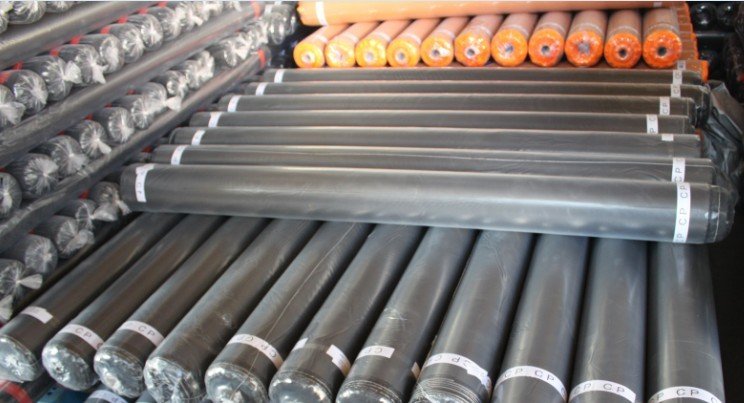
A roll lying on the conveyor is as high as its diameter, so the 450 mm sealing height sets the largest roll diameter. Illustrative examples: a 300 mm carpet roll fits with room to spare, and a 500 mm roll needs a taller sealing frame, which we confirm in the proposal.
Film size from roll circumference and length
The film has to go all the way around the roll before it is sealed. Whichever way the film runs through the machine, one dimension must cover the roll circumference, π × diameter, and the other must cover the roll length:
| Roll diameter | Circumference |
|---|---|
| 200 mm | about 628 mm |
| 300 mm | about 942 mm |
| 450 mm | about 1,414 mm |
Add the seal allowance to the circumference, and end allowances to the roll length. We set the film width and seal allowance on your roll in a trial, so you do not overbuy film.
Seal quality and temperature
The sealing system is permanently heated, with a constant-temperature seal that suits PE and industrial shrink films. The PLC controls and monitors the temperature. The sealing blade is easy to exchange, and the seal works without odour. For carpet buyers, a continuous seal keeps dust and moisture out of the roll in storage.
Line options
The machine can connect to other machines in a production line:
- **Shrink tunnel.** The sealer connects to a shrinking tunnel for a tight, shrunk finish.
- **Roll turning and stacking.** We deliver sealing stations for turning the roll, assembly stations and stacking for pallets.
- **Standalone.** A single sealer with manual infeed for lower volumes.
Utilities and safety
| Item | Specification |
|---|---|
| Sealing control | PLC, temperature controlled and detected |
| Film handling | automatic feeding and cutting |
| Power and air | confirmed in your proposal for the chosen line |
The standards that apply depend on the destination market. For CE markets, ISO 12100 sets the risk-assessment method and EN 415-10 sets general requirements for packaging machines.
Selection checklist for a carpet roll packer
- [ ] Largest roll diameter and roll length.
- [ ] Rolls per hour.
- [ ] Three-side or full-side sealing.
- [ ] PE film only, or shrink film plus tunnel.
- [ ] Roll turning, labeling or stacking after sealing.
- [ ] Auto or manual infeed.
Engineering FAQ
Q: What is the largest roll the sealer takes?
A: The sealing height is up to 450 mm, so rolls up to about 450 mm in diameter lying on the conveyor.
Q: How wide must the film be?
A: At least the roll circumference plus seal allowance. A 300 mm roll needs about 942 mm of wrap-around.
Q: Can we shrink the film after sealing?
A: Yes. The sealer connects to a shrinking tunnel, and the seal suits industrial shrink films.
Q: How is seal temperature controlled?
A: The seal is permanently heated at constant temperature, controlled and detected by the PLC.
Q: Can the machine join our existing line?
A: Yes. It connects to other machines, including roll turning, assembly and pallet stacking stations.
Next step
We size your carpet roll packer in three steps:
1. **Submit your layout drawing** with roll sizes and rolls per hour to **info@fhopepack.com**.
2. **Receive a proposal within 48 hours**, with sealing frame, film and line options.
3. **Book a site survey** to fit the line to your plant.
Related reading
- [Carpet packing machine](https://www.fhopepack.com/Industry%20Solution/Carpet_packing_machine.html)
- [Carpet shrinking machine](https://www.fhopepack.com/Industry%20Solution/Carpet_shrinking_machine.html)
- [Video: shrink packaging machine for carpet roll](https://www.fhopepack.com/videos/shrink-packaging-machine-for-carpet-roll/)
- [Bubble film wrapper](https://www.fhopepack.com/Customize-orbital-wrapper/bubble-film-wrapper.html)
- [Video: horizontal wrapping machine for furniture](https://www.fhopepack.com/videos/horizontal-wrapping-machine-and-spiral-wrapper-for-furniture/)
Sources
- Sealing machine features: [carpet packing machine page](https://www.fhopepack.com/Industry%20Solution/Carpet_packing_machine.html)
- Machine in action: [our carpet roll packing machine video on YouTube](https://www.youtube.com/watch?v=W2oNncz2TJU)
- Standards scope: [ISO 12100:2010](https://www.iso.org/standard/51528.html), [EN 415-10:2014](https://www.nen.nl/en/nen-en-415-10-2014-en-191845)
Last reviewed: 2026-10-04