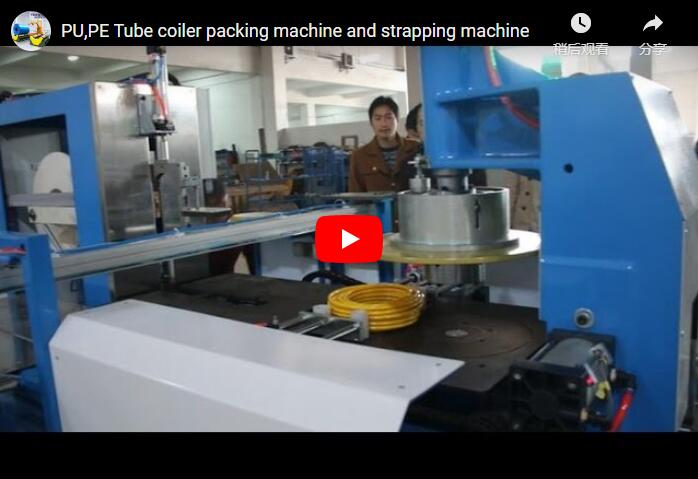
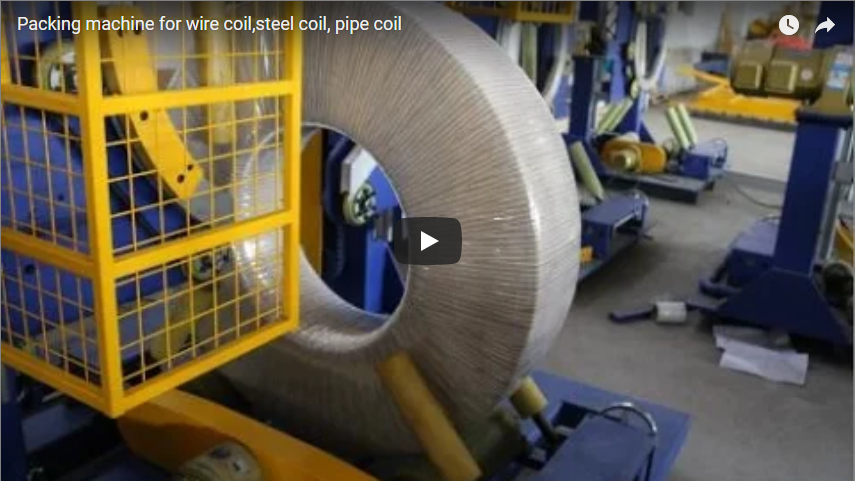
Executive summary A coil that is wrapped and strapped keeps its layers tight and its bands in place to the customer. This clip shows the wrap and strap machines in two workshops, presented as a sequence rather than one connected line. For a target of 20 coils per hour, takt is 3,600 ÷ 20 = 180 s per coil. The slower station, or wrap plus strap on one combined station, must fit inside the takt; we size the stations from your layout.
Table of Contents
- What the video shows
- The two stations in the clip
- Wrapping the coil through the eye
- Strapping the coil through the eye
- Output, line cycle time and takt
- Controls and safety
- Selection checklist for a coil wrapping and strapping station
- Engineering FAQ
- Next step
- Related reading
- Sources
What the video shows
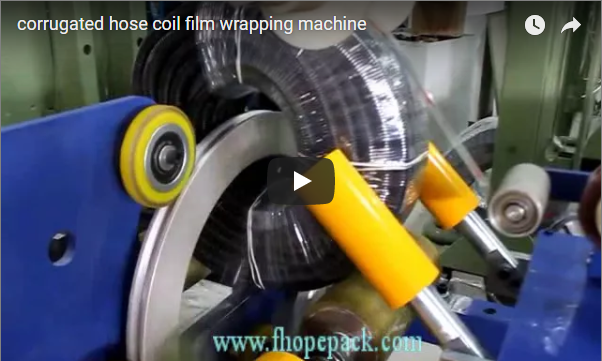
The clip opens at a wrapping station in one workshop: a coil lies flat on green rollers and the ring of an eye-through wrapper passes through the coil, laying on stretch film as it turns. The film passes through the eye and covers the OD, ID and both faces of the coil.
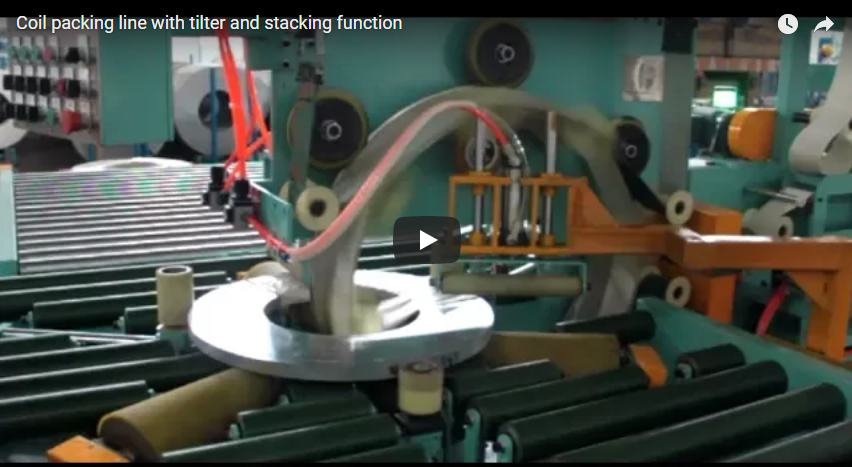
The clip then cuts to a second workshop. A strapping head on a gantry moves over a coil on yellow rollers, and a guide arc passes the strap through the coil eye. In the closing shots the camera moves in on a scissor-lift table at the end of the yellow roller line, in front of the strapping head.
The two shots come from two different workshops. The order in which the stations appear is presentation, not a measured single-line cycle, and it is not evidence that the machines share one conveyor.
The two stations in the clip
| Station | What happens |
|---|---|
| Station 1 – wrap (green rollers) | Ring passes through the coil eye and wraps film round the coil section |
| Station 2 – strap (yellow rollers) | Gantry head passes a strap through the coil and tensions it |
| Lift table (yellow rollers) | Scissor-lift table at the end of the strapping roller line |
Wrapping first holds the outer diameter and keeps the layers tight, so the strap then fixes the film and carries the handling load. Whether the two stations share one conveyor, or are fed separately, we size from your layout; the clip does not link them, and we do not claim a combined cycle. For a connected line with strapping, eye-through wrapping and stacking, see our slit coil packing line for service centers.
Wrapping the coil through the eye
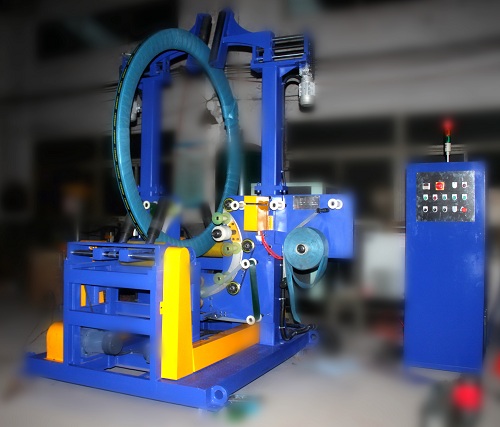
An eye-through coil wrapper is a machine whose rotating ring passes stretch film through the coil eye, covering the OD, ID and both faces. The wrapper in the video is the same eye-through type as our copper coil wrappers for strip and band coils. The model and its settings are configured per project; as a reference, the FPC-200 eye-through copper coil wrapper is specified as:
| Parameter | Value (reference) |
|---|---|
| Package OD | 600-1,200 mm |
| Package ID | 300-800 mm |
| Object weight | 5-500 kg |
| Rotating speed | 10-100 r/min |
| Roller speed | 2-4 m/min |
| Overlap scope | 20%-90% |
| Wrapping speed | 23-50 s per coil |
For heavier strip coils we offer the FPC-300:
| Wrapper | Coil OD | Coil ID | Coil weight | Ring speed | |
|---|---|---|---|---|---|
| FPC-200 | 600-1,200 mm | 300-800 mm | 5-500 kg | 10-100 r/min | |
| FPC-300 | 700-1,200 mm | 400-900 mm | 10-1,000 kg | 5-100 r/min | Wrap speed depends on the film width, overlap and coil size settable on the program, so we size the film plan per project. |
Strapping the coil through the eye
After wrapping, the strap fixes the film and takes the handling load. More on this machine class is in our steel coil radial strapping machine post. The PET eye-through strapping machine in the video is custom-built for this line and has no model code. As a reference, our standard PET eye-through strapping machine for steel coils is specified as:
| Parameter | Value (reference) |
|---|---|
| Strapping size | OD 800-1,350 mm; ID 508-610 mm; width 20-500 mm |
| Coil weight | 100-2,500 kg |
| Strap material | PET, width 9-12 mm, thickness 0.4-1.0 mm |
| Strap tension | 100-1,000 N |
| Strapping speed | About 12-15 s per strap |
| Rotation table | 360 degree turning for 4 strapping belts |
The coil OD range of our strapping machine is a machine range; we set the actual strap program, number of belts and tension to your coil and film plan per project.
Output, line cycle time and takt
Takt is set by your target output, not by the machines. Illustrative check for 20 coils per hour:
| Item | Value |
|---|---|
| Output target (illustrative) | 20 coils per hour |
| Takt, 3,600 ÷ 20 | 180 s per coil |
| Wrap time, FPC-200 reference | 23-50 s |
| Strap time, 4 straps x 12-15 s | 48-60 s |
| Condition | Slower station (separate) or wrap + strap (combined, 71-110 s) below 180 s |
When the wrap and strap run on two separate stations, the slower station sets the line cycle time, which must not exceed the takt. When one station does both in sequence, the cycle time is the sum of the two times. If the result exceeds your takt, we raise a station speed or split the work.
Controls and safety
The wrapper ring and the strapping head move automatically round and through the coil. Keep people out of the ring and head travel areas while the machines run, and clear a jam or change a coil only with the station stopped and isolated.
The standards that apply depend on the destination market. For CE markets, ISO 12100 sets the risk-assessment method and EN 415-10 sets general requirements for packaging machines.
Selection checklist for a coil wrapping and strapping station
- Coil OD, ID, width and weight range.
- Coils per hour the line must pack.
- Wrap film width, type and overlap program.
- Strap material, number of belts and tension.
- One shared conveyor or separate stations, and the level changes between them.
- Floor space, power supply and control signals.
Engineering FAQ
Q: Why wrap the coil through the eye before strapping it? A: Wrapping through the eye covers the OD, ID and both faces as the coil turns slowly on the rollers. The layers stay tight, and the strap later fixes the film and takes the handling load.
Q: Why are the two stations in different workshops? A: The clip was shot in two different workshops to show each machine clearly; the sequence is presentation, and we size the conveyor or transfer link by your layout.
Q: How fast is the strapping? A: On our PET eye-through strapping machine each strap takes about 12-15 s, so a 4-belt coil runs 48-60 s of strapping; the belt program is set per project.
Q: Can the wrap and strap share a takt? A: Yes. With separate stations the slower one must fit inside the takt. With one station doing both, the wrap time (23-50 s) plus strap time (48-60 s) must fit, and we check that sum in the takt example.
Q: Which wrapper fits my coil? A: Coils of 600-1,200 mm OD, 300-800 mm ID and up to 500 kg fit the FPC-200; heavier coils up to 1,000 kg with 400-900 mm ID fit the FPC-300.
Next step
We plan your coil wrapping and strapping station in three steps:
- Submit your layout drawing with coil sizes, strap count and output to info@fhopepack.com.
- Receive a proposal within 48 hours, with the wrap and strap plan and takt check.
- Book a site survey to check the conveyor height, floor space and power supply.
Related reading
- FPC-200 copper coil wrapper
- Steel coil PET strapping machine
- Video: coil packing machine for copper and alloy steel strip
- Video: automatic copper strip coil packing line with labeling, wrapping and stacking
- Video: steel coil and copper coil packaging machine for eye-through film wrapping
- Video: automatic steel coil strapping machine
Sources
- Wrap parameters: FPC-200 copper coil wrapper, FPC-300 copper coil wrapper
- Strap parameters: Steel coil PET strapping machine
- Takt example: our worked example, illustrative values
- Machine in action: our video on YouTube
- Standards scope: ISO 12100:2010, EN 415-10:2014
Last reviewed: 2026-10-04