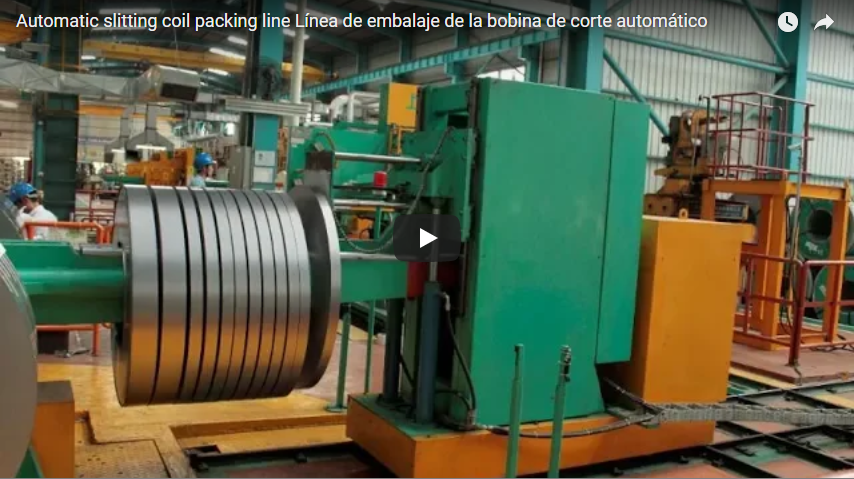
Executive summary Our slit coil packing line takes narrow coils from the slitter and straps, wraps, weighs, labels and stacks them onto pallets. In narrow-strip setups it packs 25–40 coils per hour, for coils up to 4,000 kg and 500 mm wide. The line has to keep up with the slitter, so we size it from the strips per mother coil and the slitter cycle. Strapping time per coil usually sets the pace.
Table of Contents
- Line stations
- Specifications
- Matching the slitter
- Strapping time
- Wrapping
- Stacking
- Automation levels
- Controls and utilities
- Safety
- Implementation checklist
- Engineering FAQ
- Next step
- Related reading
- Sources
Stations on a slit coil packing line
We built the line in this video for a slitting service center. Each narrow coil passes these stations, eye to sky:
- Down-ending. Coils leave the slitter turnstile eye to wall. A down-ender tilts each coil to eye to sky and puts it on the conveyor.
- Centring. A centring station with sensors and a lifting table aligns the coil with the conveyor centre line. A centred coil straps evenly and stacks straight.
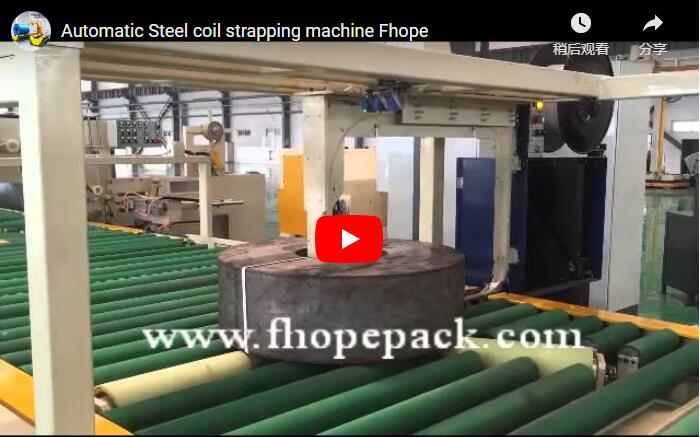
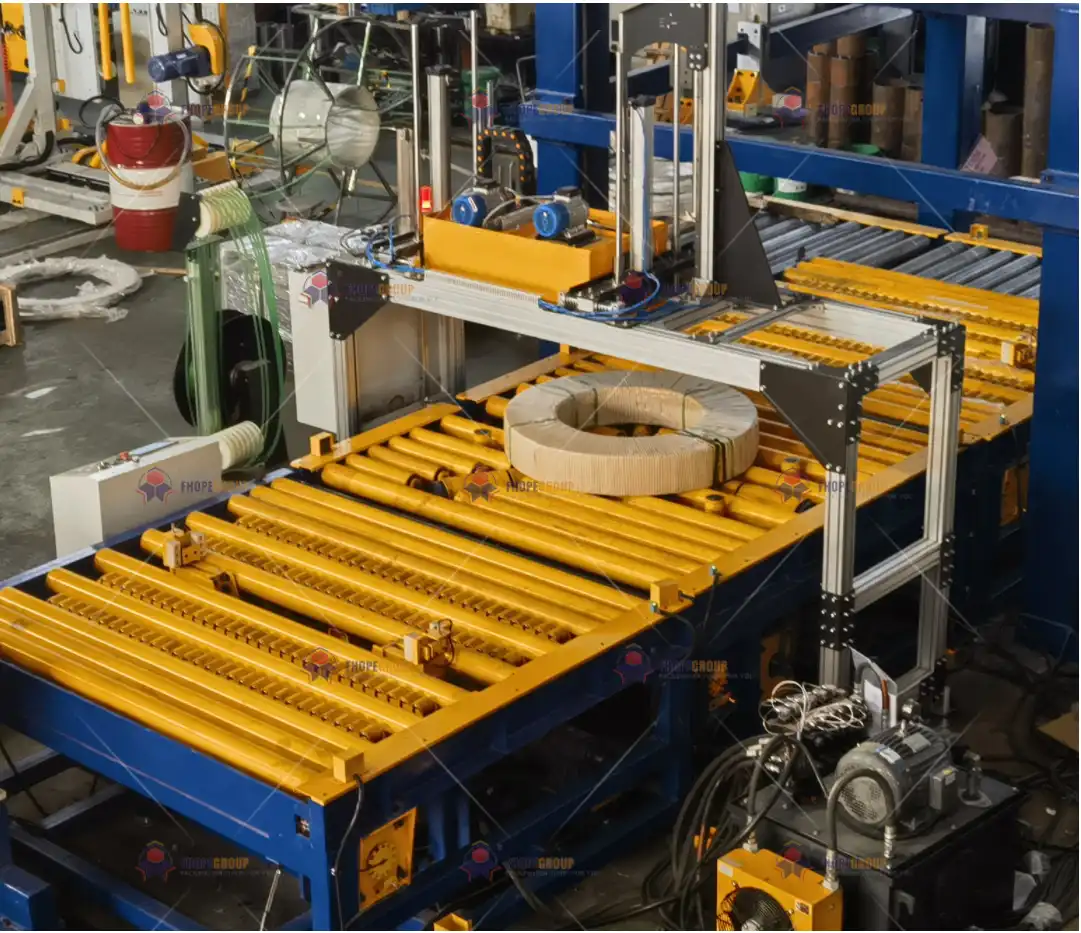
- Strapping. A strapping unit on a rotating platform puts PET or steel straps through the coil eye, at 3, 4 or 6 points.
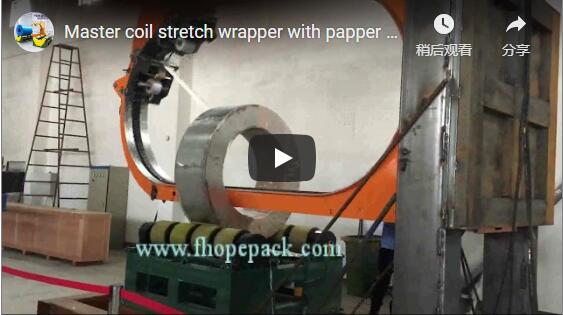
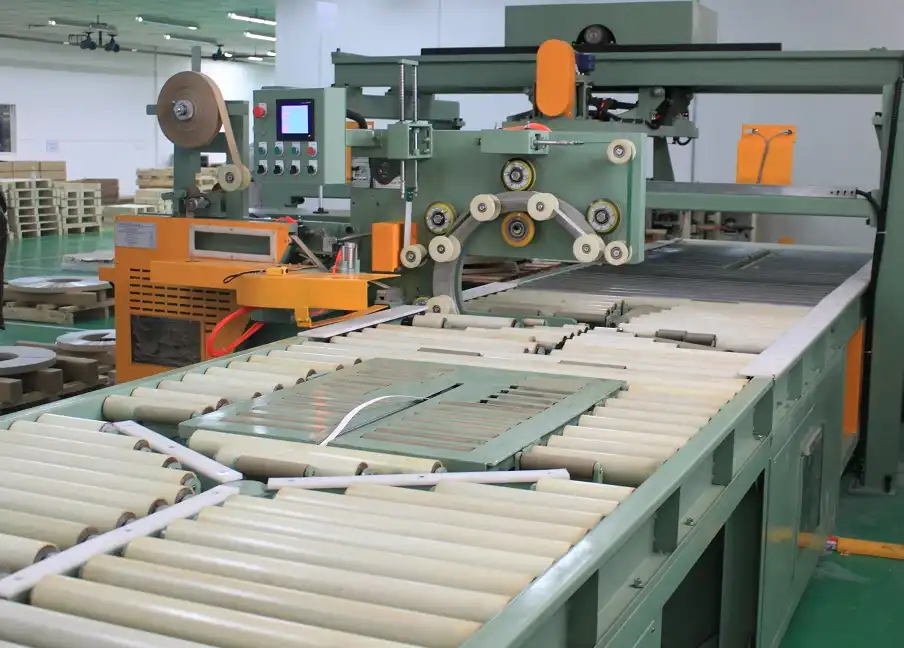
- Wrapping. An orbital wrapper passes paper or stretch film through the eye for full coverage.
- Coil weighing and labelling. An inline scale records each coil’s net and gross weight, and the line applies a barcode label for tracking.
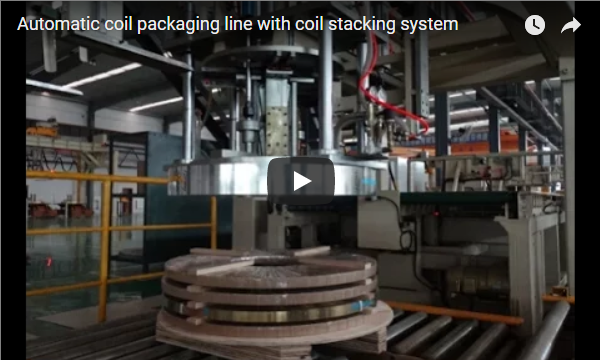
- Stacking. A stacker picks the packed coils and stacks them onto a wooden pallet. Timber separators between layers stop the stack shifting in transit.
After wrapping, powered roller conveyors carry the coils to the stacking station. On this line, the stacking arm turns on a large slewing ring to place each coil on the pallet stack.
Slit coil packing line specifications
| Parameter | Narrow slit coil line |
|---|---|
| Packing capacity | 25–40 coils per hour |
| Coil weight | up to 4,000 kg |
| Coil width | up to 500 mm |
| Coil OD | up to 1,500 mm, customizable to 2,100 mm |
| Coil ID | 508 mm or 610 mm |
| Strapping | PET or steel, 2,000–22,000 N tension |
| Wrapping overlap | 10–90% |
Wide coils of 450–1,900 mm width run on a heavier line at 5–8 coils per hour. Stacking accuracy on a gantry stacker is ±2 mm.
Matching the packing line to the slitter
A slitter turns one mother coil into many narrow coils at once. The packing line has to clear them before the next mother coil arrives:
- Time per coil = 3600 ÷ coils per hour. At 40 coils per hour, the line has 90 s per coil.
- Time per mother coil = number of strips × time per coil. With an illustrative 20 strips, packing takes 20 × 90 s = 30 min.
- Check: if the slitter needs less than that per mother coil, coils queue on the turnstile. Then we add a buffer, a second strapping head or a faster stacker.
We run this check for your strip count and mother-coil cycle before we fix the layout.
Strapping time per coil
Strapping is usually the slowest station, so we check it first. Each strap takes 15–35 s on our automatic PET or steel heads:
- 4 straps at 15 s = 60 s, which fits inside the 90 s budget at 40 coils per hour.
- 4 straps at 35 s = 140 s, which limits the line to about 25 coils per hour.
- 6 straps on heavy coils take longer again, so heavy coils run at the lower end of the range.
Turntable indexing and conveyor transfer add time on top of the strap cycles. We measure these for your layout and include them in the cycle check.
Strap tension is set on the HMI between 2,000 N and 22,000 N. The range covers both PET and steel strap, and we set it per strap material and coil. Narrow, thin strips need a lower tension so the strap does not mark the coil edge.
Eye-through wrapping for slit coils
The orbital wrapper passes paper or stretch film through the coil eye while the coil turns. The PLC sets the overlap between 10% and 90%. Material choice depends on the shipment:
- Stretch film for dust and moisture protection in storage.
- VCI paper for steel coils that need rust protection at sea.
- Woven fabric for a tougher outer layer.
Stacking slit coils onto pallets
The stacker picks packed coils by electromagnet or vacuum and places them eye to sky on wooden pallets. The coil OD and width set how many coils fit per pallet and how high the stack goes. Timber separators between layers keep a tall stack stable.
Finished pallets leave on powered roller conveyors to the shipping zone. In fully automated lines, the finished pallet is also wrapped, weighed and labelled, separately from the coil labels.
Automation levels for slitting service centers
We build the line in three levels:
| Level | Main equipment |
|---|---|
| Basic compact line | Coiler trolley, 90° tilting down-ender, turntable for semi-auto strapping, jog crane or magnetic stacker |
| Standard automated line | Turnstile pick-up and lifter, inline weighing, automatic or semi-automatic bundling, trolley lifter |
| Fully automated line | Coil car and down-ender, automatic strapping, eye-through wrapping, gantry stacking, pallet wrapping, weighing and labelling |
The fully automated line sorts coils by width, OD and stacking logic in the program. The basic line replaces crane-and-hook handling with controlled machines.
Controls and utilities
The line runs on a Siemens S7-1200 or S7-1500F PLC with HMI. The F-series is a fail-safe PLC. Plan these utilities at site:
- Power: 380–480 V, 50/60 Hz, 3 phase.
- Air: 5–8 bar for the pneumatic units.
Safety on a slit coil packing line
Moving coils, the stacker and the strapping heads are the main hazards. We fence the automatic zones and fit light curtains and safety interlocks at the stacking and strapping stations, so the stacker and heads stop when an operator enters.
The standards that apply depend on the destination market. For CE markets, ISO 12100 sets the risk-assessment method and EN 415-10 sets general requirements for packaging machines.
Implementation checklist for a slit coil packing line
- Coil width, OD, ID and weight range, narrow and wide.
- Strips per mother coil and slitter cycle time.
- Number of straps per coil and strap type, PET or steel.
- Wrapping material: film, VCI paper or woven fabric.
- Pallet size, stack height and separator use.
- Weighing, labelling and ERP connection needs.
Engineering FAQ
Q: How many slit coils per hour can the line pack? A: 25–40 coils per hour on narrow-strip lines, and 5–8 coils per hour on wide-coil lines. The strapping time per coil usually sets the exact rate.
Q: How many straps does a slit coil need? A: The program allows 3, 4 or 6 eye-through straps. At 15–35 s per strap, 4 straps take 60–140 s, so heavy coils with 6 straps run slower.
Q: Can the line handle 610 mm ID coils? A: Yes. The line takes 508 mm and 610 mm ID coils, with OD up to 1,500 mm or 2,100 mm on request.
Q: How do I know the line keeps up with my slitter? A: Multiply strips per mother coil by seconds per coil. At 40 coils per hour, 20 strips take 30 min, which must be shorter than the slitter cycle.
Q: Which PLC does the line use? A: Siemens S7-1200 or S7-1500F with HMI. The fail-safe F-series handles the safety functions on fully automated lines.
Next step
We size the slit coil packing line to your slitter in three steps:
- Submit your layout drawing with coil sizes, weights, strips per mother coil and slitter cycle to info@fhopepack.com.
- Receive a line proposal within 48 hours, with the station list, strapping time check and layout.
- Book a site survey to fit the line between your slitter and warehouse.
Related reading
- Automatic coil packing line overview
- Automatic packing line systems
- Coil packing machine details
- Slitting coil packaging line
- Video: slit coil packaging line for slitting service center with automatic labeling
Sources
- Narrow-line specifications, automation levels, controls, utilities, safety: slitting coil packaging line page
- Stations, wide-coil range, strap points, wrapping materials, stacking: slit coil handling and packaging line page
- Line in action: our slit coil packing line video on YouTube
- Standards scope: ISO 12100:2010, EN 415-10:2014
Last reviewed: 2026-10-03