Executive summary
A coil packing line with tilter and stacking function takes narrow slit strip coils from the slitter, turns them to the packing position, wraps each coil eye-through and stacks the packed coils on a pallet. Our slit coil lines handle narrow coils of 30–4,000 kg, OD 500–1,500 mm and widths of 8–500 mm at 20–40 coils per hour. Layout, stack pattern and automation level are confirmed per project.
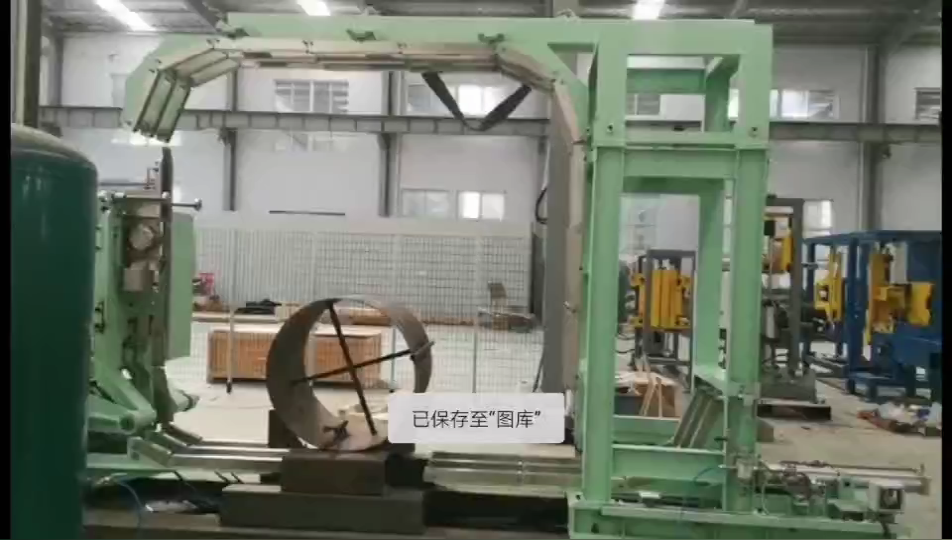
This compact version suits light slit coils. A green tilting frame presents each coil, an eye-through wrapper with a roller table wraps it lying flat, and the wrapped coils are stacked flat on a wooden pallet.
Table of Contents
- Why tilt, wrap and stack in one line
- The three stations
- Coil range and performance
- Worked example: one pallet of slit coils
- Manual-assist or fully automatic
- Selection checklist
- Safety: EN 415-10, ISO 12100 and ISO 13849
- Engineering FAQ
- Next step
- Related reading
- Sources
Why tilt, wrap and stack in one line
A slitter turns one master coil into many narrow coils in a few minutes. If each narrow coil is then lifted, turned, wrapped and stacked by hand, packing becomes the bottleneck and edges get damaged. A line that links the three steps keeps pace with the slitter and touches each coil fewer times.
The order matters. A slit coil leaves the slitter eye-horizontal. It is wrapped and stacked eye-vertical, lying flat, because a flat narrow coil is stable and its edges are protected. The tilter makes that change once, at the start, so the wrapper and the stacker both work on a flat coil.
The three stations
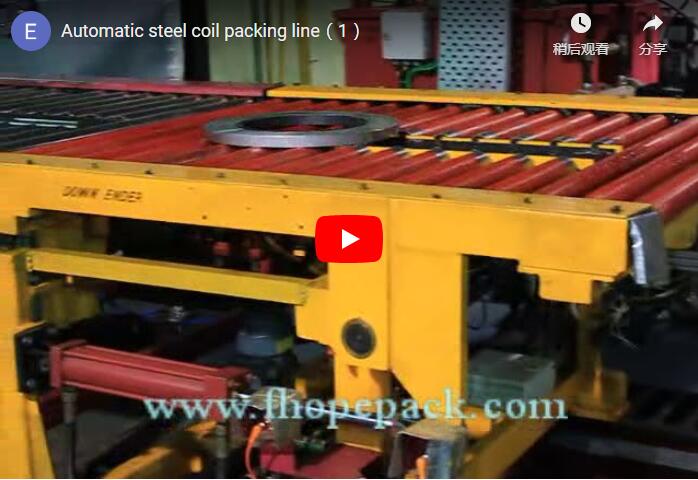
Tilter. The tilter takes the coil eye-horizontal and lays it flat onto the line. On heavier lines a turnstile and a hydraulic down-ender do this job. On light lines a tilting frame does it with less hardware.
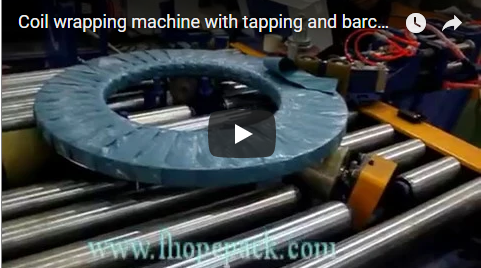
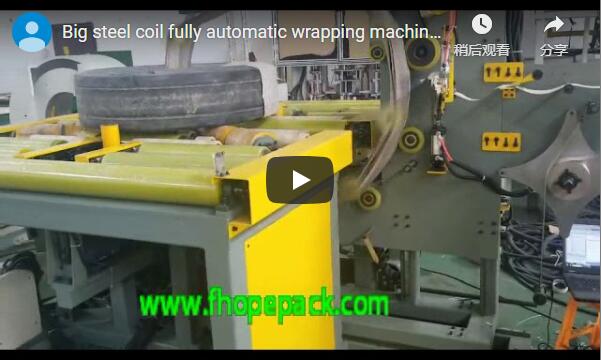
Eye-through wrapper. The coil lies on a roller conveyor table. The wrapping ring passes through the coil eye and around the section while the rollers turn the coil, so the film or paper covers the full ring. Ring speed and roller speed are set by inverter, and wrapping tension is adjustable. Stretch film, VCI paper or woven fabric can be used.
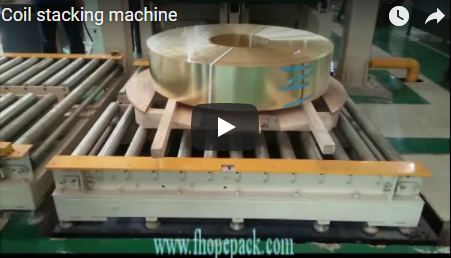
Stacker. The stacker moves each wrapped coil onto the pallet and builds the stack one coil at a time. On automatic lines the stacker head is chosen for the coil. An electromagnetic head suits carbon steel only, because austenitic stainless, copper and aluminium are not magnetic. For those metals we use a vacuum head or a gripper arm. Strapping, weighing and labelling stations can be added between wrapper and stacker.
Coil range and performance
| Item | Narrow slit coils |
|---|---|
| Coil weight | 30–4,000 kg |
| Outer diameter | 500–1,500 mm (extendable to 2,100 mm) |
| Inner diameter | 300 / 508 / 610 mm |
| Strip width | 8–500 mm |
| Packing speed | 20–40 coils/h |
| Strapping cycle (with the optional radial strapping station) | ≤ 15–38 s per strap |
| Control | Siemens S7-1200 / S7-1500F |
Pallet size, stack height and the wrapping material are set for your coils and confirmed at quote.
Worked example: one pallet of slit coils
Take a steel slit coil with OD 800 mm, ID 508 mm and width 60 mm. Steel density is 7,850 kg/m³.
| Step | Calculation | Result |
|---|---|---|
| Ring area | π/4 × (0.80² − 0.508²) | 0.300 m² |
| Steel volume | 0.300 × 0.060 | 0.018 m³ |
| Coil weight | 0.018 × 7,850 | about 141 kg |
| Inside narrow range? | 30–4,000 kg, OD 500–1,500 mm, width 8–500 mm | yes |
| Pallet of 8 coils | 8 × 141 kg | about 1,130 kg |
| Metal stack height | 8 × 60 mm | 480 mm plus packaging |
| Time per pallet | 8 coils at 20–40 coils/h | 12–24 min |
Result. Because this coil falls in the lighter part of the narrow range, a compact line configuration meets the output. Check the pallet rating against about 1.13 t, and add the wrap and any separators to the 480 mm stack height before fixing the stack count.
Manual-assist or fully automatic
| Point | Manual-assist line | Fully automatic line |
|---|---|---|
| Coil turning | Tilting frame, operator positions coil | Turnstile and hydraulic down-ender |
| Wrapping | Eye-through wrapper, operator starts cycle | Eye-through wrapper in PLC sequence |
| Stacking | Assisted stacking onto pallet | Electromagnetic, vacuum or gripper-arm stacker |
| Best fit | Light coils, moderate output | Mainstream 1–4 t coils, output matched to the slitter |
The manual-assist layout costs less and fits light coils. Once coil weight or output rises, automatic turning and stacking take the operator out of the lifting steps.
Selection checklist
- Coil weight, OD, ID and width range.
- Coils per hour from the slitter.
- Material and surface: steel, stainless or non-ferrous, and how sensitive the edges are.
- Wrapping material: stretch film, VCI paper or woven fabric.
- Pallet size, stack height and separators.
- Strapping, weighing and labelling needs, and floor space.
Safety: EN 415-10, ISO 12100 and ISO 13849
The line is assessed to ISO 12100 and built to the packaging machine safety series EN 415-10. Safety functions such as E-stops, interlocked guards and optional light curtains or scanners are designed to ISO 13849. The machines are CE marked and built under ISO 9001.
Engineering FAQ
Q: Why are slit coils stacked flat? A: A narrow coil lying flat is stable and its edges are protected. Standing narrow coils on edge risks rolling and edge damage.
Q: Can the line wrap with VCI paper instead of film? A: Yes. Stretch film, VCI paper and woven fabric are all options on the eye-through wrapper.
Q: How fast does the line run? A: 20–40 coils per hour for narrow slit coils. At that rate each coil has 90–180 s across tilting, wrapping and stacking, so the slowest station sets the line rate. Supply power and air are confirmed at quote with the layout.
Q: What warranty applies? A: Two years.
Next step
- Send your coil weight, OD, ID and width range to info@fhopepack.com.
- We match the tilter, wrapper and stacker to your output.
- We reply within 24 hours with a layout and quotation.
Related reading
- Slit coil handling and packaging line (product)
- Automatic coil packaging line with turnstile and stacker (product)
- Automatic slitting coil packing line
- Multipurpose automatic coil tilter with slide table
Sources
- FHOPE product pages: slit coil handling and packaging line; automatic coil packaging line
- EN 415-10; ISO 12100:2010; ISO 13849-1
- Our coil packing line shown above
Last reviewed: 2026-10-19