Executive summary Eye-through wrapping passes film through the centre of a coil and round its wall, so the whole coil is covered, inside and out. Our coil packaging machine does this with a ring that opens to take the coil, while rollers turn the coil slowly so the film builds up all the way round. Wraps follow from the outside diameter and the overlap set there. Both are set per project.
Table of Contents
- What the video shows
- How eye-through coil wrapping works
- Estimating wraps per coil
- Film, paper or both
- Controls and safety
- Selection checklist for an eye-through coil wrapper
- Engineering FAQ
- Next step
- Related reading
- Sources
What the video shows
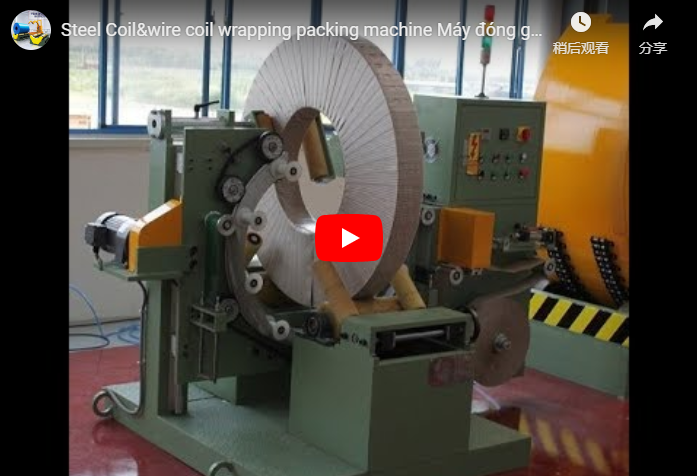
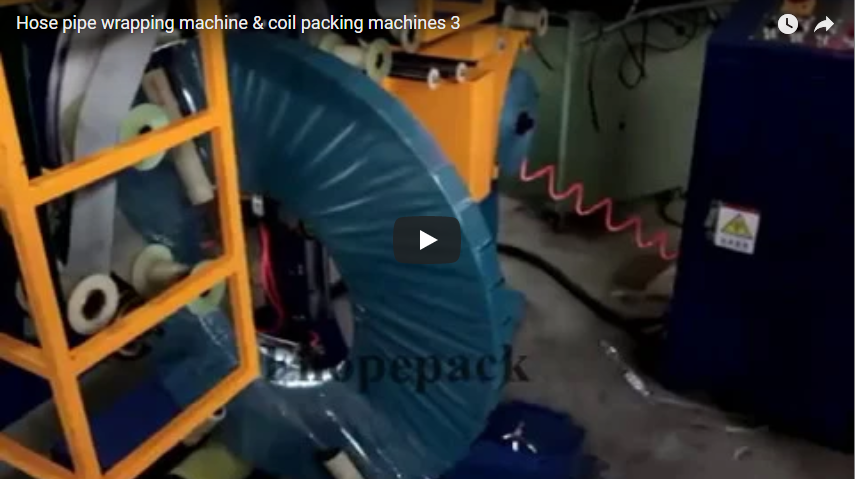
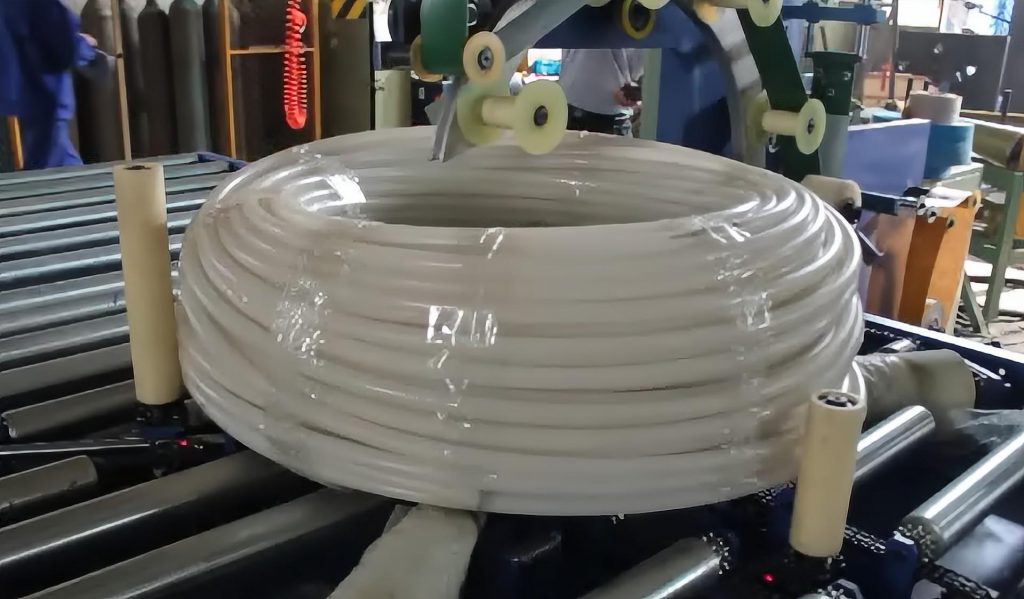
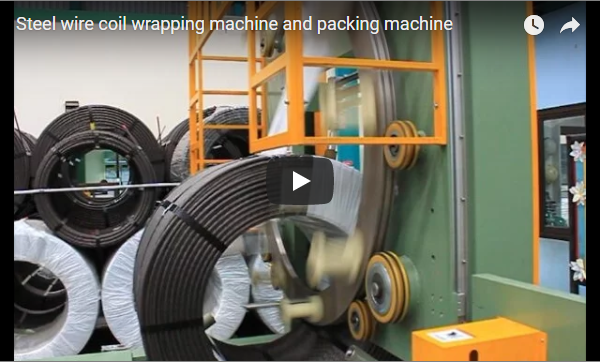
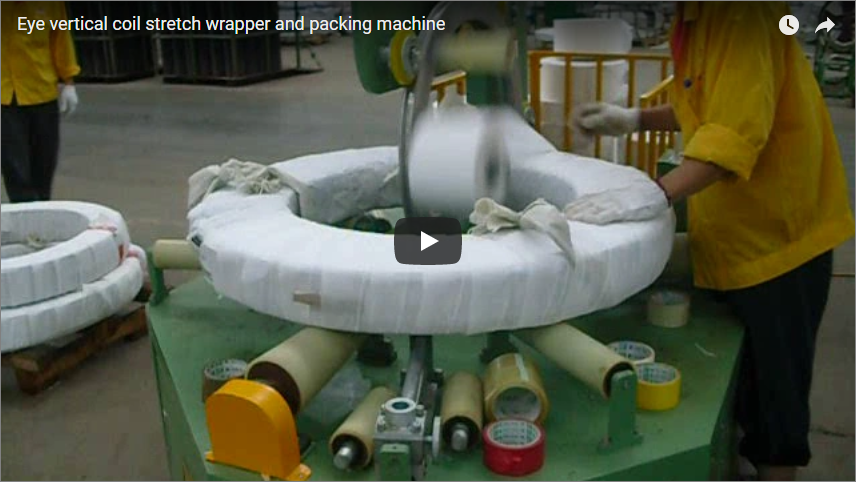
An operator sets a coil upright on the support rollers of our green coil wrapper. The ring passes through the coil’s eye and carries the film roll round the coil wall.
As the ring turns, the rollers turn the coil slowly, and blue film builds up round it. The operator steps away and the machine runs on its own until the coil is fully covered. A control cabinet with a signal tower stands beside it, and the fhopepack.com mark runs along the foot of the clip.
How eye-through coil wrapping works
| Step | What happens |
|---|---|
| Load | The coil is stood on its edge on the support rollers |
| Ring through the eye | The ring opens, passes through the coil eye and closes |
| Wrap | The ring carries film round the coil wall |
| Coil turn | The rollers turn the coil so each wrap is laid next to the last |
| Finish | The film is cut and the coil lifted off |
Two motions work together: the ring wraps round the wall, and the coil turns. Their speed ratio sets the overlap.
Estimating wraps per coil
The wraps are closest together at the inside diameter and furthest apart at the outside, so full cover is worked out at the outside. Illustrative example for a coil with 508 mm ID, 1,000 mm OD and 300 mm width, wrapped with 100 mm film at half overlap on the outside:
| Item | Value |
|---|---|
| OD circumference, π × 1,000 | about 3,142 mm |
| Advance per wrap at the OD, half of 100 mm | 50 mm |
| Wraps for full cover, 3,142 ÷ 50 | about 63 |
| Advance at the ID, 1,596 mm ÷ 63 | about 25 mm |
| Coil wall, (1,000 − 508) ÷ 2 | 246 mm |
| Section perimeter, 2 × (246 + 300) | 1,092 mm |
| Film laid, 63 × 1.092 m | about 69 m |
At the inside the same wraps sit much closer, so the eye gets several layers. That is why the inside is rarely the weak point.
Film, paper or both
| Wrap | Use |
|---|---|
| Stretch film | Keeps out dust and damp |
| VCI paper or film | Slows rust on steel coils |
| Woven tape | Tougher cover for rough handling |
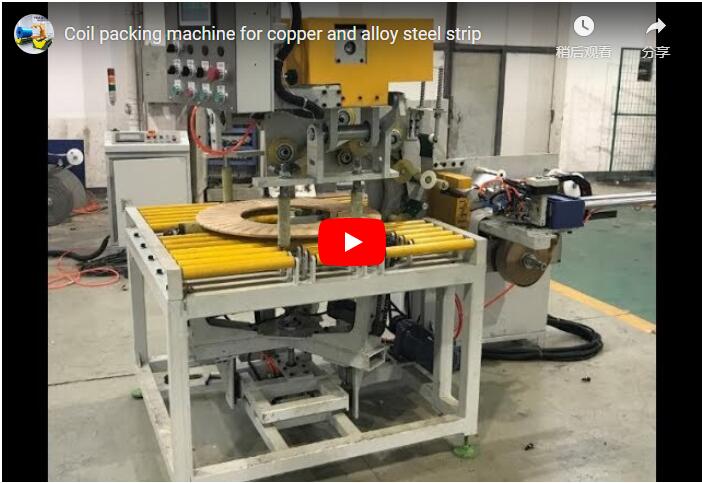
Copper coils mainly need dust and moisture cover. Steel coils for long transit often get a VCI layer under the film.
Controls and safety
The ring and the coil both turn during wrapping. Keep hands clear of the ring opening and the support rollers, and stop the machine before lifting a coil on or off.
The standards that apply depend on the destination market. For CE markets, ISO 12100 sets the risk-assessment method and EN 415-10 sets general requirements for packaging machines.
Selection checklist for an eye-through coil wrapper
- Coil ID, OD, width and weight.
- Steel, copper or other material.
- Coils per hour.
- Film, paper or tape, and how many layers.
- How coils are loaded and unloaded.
- Signal and control needs.
Engineering FAQ
Q: What is eye-through wrapping? A: Film passes through the coil centre and round the wall, covering the coil inside and out.
Q: Why is overlap set at the outside diameter? A: That is where wraps sit furthest apart. Set the overlap there and the inside is covered too.
Q: How many wraps does a coil need? A: OD circumference divided by the advance per wrap. Our 1,000 mm OD example needs about 63.
Q: Does it suit copper and steel? A: Yes. The film type changes: VCI layers are common on steel for long transit.
Q: Does the operator stay at the machine? A: In the video the operator loads the coil, then the machine runs on its own.
Next step
We plan your coil wrapper in three steps:
- Submit your layout drawing with coil sizes and output to info@fhopepack.com.
- Receive a proposal within 48 hours, with the wrap and film plan.
- Book a site survey to check the loading method and floor space.
Related reading
- Automatic coil packing line
- Steel coil strapping machines
- Video: coil wrapping machine with movable trolley
Sources
- Machine content: FHOPE engineering team, 2026-10-04
- Wrap example: our worked example, illustrative values
- Machine in action: our video on YouTube
- Standards scope: ISO 12100:2010, EN 415-10:2014
Last reviewed: 2026-10-04