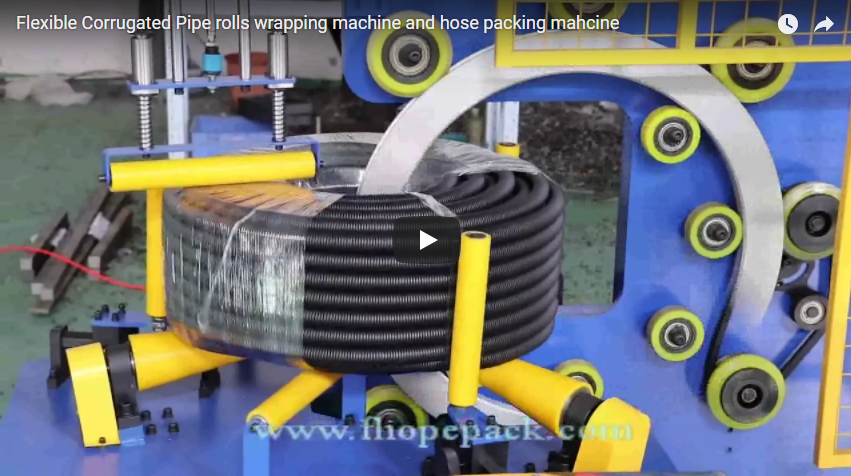
Executive summary Corrugated hose coils are springy, so they must be held flat while film goes on or the turns spread. Our wrapping machine in this video holds a black corrugated hose coil in the wrapping station on a blue frame, presses it from above with two white rollers and wraps it in clear film. The passes needed follow from the coil OD and the film overlap. We set both per project.
Table of Contents
- What the video shows
- How the hose coil wrapper works
- Wrap passes and film overlap per coil
- What to tell us about your hose
- Controls and safety
- Selection checklist for a hose coil wrapping machine
- Engineering FAQ
- Next step
- Related reading
- Sources
What the video shows
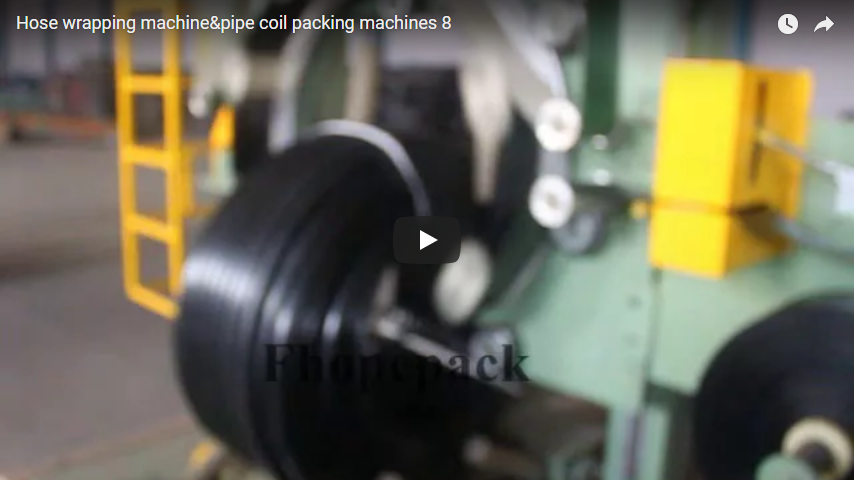
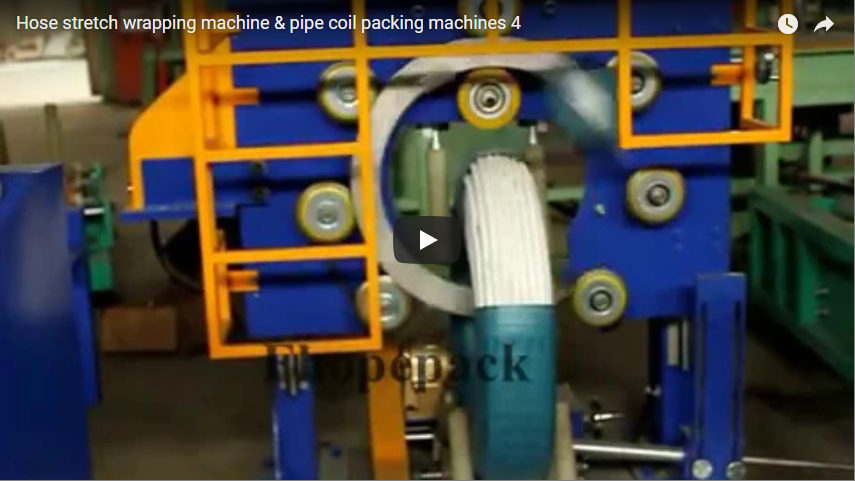
A black corrugated hose coil sits in the wrapping station of our blue-framed machine. The white press unit above it, with two white rollers, comes down onto the top of the coil.
The coil starts to turn and clear film from the white reel above wraps round it in a spiral, while yellow support arms and rollers guide it. When the coil is covered, the press unit lifts and the machine returns to its start position. The www.fhopepack.com watermark runs in the corner of the clip.
How the hose coil wrapper works
| Step | What happens |
|---|---|
| Load | The hose coil is set in the wrapping station |
| Press | The white roller press comes down on the coil |
| Wrap | The coil turns and film wraps round it in a spiral |
| Release | The press lifts when the coil is covered |
| Unload | The wrapped coil is taken off |
The roller press holds the springy turns flat, so the film goes on a coil that keeps its shape. For smooth-wall pipe coils, see our HDPE pipe coil and hose wrapping machine; for press-down devices on long loads, see our horizontal ring orbital stretch wrapping machine.
Wrap passes and film overlap per coil
Passes depend on the coil circumference and the advance per pass. Illustrative example:
| Item | Value |
|---|---|
| Coil OD (illustrative) | 1,000 mm |
| Circumference, π × 1,000 | about 3,142 mm |
| Film width (illustrative) | 100 mm |
| Advance per pass at 50% overlap | 50 mm |
| Passes, 3,142 ÷ 50 | about 63 |
We set overlap at the OD, where it is lowest; the inside of the coil always gets more.
What to tell us about your hose
| Item | Why it matters |
|---|---|
| Hose OD and corrugation | Sets the press roller force |
| Coil OD, ID and height | Sets the station and ring size |
| Coils per hour | Sets the wrap speed |
| Film type | Clear, coloured or UV-resistant |
| Label or tag | Fitted before or after wrapping |
Softer hose needs less press force, so we set it on trial with your coils.
Controls and safety
The coil turns, the press comes down and the film ring moves during the cycle. Keep hands out of the coil and press area while the machine runs, and load and unload only with it stopped.
The standards that apply depend on the destination market. For CE markets, ISO 12100 sets the risk-assessment method and EN 415-10 sets general requirements for packaging machines.
Selection checklist for a hose coil wrapping machine
- Hose OD, material and corrugation.
- Coil OD, ID and height.
- Coils per hour.
- Film type and overlap.
- Manual or conveyor loading.
- Floor space and power supply.
Engineering FAQ
Q: Why press the coil before wrapping? A: The roller press holds the springy turns flat so the coil keeps its shape.
Q: How many passes does a coil need? A: Circumference at the OD divided by the advance per pass: about 63 for a 1,000 mm OD coil with 100 mm film at 50% overlap in our example.
Q: Where is overlap set? A: At the OD, where it is lowest.
Q: Can press force be adjusted for soft hose? A: Yes. We set it on trial with your coils.
Q: What happens at the end of the cycle? A: The press lifts and the machine returns to its start position.
Next step
We plan your hose coil wrapping machine in three steps:
- Submit your layout drawing with hose and coil sizes and output to info@fhopepack.com.
- Receive a proposal within 48 hours, with the wrap and press plan.
- Book a site survey to check the loading method and floor space.
Related reading
- Pipe packing machines
- Video: flexible corrugated pipe rolls wrapping machine
- Video: double wall corrugated hose coiling and strapping machine
Sources
- Machine content: FHOPE engineering team, 2026-10-04
- Pass example: our worked example, illustrative values
- Machine in action: our video on YouTube
- Standards scope: ISO 12100:2010, EN 415-10:2014
Last reviewed: 2026-10-04