Executive summary Our copper strip coil packing line takes slit coils from the slitter, weighs and labels them, wraps each coil through the eye, and stacks the finished coils on a pallet. The line handles coils of 500 to 1,200 mm OD and 10 to 300 mm width at 40 to 60 coils per hour, with one operator for the whole line.
Table of Contents
- The stations, in order
- Copper strip coil packing line: coil range and materials
- Weighing and labelling: why they sit before the wrap
- Worked example: takt time and pallet changes
- Protecting a soft copper surface
- Selection checklist: what to send us
- Safety: EN 415-10 and the robot cell
- Engineering FAQ
- Next step
- Related reading
- Sources
The stations, in order
Slit copper strip coils leave the slitter small, numerous and easy to dent. The line is built to keep them moving without a person lifting each one.
- Coil tilter and down-ender: turns the coil to the orientation the line needs and sets it on the conveyor.
- Conveyor line: variable-speed roller conveyors move coils eye-to-sky between stations.
- Weighing and labelling: each coil is weighed, and a label can be printed and applied as an option.
- Strapping: where the order calls for it, the coil is strapped with PP or PET strap.
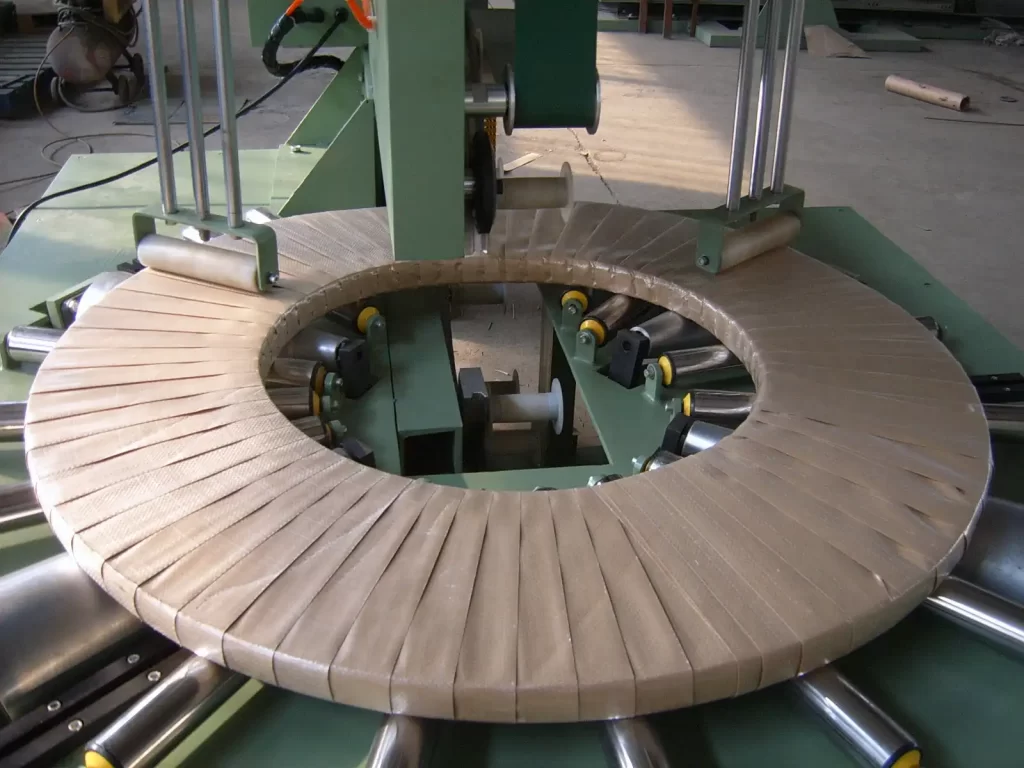
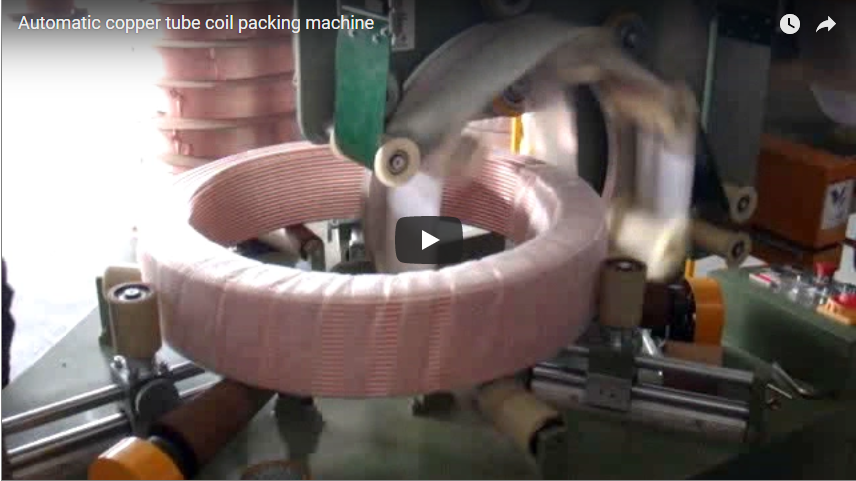
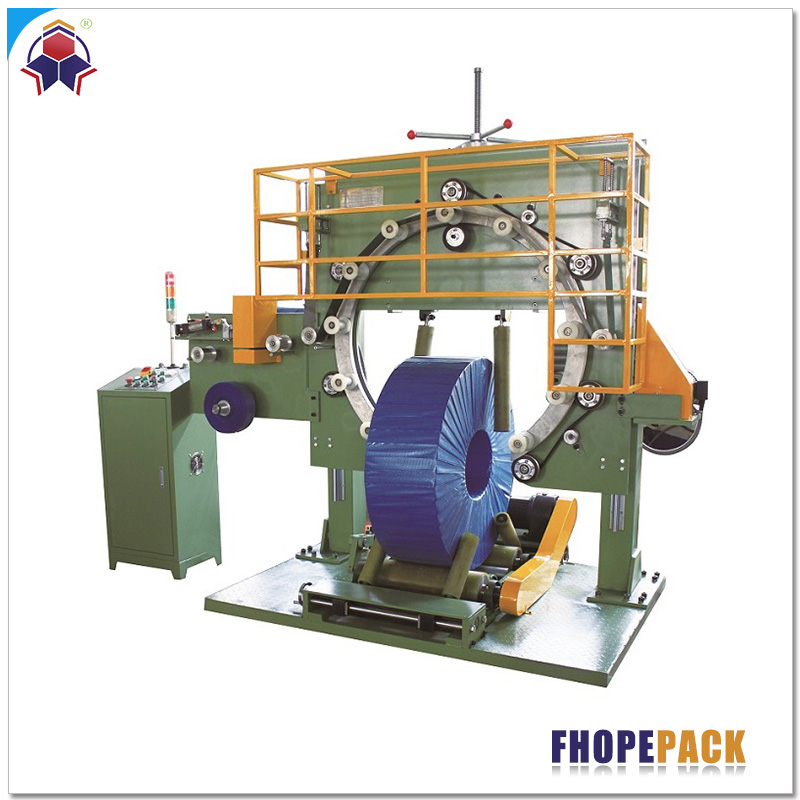
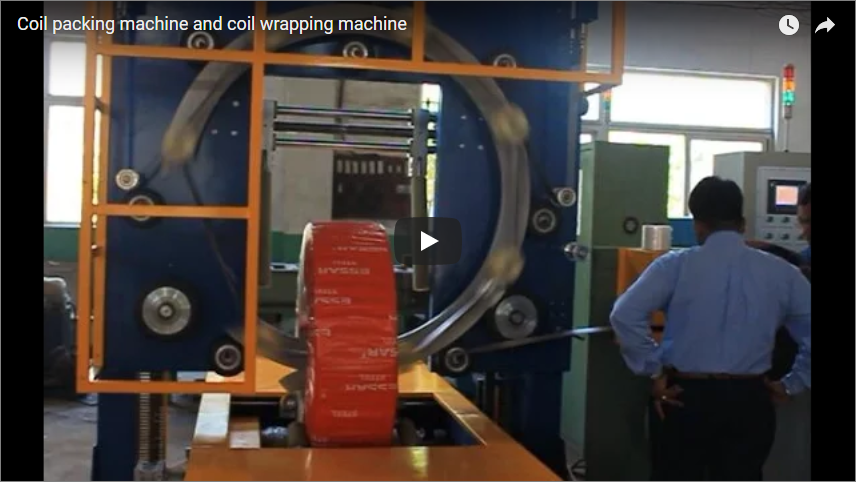
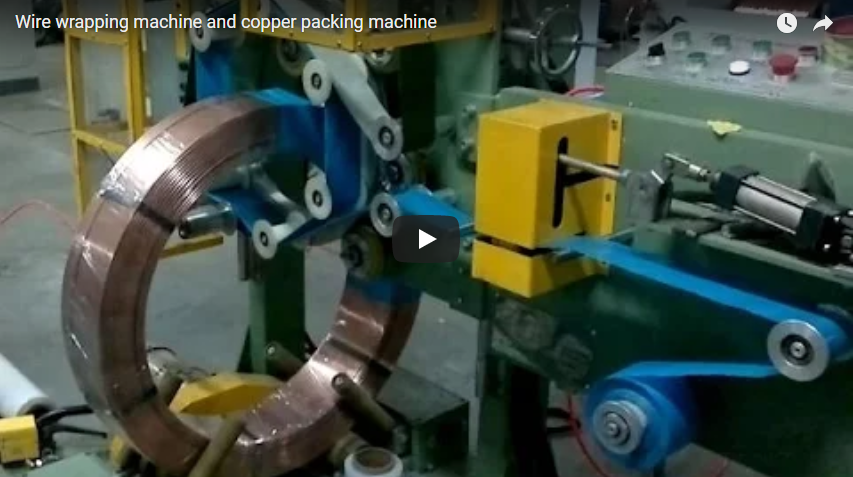
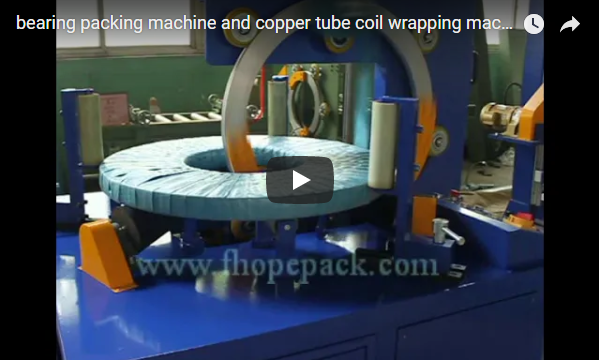
- Coil wrapping machine: a ring passes through the coil eye and around the coil, laying stretch film, PE or paper over every face.
- Coil stacker and pallet wrapper: the stacker places finished coils on the pallet, and the pallet is wrapped for shipping. An automatic timber runner dispenser is an option, so spacers go between layers without manual handling.
A Siemens PLC and HMI run the line in automatic or manual mode, so a single station can be run by hand during changeover.
Copper strip coil packing line: coil range and materials
| Item | Our copper coil packing line |
|---|---|
| Coil OD | 500 to 1,200 mm |
| Coil ID | 300 to 610 mm |
| Coil width | 10 to 300 mm |
| Packing speed | 40 to 60 coils per hour |
| Strapping | PP or PET |
| Paper | core ID 50 mm, roll OD 450 mm, width 90 to 120 mm |
| Stretch film | core ID 50 mm, roll OD 100 to 180 mm, width 90 to 120 mm |
| Weighing | available |
| Label | option |
| Stacking accuracy | within ±2 mm |
| Operators | one for the whole line |
| Power supply | per requirement |
The coil weight range depends on the configuration: a basic line covers 20 to 1,500 kg, and a standard fully automatic line 100 to 4,000 kg.
Weighing and labelling: why they sit before the wrap
A label that goes on before the final wrap stays readable through clear film and is protected from scuffing in transport. Putting the scale in the same station means the weight on the label is the weight of that coil, not a batch average. Where the plant runs an MES, the coil number, weight and label data can pass to it, so each coil on a pallet can be traced back to its slit run.
Our automated copper coil packaging line from upending to stacking follows the same order.
Worked example: takt time and pallet changes
| Step | Value |
|---|---|
| Packing speed, low end | 40 coils per hour |
| Takt time per coil, 3,600 ÷ 40 | 90 s |
| Packing speed, high end | 60 coils per hour |
| Takt time per coil, 3,600 ÷ 60 | 60 s |
| Coils per pallet (illustrative) | 8 |
| Pallet change interval at 40 coils/h, 8 × 90 | 720 s = 12 min |
| Pallet change interval at 60 coils/h, 8 × 60 | 480 s = 8 min |
| Coils per 8-hour shift, 40 × 8 to 60 × 8 | 320 to 480 |
Every station has to finish its job inside the takt time, so the slowest station sets the line speed. A pallet change every 8 to 12 minutes is also the rhythm the forklift or pallet conveyor at the end of the line has to keep.
Protecting a soft copper surface
Copper and brass strip mark easily, and a dent at the edge of a coil can mean a rejected coil at the customer. All contact parts on the line are PU coated, so rollers, grippers and the stacker do not scratch the coil. Paper or PE under the film adds a further layer where the customer asks for it.
Selection checklist: what to send us
- Coil OD, ID, width and the heaviest coil.
- Coils per hour from the slitter.
- Wrapping material: film, PE or paper, and whether you strap.
- Label content and whether you need weighing or MES data.
- Pallet size and coils per stack.
- Floor layout from the slitter exit to the warehouse.
Safety: EN 415-10 and the robot cell
The standards that apply depend on the destination market. For CE markets, ISO 12100 sets the risk-assessment method. EN 415-10 sets the general safety requirements for packaging machines, covering the wrapping ring, conveyors and strapping, and EN 415-6 covers the pallet wrapper at the end of the line.
Where an industrial robot does the stacking, ISO 10218-2 covers the integration of the robot cell, including its guarding.
For each installation, the site risk assessment should decide the guarding around the stacker and wrapping station. Operators should enter the stacking area only with the cell stopped and locked out.
Engineering FAQ
Q: What coil sizes does the line handle? A: Coils of 500 to 1,200 mm OD, 300 to 610 mm ID and 10 to 300 mm width.
Q: How many coils per hour can it pack? A: 40 to 60 coils per hour, which is a takt time of 60 to 90 s per coil.
Q: How many people does the line need? A: One operator for the whole line.
Q: Can it weigh and label each coil? A: Yes: weighing is available, and labelling is an option.
Q: Which safety standards apply? A: For CE markets, ISO 12100 and EN 415-10, EN 415-6 for the pallet wrapper, and ISO 10218-2 where a robot stacks the coils.
Next step
- Email your coil sizes, weights and coils per hour to info@fhopepack.com.
- We reply within 24 hours with a proposal listing the stations and wrapping material.
- We send a layout drawing from the slitter exit to the pallet station.
Related reading
- Automatic copper coil packaging line
- Copper strip coil packaging line
- Automated slit coil packing line for service centres
- Two-stage wrapping and stacking system for copper coils
- Copper tube coil packing and shrinking machine
Sources
- Specifications: FHOPE copper coil packaging line and copper strip coil packaging line product pages
- Machine video: copper strip coil packing line on YouTube
- Takt time and pallet changes: our worked example, illustrative coils per pallet
- Standards: EN 415-10 (packaging machines, general safety); EN 415-6 (pallet wrapping machines); ISO 12100:2010; ISO 10218-2 (robot systems integration)
Last reviewed: 2026-10-17