Executive summary Our radial steel coil strapping machine passes a steel band through the coil eye and around the wall, so the wraps cannot spring loose or telescope. A rotating head and arch turn 360 degrees to place bands at any angle. It takes steel strap from 19 to 32 mm wide and runs in semi-automatic or automatic mode. Circumferential bands round the outside diameter are a separate machine, and many lines use both.
Table of Contents
- Radial or circumferential bands
- How the radial machine works
- Work out band length
- Protecting the coil edges
- Machine data
- Utilities and safety
- Selection checklist
- Engineering FAQ
- Next step
- Related reading
- Sources
Radial or circumferential bands
| Band | Where it goes | What it holds |
|---|---|---|
| Radial (eye-through) | Through the eye, across both faces and round the wall | Stops the wraps sliding sideways or telescoping |
| Circumferential | Round the outside diameter | Stops the outer wrap unwinding |
A coil that will be lifted, turned or stacked needs radial bands, because handling pushes the wraps sideways. The outer end of the strip is held by circumferential bands. We set the number of each from the coil weight and the transport.
How the radial machine works
The strapping head and arch sit on a rotating unit. The arch passes through the coil eye, the head feeds the steel band round the wall, then tensions and seals it. The unit then turns the head and arch to the next angle and repeats, so one machine places every radial band without moving the coil.
For the joint, we offer two sealless options for steel strap: a notched joint or a welded joint. For lighter coils, a PET strapping head for PET strap up to 32 mm wide is an alternative to steel.
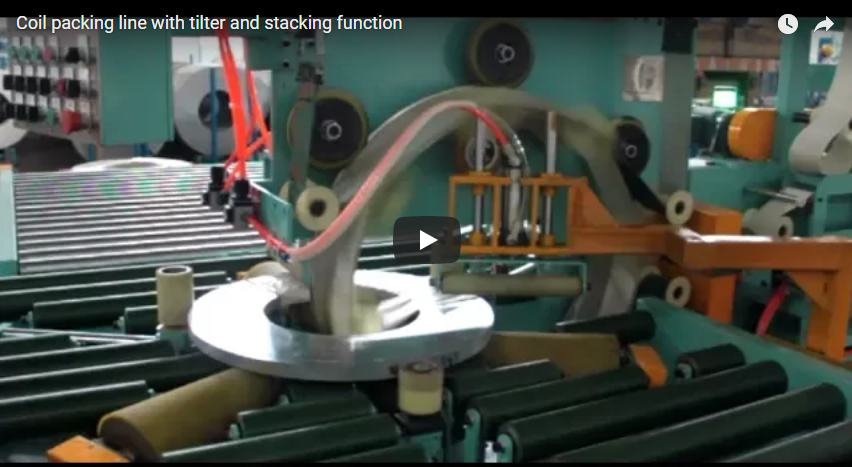
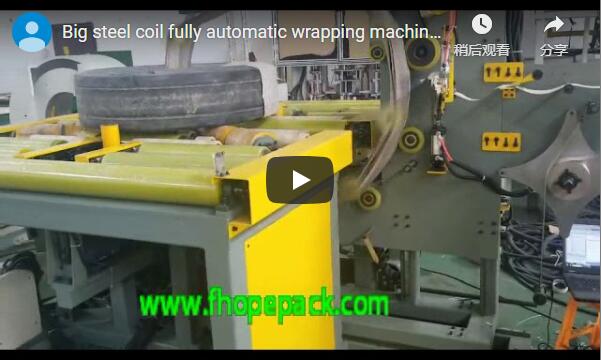
In our video, the gantry lowers the arch through the eye of a large ring while the ring stays still on its support. The head then turns to the next band angle, so the coil never has to be rotated between bands.

Work out band length
One radial band runs along the coil width on the inside and the outside, and across the wall on both faces:
Band length = 2 × width + (OD − ID) + seal overlap.
Illustrative example for a coil of OD 1,500 mm, ID 610 mm and width 1,200 mm:
| Check | Calculation | Result |
|---|---|---|
| Band length before overlap | 2 × 1,200 + (1,500 − 610) | 3,290 mm |
| 4 radial bands | 4 × 3,290 | about 13.2 m |
| Circumferential band | π × 1,500 | about 4.7 m |
We add the seal overlap, the bends at the coil corners and the strap taken up by the tensioner when we plan strap use for a shift.
Protecting the coil edges
A steel band pulled tight over a bare coil edge can cut into it. To stop this, we offer an automatic cardboard or corner protector applicator, which places protective material between the coil and the band before it is tensioned.
Machine data
| Item | Radial steel coil strapping machine |
|---|---|
| Strapping | Eye-through (radial) |
| Head and arch | Rotate 360 degrees |
| Steel strap width | 19–32 mm |
| Coils | Hot-rolled and cold-rolled |
| Modes | Semi-automatic and automatic, with stored programs |
| Strapping head life | Up to 1 million cycles |
| Option | Automatic cardboard or corner protector applicator |
Utilities and safety
The power supply is built to your local supply, and we plan the machine’s link to your coil car and line controls. A steel band under tension stores energy, so we guard the arch and head and keep people out of the band path during the cycle.
The standards that apply depend on the destination market. For CE markets, ISO 12100 sets the risk-assessment method and EN 415-10 sets general requirements for packaging machines.
Selection checklist for a radial coil strapping machine
- Coil OD, ID and width, smallest to largest.
- Heaviest coil weight.
- Number of radial and circumferential bands.
- Steel strap width, from 19 to 32 mm.
- Edge protection needed?
- Coil car or conveyor feed, and line controls.
- Local power supply.
Engineering FAQ
Q: What is radial coil strapping? A: The band goes through the coil eye and round the wall, so the wraps cannot slide sideways.
Q: Do we still need circumferential bands? A: Yes, to hold the outer end of the strip. Circumferential strapping is a separate machine.
Q: What strap width does it take? A: Steel strap from 19 to 32 mm wide. A PET head for PET strap up to 32 mm is an option for lighter coils.
Q: How long is one radial band? A: 2 × width + (OD − ID), plus the seal overlap.
Q: How do we stop the band cutting the coil edge? A: Our automatic applicator places cardboard or corner protectors between the coil and the band before it is tensioned.
Next step
We plan your coil strapping in three steps:
- Submit your layout drawing with your coil list and band pattern to info@fhopepack.com.
- Receive a proposal within 48 hours, with the machine layout and strap size.
- Book a site survey to check the coil car and line link.
Related reading
- Radial steel coil strapping machine
- Circumference steel coil strapping machine
- Radial strip coil strapping machine by PET
Sources
- Radial machine data: radial steel coil strapping machine page
- Circumferential strapping: circumference steel coil strapping machine page
- Machine in action: our steel coil strapping machine video on YouTube
- Standards scope: ISO 12100:2010, EN 415-10:2014
Last reviewed: 2026-10-04