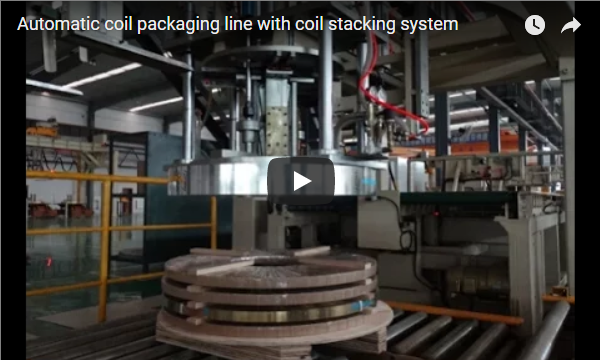
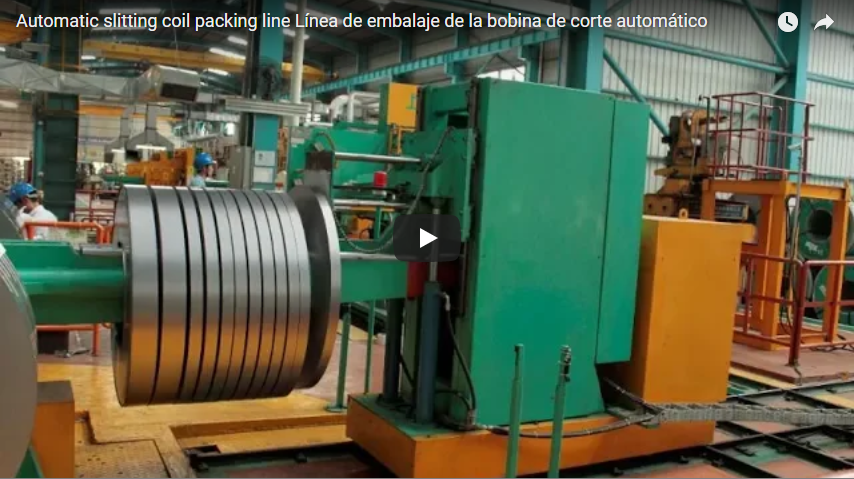
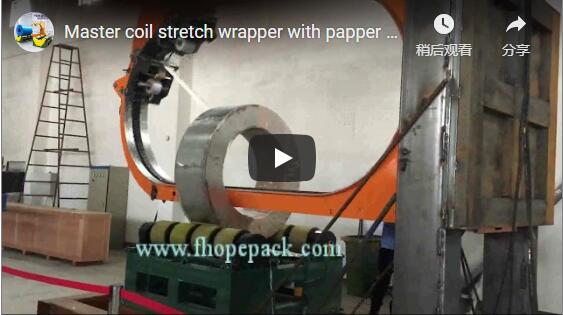
Executive summary This video shows a fully automated coil packaging cycle: a steel coil is conveyed in, clamped, wrapped with film, cut and sealed, then conveyed out — with no manual handling visible. The full cycle shown runs in roughly 30 seconds of footage, and the machine resets itself for the next coil. Use this article to understand what automation delivers, what the footage proves, and what you must confirm with the manufacturer before buying.
Why automation matters for coil packaging
Steel coils are heavy, awkward and abrasive to handle. Manual wrapping and strapping around a coil puts workers close to sharp coil edges, rotating material and repetitive lifting. An automated coil packaging line replaces those steps with a machine sequence: convey, clamp, wrap, cut, and discharge.
The video on this page is a short demonstration of that idea. It does not narrate anything — there is only background music — so what you can trust from it is what the camera shows: one complete automated wrapping cycle on a horizontal steel coil, repeated with a second coil at the end of the clip.
What the video shows
The footage runs about half a minute and follows a single repeatable sequence:
| Time | What happens on screen |
|---|---|
| 0:00–0:04 | A steel coil sits horizontally on a conveyor track in front of the machine; the machine is idle, no indicator lights lit. |
| 0:04–0:08 | The machine starts; the conveyor feeds the coil slowly into the machine while a multi-joint arm on the left moves toward it. |
| 0:08–0:12 | The coil is fully inside; clamps on both sides close and fix the coil; the top wrapping unit begins to rotate. |
| 0:12–0:16 | Film is released from a spool and wound evenly around the coil, working from the bottom upward. |
| 0:16–0:20 | Wrapping continues; roughly two-thirds of the coil height is covered; a green indicator lights on the control panel. |
| 0:20–0:24 | The film end is cut and sealed; clamps open and the conveyor pushes the wrapped coil out to the next station. |
| 0:24–0:28 | The machine resets — the arm returns to its home position and the panel shows standby (yellow). |
| 0:28–0:32 | A new coil enters and the cycle repeats. |
The process, step by step
Breaking the cycle down the way a line engineer would see it:
- Infeed. The coil arrives horizontally, axis parallel to the conveyor, and is fed into the machine at a steady, gentle speed. Smooth infeed matters — a jolted coil can shift before clamping.
- Clamping. Symmetric clamps on both sides close on the coil and hold it still for the entire wrap. The coil does not rotate during wrapping; the wrapping head does the moving.
- Wrapping. A rotating wrap unit at the top pays film off a spool and builds an even layer over the coil surface, from bottom to top, with no visible wobble or bunching.
- Cut and seal. When the wrap is complete, a cutting mechanism at the end of the wrap unit severs the film and the tail is secured — no operator reaches in to finish it.
- Discharge. Clamps open and the conveyor carries the wrapped coil out of the machine.
- Reset and repeat. All components return to start position, and the next coil enters automatically.
This is the core value of automating a coil packaging line: the sequence is identical every cycle, and the operator’s role shrinks to supervision rather than handling.
Machine structure at a glance
From the footage, the machine has these observable components:
| Component | Observed detail |
|---|---|
| Frame | Dark grey painted steel structure, industrial anti-rust finish, long horizontal layout |
| Conveyor | Runs through the machine front-to-back, carries coils in and out |
| Clamps | Symmetric, one each side, close to hold the coil during wrapping |
| Wrapping unit | Rotating drum-type unit at top center, dispenses film from a spool |
| Cut/seal unit | Mounted at the end of the wrapping unit |
| Control arm | Multi-joint arm on the left, dark grey |
| Control panel | Right side of the machine, about 1.2 m high, small LCD screen plus buttons |
The panel layout is typical of packaging machinery: a green start button, a yellow pause button, a red emergency stop on the left of the panel, and indicator lights for running (green), standby (yellow) and fault (red). The screen showed “RUNNING” during the wrap and “IDLE” when the machine reset.
Direct observation notes
- The coil shown is metallic grey with slight reflection; estimated proportions in the footage are roughly 1.2 m diameter and 0.8 m height (estimate from visual scale only — verify actual capacity with the manufacturer).
- The coil stays horizontal and its axis does not change direction through the whole cycle; it is held stationary while the wrap head rotates.
- The wrap builds evenly from the bottom upward, at a steady speed with no visible shaking.
- Film end is cut automatically and secured; no operator intervenes at any point in the cycle.
- Warning signage is visible on the machine side: “DANGER: MOVING PARTS” and “KEEP HANDS CLEAR”, in black on white.
- The red emergency stop button is labelled “EMERGENCY STOP”.
- Hazard areas are marked with yellow-and-black striped warning lines on the floor rather than physical fencing. No light curtain or interlocked gate is visible in the footage.
- A watermark “© 2023 Industrial Automation Solutions” appears in the footage; this indicates the clip’s origin and does not describe the machine itself.
What the video does not show
The clip proves the motion sequence, but a purchase decision needs more. Not observable in this footage:
- Rated throughput (coils per hour)
- Machine model, power supply and motor drive details
- Packaging material specification (film type, width, gauge)
- Minimum and maximum coil dimensions and weight the line accepts
- Maintenance intervals and spare-parts requirements
- Safety certifications (CE, ISO or others)
- Control system brand, PLC model, or communication interfaces (Ethernet, Modbus, etc.)
- Alarm and diagnostics functions
- Installation footprint, noise level, electrical protection rating
- Operator training and after-sales support
Treat every one of these as verify with the manufacturer items.
What to verify with the manufacturer
Before committing to an automated coil packaging line, put these questions in writing:
- What coil diameter, width and weight range does the line handle — and can it handle your full product mix?
- What is the rated cycle time and throughput at your coil size?
- Which packaging materials are compatible (PE film, paper, woven or composite wraps) and what is the consumption per coil?
- What safety package is included — fencing, light curtains, interlocks — beyond the floor marking seen in the video?
- What fault diagnostics, alarm codes and remote monitoring options exist?
- What installation, commissioning, training and local support are provided?
Where a line like this fits
The automated sequence shown suits operations that wrap or strap coils continuously: steel service centers, wire and cable plants, and warehouse/logistics hubs moving coil stock. Typical benefits, all visible in the clip rather than claimed from numbers:
- Consistency. Every coil gets the same wrap pattern, so protection quality stops depending on who is on shift.
- Reduced manual risk. No one stands next to a coil while film is being wound or cut.
- Traceability of state. The panel indicates running, standby and fault conditions, which supports line monitoring.
- Continuous flow. The machine discharges a wrapped coil and takes the next one without pause, as shown by the second coil entering at the end of the footage.
If your volume is lower, a semi-automatic or single-machine setup may be more economical; if your products include more than coils, a broader packaging line may suit better — the related reading below covers both directions.
Safety notes for operators
The footage shows floor warning lines and warning signage rather than physical guarding. Regardless of what your installed configuration includes:
- Keep hands clear of clamps and the wrap head during operation, as the signage states.
- Confirm the emergency stop is reachable from your normal standing position and test it on a schedule.
- Never reach toward the coil while the wrap unit is moving, even if it looks slow.
- If your supplier’s installation adds fencing or interlocks, keep them functional — do not bypass.
Your final safety requirements should match local regulations; confirm the delivered safety package with the manufacturer.
Frequently asked questions
Does the machine wrap the coil automatically from start to finish? In the footage, yes: infeed, clamping, wrapping, cut-and-seal and discharge all happen without an operator. Startup and supervision are operator roles.
How long does one wrap cycle take? The full visible cycle takes about 30 seconds of footage. This reflects the demo, not a rated cycle time — check with the manufacturer for throughput at your coil size.
Does the coil rotate during wrapping? No. The coil is held stationary by the clamps; the wrapping head rotates around it.
What film or strapping material does it use? Not identifiable from the video. Material type, width and compatibility must be confirmed with the manufacturer.
What safety features are included? The video shows an emergency stop, warning signage and floor hazard marking, but no fencing or light curtain. Confirm the safety package for your installation.
Can it handle different coil sizes? The video shows one coil size only. Size range and changeover are check with the manufacturer items.
Source and method
This article is based on the embedded video above. The footage was analyzed frame by frame with a vision model; the video contains background music only, with no narration or speech, so no spoken content was transcribed. All factual statements trace to what is visible in the footage; anything not visible is explicitly marked as to be verified. Dimensions in the report are visual estimates, not manufacturer specifications.
Related reading
- Automatic coil packing line — the full-line view of automated coil packaging
- Coil packing machine — machine-level options for coil packaging
- Steel coil wrapping machine — wrapping solutions for steel coils
- Semi-auto pallet wrapping machine — a lower-volume automation option
- Hose packaging machine — packaging machinery for coiled hose products
Next step
If the sequence in this video matches your packaging requirement, the fastest way forward is to send us your coil dimensions, weight range and target throughput. We will confirm which line configuration fits and provide the specifications the video cannot show. Reach us through our contact page.
Published: 2026-09-03