Executive summary A pipe coil’s worst moment is when its wrap drifts as the film roll runs down. In this guide we review our orbital pipe coil wrapping process: how an orbital ring turns around a stationary coil, how tension is held as the film roll empties, and where the wrapping is laid out so the coil cannot unspool. Pipe coil sizes and film are confirmed per project.
Table of Contents
- Why pipe coils need more than a hand wrap
- The hidden drift in manual wrapping
- The orbital ring
- Laying the coil eye to sky
- Holding tension and trimming the tail
- Feed and buffer
- Typical configuration
- What the video shows
- Selection checklist
- Controls and safety
- Engineering FAQ
- Next step
- Related reading
- Sources and standards
Why pipe coils need more than a hand wrap
A large-diameter polyethylene pipe coil travels for municipal water, gas and industrial lines, and its protective film has to stay intact the whole way. A hand wrap that loosens mid-transit is worse than no wrap, because it lets grit work in under a film the buyer thinks is sealed.
The demand is for a repeatable cover, coil after coil, that survives storage and the truck.
The hidden drift in manual wrapping
The failure starts quietly. As the film roll gets smaller, an operator eases off the brake without meaning to, and the film’s stretch drops with it. One end of the shift gets film that is stretched and thin; the other gets film pulled nearly slack.
That drift shows up twice: film overconsumed on the tight runs, and bundles that loosen and shift on the loose ones.
The orbital ring
We engineer our orbital ring the other way round from a turntable. The coil stays still while a motorized carriage runs around it on a ring, laying film with a pre-stretch that is set and held by the machine.
Because the ring does the moving, the wrap is consistent for a full roll of film and for the next roll after it.
Laying the coil eye to sky
A pipe coil is oriented with its circular face up, so the wrapping ring rotates parallel to the floor around a coil that cannot unspool. This eye-to-sky position is what keeps the coil’s own stored wind from playing out during the wrap.
Holding tension and trimming the tail
Tension is monitored as the cycle runs and the brake is set digitally, so the film holds its stretch whether the roll is full or nearly empty. The tail is then welded to the wrap by a heat cutter, so no loose end flaps in transit; loose ends snag, and snags tear film.
Feed and buffer
The coil rides in eye-to-sky on a flat conveyor with centering guides that hold it from drifting sideways. A short buffer stretch of conveyor lets the wrapper work steadily even when the line ahead briefly outpaces it, so the wrapping cell does not choke the extrusion end.
The wrapped coil then travels to food and beverage processing, HVAC airflow, electrical wiring protection and chemical handling lines. Film gauge, barrier and overlap are selected per project by which of these routes the coil takes, so the bore stays clean to the point of use.
Typical configuration
Figures below are common starting envelopes for this machine class and are confirmed per project.
| Parameter | Typical range, confirmed per project |
|---|---|
| Coil range | outer diameter, width and weight |
| Orientation | eye-to-sky on flat conveyor with centering guides |
| Wrapping | orbital ring with digital tension |
| Pre-stretch | set to film grade and coil |
| Tail | heat-welded to the wrap |
| Electrical supply | 380 V three phase 50 Hz, or 220 V single phase for light stations, selected per project to the plant supply |
What the video shows
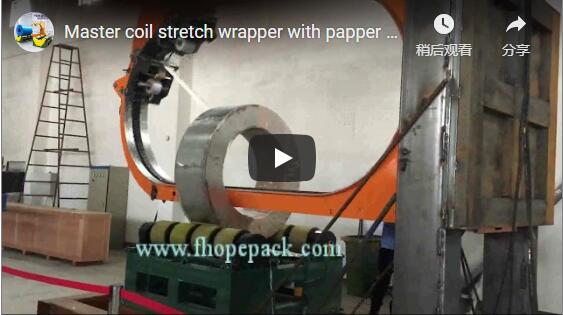
Our footage shows a pipe coil being wrapped by an orbital ring on a conveyor, with the coil held eye-to-sky. It is a general demonstration, so coil range, film and layout for your plant are confirmed with us per project.
Selection checklist
| Question | Confirm per project |
|---|---|
| Heaviest and widest coil | ring and conveyor envelope |
| Film in use | pre-stretch and trim settings |
| Line pace | buffer length needed |
| Coil orientation | eye-to-sky infeed with centering guides |
| Applications | film duty for your route |
| Electrical supply | voltage, phase and frequency on site |
Controls and safety
The wrapper runs from a control panel with an emergency stop at the operator position and guarding around the ring while it rotates. Keep hands clear of the ring, conveyor and heat cutter while the cycle runs. Routine checks cover the ring carriage, tension monitoring, cutter and guards, per the machine manual.
Engineering FAQ
Q: Why does tension drift on a manual wrap? A: As the film roll empties, a hand brake gets eased off, and the film stretches less with every coil. A machine sets the tension digitally instead.
Q: Why wrap the coil eye-to-sky? A: With the circular face up, the ring rotates parallel to the floor around a coil that cannot unspool during the cycle.
Q: What stops the film tail from catching? A: A heat cutter welds the tail to the wrap, so no loose end flaps and snags in transit.
Q: Does it keep pace with the extrusion line? A: A short buffer conveyor lets the wrapper work steadily even when output ahead briefly outpaces it.
Q: What coil sizes are covered? A: We configure machine frames to standard pipe coil classes, with the exact ring opening, conveyor drive and tension range confirmed per project.
Next step
- Email us at info@fhopepack.com with your coil sizes, film and line pace.
- We send an orbital wrapping proposal and a layout drawing within 48 hours.
- We arrange a site survey to confirm floor and services.
Related reading
- Tube bagging machine
- Wire coil wrapping and packing: technology and best practices
- Steel coil tilter with customized service
- FHOPE packing machinery product lines
Sources and standards
- ISO 12100:2010 — Safety of machinery. General principles for design, risk assessment and risk reduction
- EN 415-10:2014 — Safety of packaging machines. General requirements
- EN ISO 13849-1:2023 — Safety of machinery. Safety-related parts of control systems
- FHOPE orbital pipe coil wrapping demonstration video. Reviewed as a general demonstration; coil range, film and layout confirmed per project.
Last reviewed: 2026-10-10