Executive summary
A manual horizontal wrapping machine has a film ring that spins round a long product while the operator pushes the product through by hand. It suits small workshops wrapping timber strips, profiles, bars and tubes in modest numbers, where a full conveyor line would not pay back. Our S300 wraps packs up to 300 mm across and from 1,000 mm long with 120 mm film, at up to 100 r/min. Below: how hand feeding works, how it compares with conveyor feeding, the data, and a worked film example.
Table of Contents
- What a manual horizontal wrapper is
- How hand feeding works
- Manual feed vs conveyor feed
- Machine data
- Worked example: a timber strip
- Good practice
- Selection checklist
- Safety: EN 415-10 and ISO 12100
- Engineering FAQ
- Next step
- Related reading
- Sources
What a manual horizontal wrapper is
A horizontal (orbital) wrapper turns a ring carrying a film roll round the product, so the film spirals along it as the product moves through. “Manual” refers to the feed: there is no powered conveyor, and the operator sets the pace by pushing the product through the ring. The ring itself is motor-driven.
It is the simplest way to put an even spiral of film on long, narrow goods: timber strips and mouldings, aluminium and PVC profiles, steel bars, tubes and cable trunking.
How hand feeding works
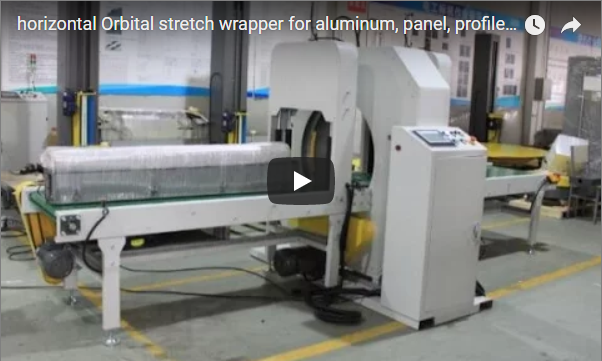
The ring and film roll sit inside a white upper housing. An arc of yellow rubber-covered rollers guides the product through the centre, so it stays in line while the ring turns. The operator starts the ring at the panel, lays the front of the pack on the infeed and pushes it through at a steady walking pace. The film catches the leading end and spirals along the pack as it moves.
When the tail leaves the ring, the operator stops the ring and cuts the film by hand. Feeding faster opens the spiral; feeding slower closes it. Hand pace varies with fatigue and pack weight, so set the overlap with a margin, and use roller stands and a speed mark on the infeed to keep it steady.
Manual feed vs conveyor feed
| Point | Manual feed (S300) | Conveyor feed (economic orbital wrapper) |
|---|---|---|
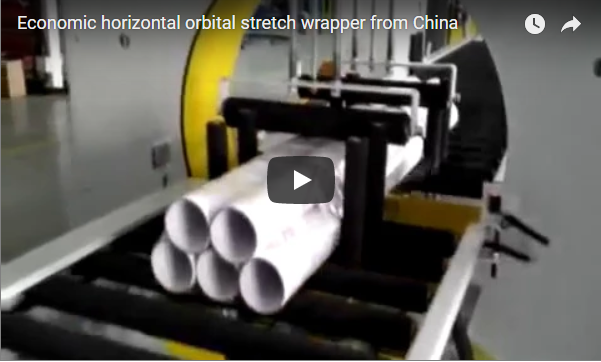
| Pack size | up to 300 mm across, from 1,000 mm long | 50–200 mm across, over 1,500 mm long |
| Feed | operator pushes | entrance and outlet conveyors, 1,000 mm each |
| Feed speed | set by the operator | 4–15 m/min |
| Overlap | set by hand pace | 10–90%, set on the panel |
| Labour | one operator per pack | operator loads and unloads |
| Best for | mixed, low-volume work | steady runs of one size |
If output grows, the same ring principle moves to a conveyor-fed machine.
Machine data
| Item | S300 (manual feed) | Economic orbital wrapper |
|---|---|---|
| Pack diameter | up to 300 mm | 50–200 mm |
| Pack length | from 1,000 mm | over 1,500 mm |
| Ring speed | up to 100 r/min | 20–100 r/min |
| Film width | 120 mm | confirmed at quote |
| Film core | 50 mm | confirmed at quote |
| Film gauge | 25 micron standard in our quotations | 25 micron standard in our quotations |
| Minimum pack size | confirmed at quote with samples | 50 mm |
| Power | confirmed at quote | 1.5 kW; 380 V, 60 Hz |
Worked example: a timber strip
Illustrative pack: a 100 × 50 mm timber strip, 2,400 mm long, wrapped with 120 mm film at 50% overlap, ring at 100 r/min. Each ring turn must cover 60 mm of the pack.
| Check | Calculation | Result |
|---|---|---|
| Advance per turn | 120 × (1 − 0.5) | 60 mm |
| Hand feed speed needed | 60 × 100 | 6,000 mm/min = 6 m/min |
| Ring turns | 2,400 ÷ 60 | 40 turns |
| Wrapping time | 40 ÷ 100 | 0.4 min = 24 s |
| Film per turn | 2 × (100 + 50) | 300 mm |
| Film per strip, before stretch | 40 × 0.3 | 12 m |
Result. About 24 s and 12 m of film per strip at a steady 6 m/min, an easy walking pace. At 30% overlap the advance becomes 84 mm, the feed 8.4 m/min, and the strip takes 29 turns, about 17 s.
Good practice
- Support long packs on stands at both sides, so the operator only pushes and does not lift.
- Keep a steady pace; mark the target speed on the infeed if several people use the machine.
- Tape the film tail to the pack at the start and finish.
- Bundle loose pieces first so they do not spread inside the ring.
Selection checklist
- Largest pack cross-section and shortest length.
- Packs per shift.
- Film width and type.
- Hand feed or conveyor feed.
- Space for infeed and outfeed supports.
Safety: EN 415-10 and ISO 12100
Horizontal wrappers are built to EN 415-10, with the risk assessment done to ISO 12100. With hand feeding the operator stands close to the ring, so the main hazards are the turning ring and the nip at the guide rollers. Guarding is engineered, not left to discipline. A fixed housing encloses the ring. An infeed guide or tunnel extension keeps hands at a safe reach distance from the ring path, sized to ISO 13857 for the pack range.
Stop the ring before cutting the film, and keep the emergency stop within reach.
Engineering FAQ
Q: What size of pack can the manual machine take? A: Up to 300 mm across, from 1,000 mm long.
Q: Who sets the overlap? A: The operator, through the feed pace. At 100 r/min with 120 mm film, 6 m/min gives 50%.
Q: Can it run without an operator? A: No. For unattended feeding, choose a conveyor-fed orbital wrapper.
Q: Which standard applies? A: EN 415-10 for the machine; ISO 12100 for the risk assessment.
Next step
- Send pack sizes, lengths and daily numbers to info@fhopepack.com.
- We match a manual or conveyor-fed wrapper.
- We reply within 24 hours with a proposal and quotation.
Related reading
- Semi-auto orbital wrapping machine S300 (product)
- Economic orbital wrapper (product)
- FHOPE semi-auto orbital wrapper
- Manual orbital stretch wrapper
- Horizontal stretch wrapping machine for bundles
Sources
- FHOPE quotations (film gauge)
- FHOPE product pages: S300 semi-auto orbital wrapper; economic orbital wrapper
- Our manual horizontal wrapping machine shown above
- Worked example: illustrative figures
- Standards: EN 415-10; ISO 12100:2010; ISO 13857
Last reviewed: 2026-10-19