Executive summary Our compact horizontal stretch wrappers spiral film around single aluminum profiles and small bundles as they pass through the ring. Three models cover packages of 50–100 mm, 50–200 mm and 100–300 mm OD. Film width and the ratio of wrapping speed to ring speed decide the overlap, so we size both together.
Table of Contents
- How the profile wrapper works
- Three compact models
- Measuring package OD
- Speed, film width and overlap
- Unmanned film handling
- Utilities and safety
- Selection checklist
- Engineering FAQ
- Next step
- Related reading
- Sources
How the profile wrapper works
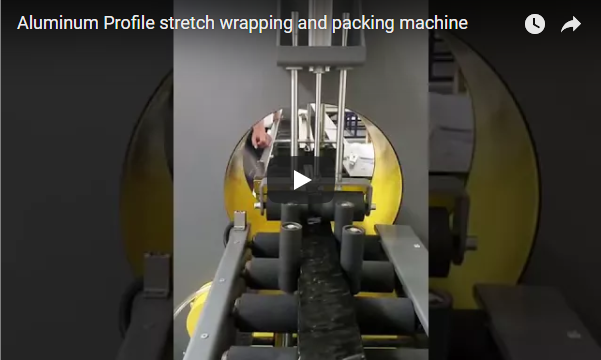
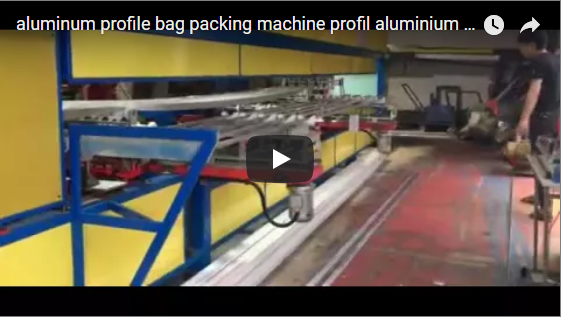
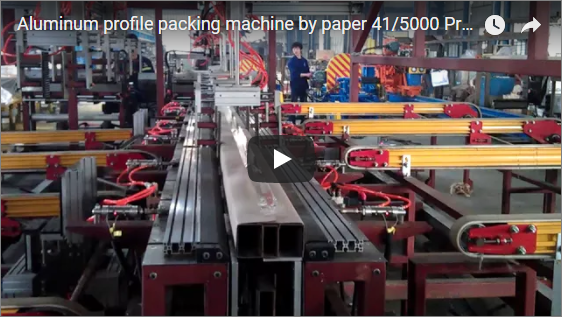
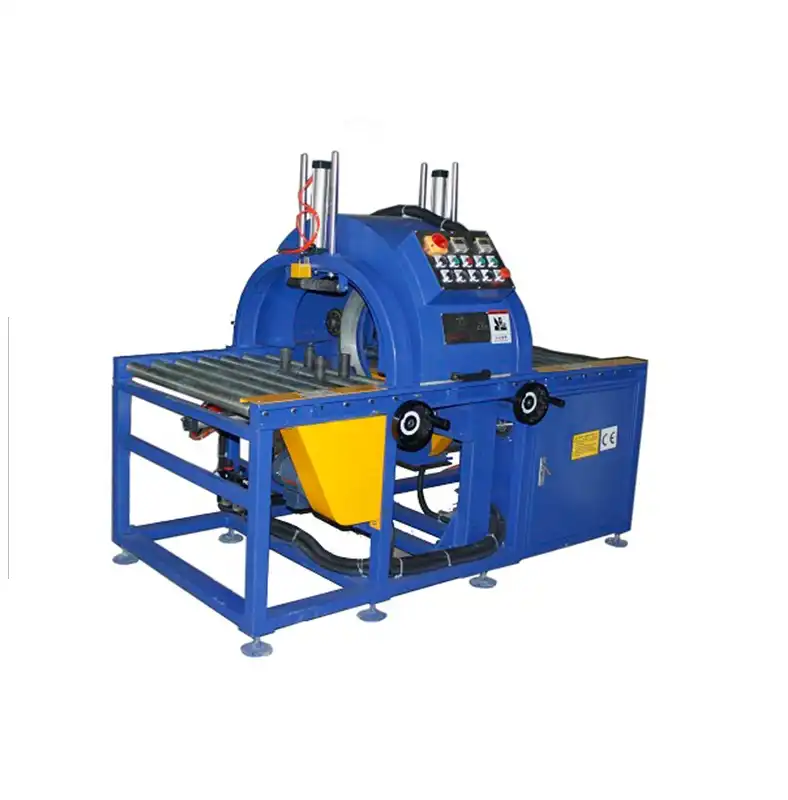
Our horizontal stretch wrapper carries the profile on infeed and outfeed conveyors through a rotating ring. A photocell sensor sets the packing position and cutting time, and the ring lays film around the profile as it moves forward. Guide rollers keep the profile on the conveyor centerline so the ring wraps it evenly. Our video shows a single aluminum profile wrapped this way, with the sensor beam marking its position.
Inverters set the ring speed and the conveyor speed separately. The ring starts and stops softly and returns to its wrapping position automatically, so each profile starts in the same place.
Three compact models
| Parameter | E100 | E200 | E300 |
|---|---|---|---|
| Package OD | 50–100 mm | 50–200 mm | 100–300 mm |
| Package length | over 1,000 mm | over 1,000 mm | over 1,000 mm |
| Weight | 8–100 kg | 8–100 kg | 15–100 kg |
| Ring speed | 20–120 r/min | 10–120 r/min | 20–90 r/min |
| Wrapping speed (through the ring) | 3–15 m/min | confirmed in proposal | 5–15 m/min |
| Infeed/outfeed conveyor speed | 6–12 m/min | 6–12 m/min | 6–12 m/min |
| Film roll width | 50–100 mm | 100–200 mm | 100–200 mm |
| Overlap | 10–90% | 10–90% | 10–90% |
Our pages list the wrapping speed and the infeed/outfeed conveyor speed separately. The E200 page gives no wrapping speed, so we confirm it with your profile. All three use 2,000 mm motorized infeed and outfeed conveyors, and film rolls of 100–200 mm OD on a 50 mm core.
Measuring package OD
Package OD is the diagonal of the profile or bundle cross-section, because the ring has to clear the corners. Illustrative examples:
- 60 × 40 mm profile. √(60² + 40²) = about 72 mm, so the E100 fits.
- 150 × 120 mm bundle. √(150² + 120²) = about 192 mm, so the E200 or E300 fits.
- 250 × 150 mm bundle. √(250² + 150²) = about 292 mm, so the E300 fits.
For bundles larger than 300 mm OD, we move to our aluminum profile wrapper with a larger ring.
Speed, film width and overlap
Advance per ring turn = wrapping speed ÷ ring speed. For 50% overlap (illustrative), the advance must be no more than half the film width:
| Model | Film width | Ring speed | Max advance for 50% | Max wrapping speed |
|---|---|---|---|---|
| E100 | 100 mm | 120 r/min | 50 mm | 6 m/min |
| E300 | 200 mm | 90 r/min | 100 mm | 9 m/min |
So the E100 reaches 15 m/min only at low overlap. Illustrative example: a 6 m profile at 6 m/min takes 1 min of travel, before film cut and transfer. We set the speeds on your profile during a trial.
Unmanned film handling
Each model has an automatic cutter and feeder for unmanned operation. It clamps and feeds the film at the start, then cuts and holds it at the end. Tension is adjusted with a tensioner, and the material frame takes several types of film. As options, the E100 can take a pre-stretch film frame for 100–250% pre-stretch, and the E200 can have PVC, roller or chain conveyors.
Utilities and safety
| Utility | E100 / E200 / E300 |
|---|---|
| Power | about 2.5 kW |
| Power supply | 380 V, 3 phase, 60 Hz; other voltages on request |
| Control | PLC with separate control panel |
| Fault response | indicator alarms automatically when trouble occurs |
Guardrails cover the moving parts. The standards that apply depend on the destination market. For CE markets, ISO 12100 sets the risk-assessment method and EN 415-10 sets general requirements for packaging machines.
Selection checklist for a profile wrapper
- Largest profile or bundle cross-section.
- Shortest and longest length.
- Profiles per hour.
- Film width and overlap needed for surface protection.
- Pre-stretch frame, yes or no.
- Inline after the saw, or standalone.
Engineering FAQ
Q: Which model fits a single 60 × 40 mm profile? A: The E100, because its diagonal of about 72 mm is inside the 50–100 mm window.
Q: Can the E100 wrap at 15 m/min? A: Yes, at low overlap. For 50% overlap with 100 mm film at 120 r/min, the limit is 6 m/min.
Q: Does an operator need to cut the film? A: No. The automatic cutter and feeder clamps, feeds, cuts and holds the film.
Q: How short can a profile be? A: Each model takes packages over 1,000 mm long.
Q: What if our bundles exceed 300 mm OD? A: We move to our aluminum profile wrapper, which takes bundles of 300–1,500 mm OD.
Next step
We size your profile wrapper in three steps:
- Submit your layout drawing with profile sizes and profiles per hour to info@fhopepack.com.
- Receive a proposal within 48 hours, with the model, film width and speeds.
- Book a site survey to fit the wrapper to your line.
Related reading
- E100 horizontal stretch wrapper
- E300 horizontal stretch wrapper
- Aluminum profile wrapping machine
- Video: aluminum rod material wrapper
- Video: aluminum horizontal wrapping machine with spacer feeder
Sources
- E100 data and options: E100 horizontal stretch wrapper page
- E200 data and options: E200 horizontal stretch wrapper page
- E300 data: E300 horizontal stretch wrapper page
- Larger bundles: aluminum profile wrapping machine page
- Machine in action: our aluminum profile stretch wrapper video on YouTube
- Standards scope: ISO 12100:2010, EN 415-10:2014
Last reviewed: 2026-10-04