Executive summary
An aluminum horizontal wrapping machine with spacer feeder wraps a bundle of extruded profiles in stretch film and places wooden spacer blocks under the bundle in the same pass. The blocks give forklift entry and keep the profiles off the floor. Our aluminum profile line takes bundles from 70 × 450 mm up to 300 × 450 mm in section and 5,650 to 6,500 mm long, with one operator at the infeed.
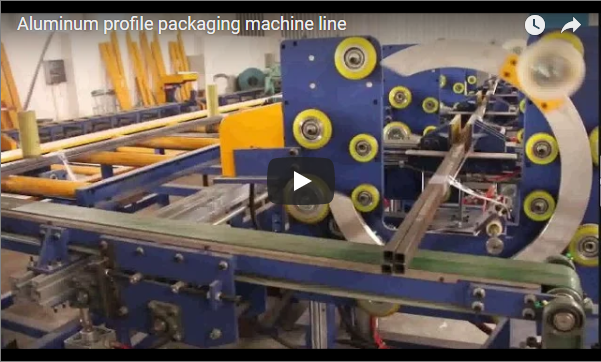
The bundle of bronze-finish profiles travels on a long white infeed conveyor with yellow side posts. A large white orbital ring then wraps it in blue film, and the wrapped bundle leaves on the outfeed conveyor with its head, tail and top covered.
Table of Contents
- Why aluminum profile bundles need spacers and film
- How the spacer feeder works
- Film covering plus orbital wrapping
- Bundle range and wrapper data
- Worked example: a 6 m profile bundle
- Selection checklist
- Safety: EN 415-10 and ISO 12100
- Engineering FAQ
- Next step
- Related reading
- Sources
Why aluminum profile bundles need spacers and film
Extruded profiles are long, light for their size and easy to mark. A bundle lying flat on the floor gives a forklift nothing to lift under, and a fork pushed into the bundle bends profiles. Wooden blocks under the bundle make a gap for the forks. Film holds the bundle together and keeps dust and moisture off the anodised or painted surface.
Placing blocks by hand after wrapping means lifting a 6 m bundle a second time. A spacer feeder places them during wrapping, so the bundle leaves the machine ready to lift.
How the spacer feeder works
The feeder is integrated with the wrapping machine. Wooden blocks are stored beside the machine. The operator selects the bundle length and sets the block quantity, and the device feeds the blocks under the bundle automatically at the final stage of wrapping. The film then passes around both the bundle and the blocks, so the blocks are locked to the bundle.
| Point | Manual spacer placing | Automatic spacer feeder |
|---|---|---|
| When blocks go on | After wrapping, bundle lifted again | During wrapping, in the same pass |
| Block fixing | Loose, or strapped separately | Wrapped in with the bundle |
| Block count and spacing | Depends on the operator | Set by bundle length and block quantity |
| Labour | Extra lift and handling per bundle | One operator at infeed for the line |
Film covering plus orbital wrapping
For a waterproof pack, a whole film sheet covers the top, head and tail of the bundle, and the orbital ring then wraps over it. The ring wrap alone leaves the bundle ends open, so the end covering is what keeps water out of the profile ends.
Other finishes on our horizontal wrappers include partial wrapping and six-sided wrapping. The finish is chosen by how the bundle is stored and shipped.
Bundle range and wrapper data
| Item | Aluminum profile line with timber feeding |
|---|---|
| Minimum bundle | 70 mm high × 450 mm wide × 5,650 mm long |
| Maximum bundle | 300 mm high × 450 mm wide × 6,500 mm long |
| Standard lengths | 5,650 / 6,000 / 6,500 mm |
| Air supply | 6–8 bar |
| Operator | 1, at bundle infeed |
| Pack | Timber feeding, film covering and wrapping |
The example below uses the E600 for ring size and speed formulas only; the payload of a heavier profile bundle sets the wrapper frame, confirmed at quote. For reference, our standard E600 horizontal stretch wrapper takes bundles over 800 mm long, 200–600 mm OD and 20–200 kg. It runs a 10–90 r/min ring, 3–12 m/min conveyors and 150–300 mm film with 10–90% overlap, on about 4.5 kW at AC 380 V 50 Hz 3 phase.
Worked example: a 6 m profile bundle
Take a bundle 450 mm wide, 200 mm high and 6,000 mm long, wrapped with 250 mm film at 50% overlap.
| Step | Calculation | Result |
|---|---|---|
| Section diagonal | √(450² + 200²) | about 492 mm |
| Fits ring? | 492 mm vs E600 OD 200–600 mm | yes |
| Section perimeter | 2 × (450 + 200) | 1,300 mm |
| Advance per ring turn | 250 × 50% | 125 mm |
| Ring turns | 6,000 ÷ 125 | 48 |
| Conveyor at 60 r/min | 125 mm × 60 | 7.5 m/min |
| Wrap time | 6.0 ÷ 7.5 | 0.8 min, about 48 s |
| Film laid on the body | 48 × 1.3 m | about 62 m applied length |
| Weight at 15% metal fill | 0.45 × 0.20 × 6.0 × 2,700 × 0.15 | about 219 kg |
Result. The bundle section fits the ring, and the wrap takes under a minute. The 62 m is applied length on the bundle; the film drawn from the roll is less if the carriage pre-stretches it, and the pre-stretch setup is confirmed at quote. The weight line is the one to check. The 15% fill is only an example; at that fill the bundle is just above the E600’s 200 kg, so weigh a real bundle. Heavier bundles move to a larger wrapper, confirmed at quote.
Selection checklist
- Bundle height, width and length range.
- Bundle weight.
- Spacer block size, quantity and spacing.
- Finish: wrap only, film covering plus wrap, or six-sided.
- Bundles per hour from the extrusion line.
- Air supply of 6–8 bar and floor space.
Safety: EN 415-10 and ISO 12100
The line is built to EN 415-10, the general safety requirements for packaging machines, with the risk assessment done to ISO 12100. Position sensors track the bundle from infeed to outfeed, press-down devices hold it on the conveyors, and guarding is set for each layout.
Engineering FAQ
Q: Are the spacer blocks wrapped in with the bundle? A: Yes. They are fed at the final stage of wrapping, so the film holds them in place.
Q: How many blocks go under each bundle? A: The operator selects the bundle length and sets the block quantity, and the feeder places that number of blocks. Block size, magazine capacity and reload interval are confirmed at quote for your blocks.
Q: Can the ends be sealed against water? A: Yes, with film covering of the top, head and tail before the ring wrap.
Q: What air supply is needed? A: 6–8 bar.
Next step
- Send your bundle sizes, weight and block layout to info@fhopepack.com.
- We match the wrapper, spacer feeder and covering to your bundles.
- We reply within 24 hours with a layout and quotation.
Related reading
- Aluminum profile packing line with timber feeding (product)
- E600 horizontal stretch wrapper (product)
- Fully automatic film and paper wrapping machine for aluminum profile
- Wooden timber strapping and wrapping machine
Sources
- FHOPE product pages: aluminum profile packing line with timber feeding; E600 horizontal stretch wrapper
- E600 ring speed as confirmed by our engineering team
- EN 415-10; ISO 12100:2010
Last reviewed: 2026-10-19