Executive summary
A high speed small tyre wrapping machine spirals film or tape through the tyre bore while the tyre turns, covering tread, sidewalls and bead in one pass. Our FPT-200 takes tyres with a 300–700 mm bore and 510–800 mm outside diameter, up to 250 mm wide and 30 kg, with a ring speed of up to 120 r/min. A small tyre takes about 18–30 s. Below we show how overlap sets the speed, a motorcycle tyre example, and tyres per hour and per shift.
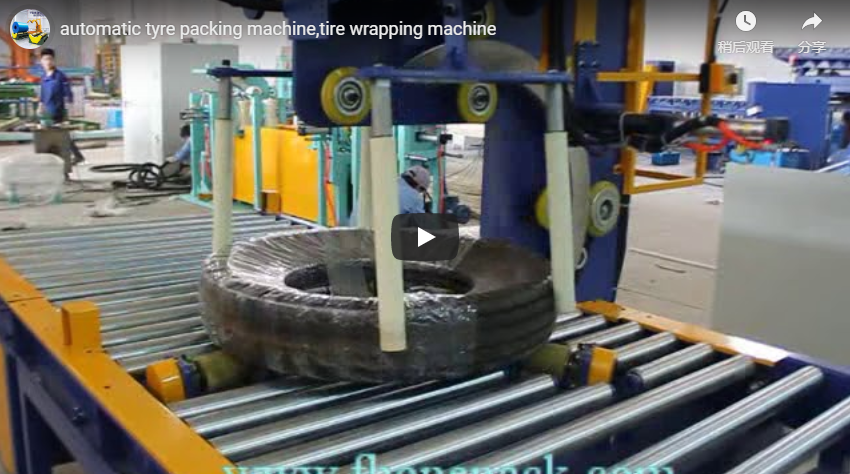
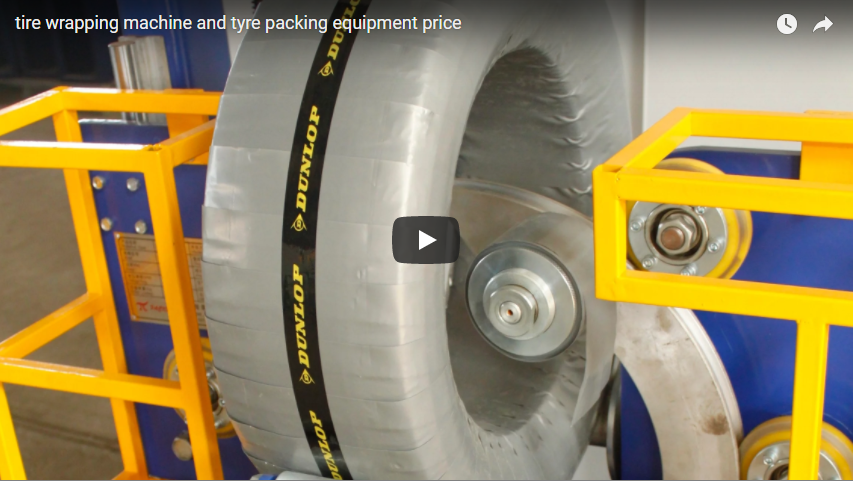
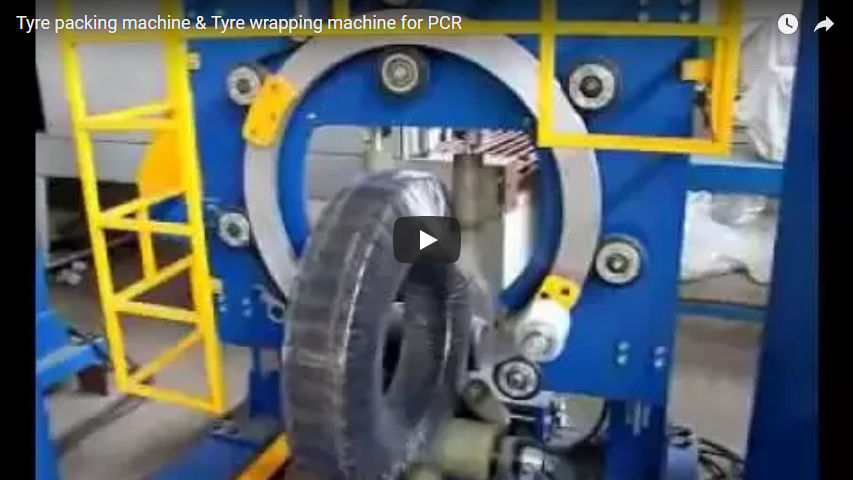
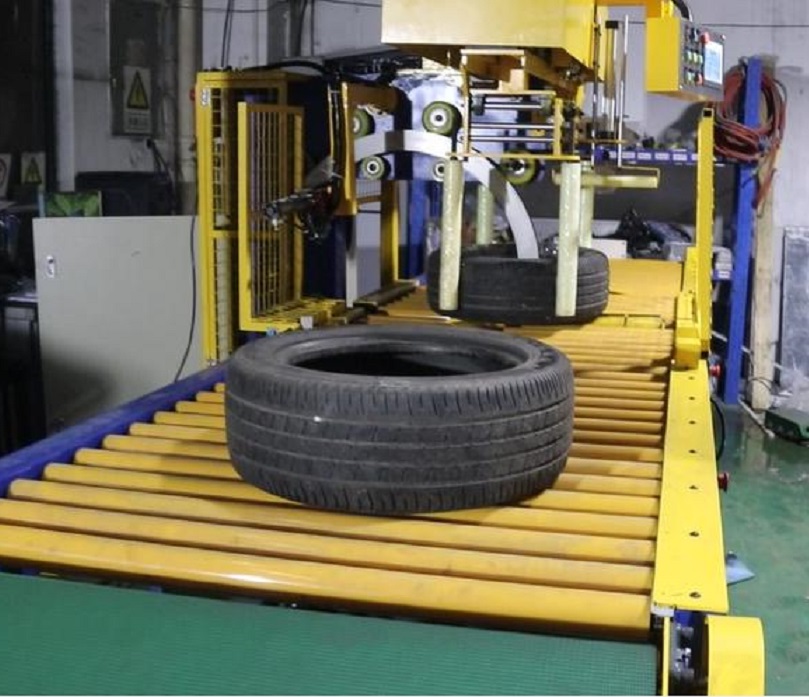
The tyre stands upright on drive rollers while the white wrapping ring passes through its bore, laying a spiral of film round the section. The base is blue, and a yellow guard covers the drive side. An operator loads the tyre from the top through the open ring.
Table of Contents
- Which tyres count as small
- What sets the speed
- FPT-200 data
- Worked example: a 90/90-18 motorcycle tyre
- Tyres per hour and per shift
- Film, tape or knit belt
- Selection checklist
- Safety
- Engineering FAQ
- Next step
- Related reading
- Sources
Which tyres count as small
| Tyre | Fits the FPT-200 when |
|---|---|
| Motorcycle and scooter tyres | bore 300–700 mm and OD 510–800 mm |
| Small car tyres | width up to 250 mm and weight up to 30 kg |
| Wheelbarrow, trolley and small industrial tyres | OD at least 510 mm |
| Larger car and SUV tyres | move to the FPT-300: bore 500–900 mm, OD 800–1,200 mm |
What sets the speed
The ring makes one wrap per turn. The number of wraps comes from the tyre size and the overlap:
Wraps = π × OD ÷ advance per wrap, where the advance is the film width × (1 − overlap).
Ring time = wraps ÷ ring speed. At 120 r/min the ring makes two wraps a second.
So overlap is the main speed lever. Less overlap means fewer wraps and a faster cycle, but a thinner cover. The FPT-200 sets overlap from 10 to 80%. Soft start and stop by inverter keeps the tyre steady at full ring speed, and a brake in the film roller holds the tension. Film roll size, the film cut method and tyre unloading are confirmed at quote.
FPT-200 data
| Item | FPT-200 |
|---|---|
| Tyre bore (ID) | 300–700 mm |
| Tyre OD | 510–800 mm |
| Tyre width | 40–250 mm |
| Tyre weight | 10–30 kg |
| Ring speed | 0–120 r/min |
| Wrapping time | 18–30 s per tyre |
| Overlap | 10–80% |
| Power | 1.5 kW |
| Voltage | AC 380 V, 50 Hz, or to order |
| Loading | from the top, C ring opens upward |
| Operation | automatic or semi-automatic, touch screen with error display |
Worked example: a 90/90-18 motorcycle tyre
Take a 90/90-18 tyre wrapped with 100 mm film. These are illustrative customer figures.
| Check | Calculation | Result |
|---|---|---|
| Bore | 18 × 25.4 | ≈ 457 mm |
| Sidewall height | 0.9 × 90 | 81 mm |
| OD | 457 + 2 × 81 | 619 mm |
| Fits FPT-200? | bore 457, OD 619, width 90 mm | yes |
| Advance at 50% overlap | 100 × 0.5 | 50 mm |
| Wraps | π × 619 ÷ 50 | ≈ 39 |
| Ring time at 120 r/min | 39 ÷ 120 × 60 | ≈ 20 s |
| Film path per wrap | 2 × (90 + 81) | 342 mm |
| Film per tyre | 39 × 0.342 | ≈ 13 m |
At 30% overlap the advance is 100 × 0.7 = 70 mm, the wraps drop to π × 619 ÷ 70 ≈ 28, and the pure ring time to 28 ÷ 120 × 60 = 14 s. That is steady running at full speed only. The rated 18–30 s per tyre also covers the soft start, the stop and the film cut, so plan with 18 s as the floor.
The 342 mm film path treats the tyre section as a rectangle. It is an envelope figure; the real path round the rounded section is a little shorter, and film neck-down under tension changes the applied length.
Tyres per hour and per shift
Add loading and unloading to the ring time. Say 10 s by hand, an illustrative figure.
| Overlap | Ring time | Total per tyre | Tyres per hour | Tyres per 8 h shift |
|---|---|---|---|---|
| 50% | 20 s | 30 s | 3,600 ÷ 30 = 120 | 8 × 120 = 960 |
| 30% | 18 s (rated floor) | 28 s | 3,600 ÷ 28 ≈ 128 | 8 × 128 = 1,024 |
Result. Cutting overlap from 50% to 30% raises output from 120 to about 128 tyres an hour on this tyre, because the cycle meets the 18 s floor. Loading is the bigger lever: a conveyor feed and automatic mode remove most of the 10 s, confirmed at quote.
Film, tape or knit belt
| Material | Use |
|---|---|
| Stretch film or PE film | dust and moisture cover for storage and export |
| PP or knit belt | breathable cover, abrasion protection |
| Silver or paper tape | retail look; a logo tape can cover the OD in the same pass |
Selection checklist
- Tyre sizes: bore, OD and width, smallest and largest.
- Tyre weight.
- Tyres per hour.
- Material and overlap wanted.
- Manual top loading or conveyor feed.
- Power supply.
Safety
We design to EN ISO 12100:2010, EN 415-10 for packaging machinery and EN 60204-1 for the electrical equipment. The turning ring and the drive rollers are the hazards. The ring opens to the top for loading, so the loading zone needs hold-to-run setting controls or a light curtain. Guardrails, an emergency stop and an interlocked guard are agreed per project, together with the CE documents.
Engineering FAQ
Q: How fast is one tyre? A: About 18–30 s on the FPT-200, set by tyre size and overlap.
Q: Can one machine take different tyre sizes? A: Yes, within the bore, OD and width ranges; the rollers adjust to the tyre.
Q: Does the tyre need a pallet or jig? A: No. It stands on the drive rollers and turns during wrapping.
Q: Can it print or show our logo? A: A logo tape can cover the OD in the same pass.
Q: Which model for car tyres? A: Small car tyres fit the FPT-200; larger ones need the FPT-300.
Next step
- Send your tyre sizes, weights and tyres per hour to info@fhopepack.com.
- We choose the model, material and overlap.
- We reply within 24 hours with a proposal and quotation.
Related reading
- Top-loading tyre packing machine, FPT-200 data (product)
- Tyre packing machine, FPT-300 data (product)
- Tyre wrapping machine new design
- Tyre wrapping machines, cool design
- Tyre wrapping machine for PCR tyres
- Online automatic multiple tyres strapping machine
Sources
- FHOPE product pages: tyre packing machine tables FPT-200 and FPT-300 (labelled by the model name in each table)
- EN ISO 12100:2010; EN 415-10; EN 60204-1
- Our small tyre wrapping machine shown above
Last reviewed: 2026-10-19