Executive summary Our automatic tyre packing machine wraps tyres lying flat on a roller conveyor, so it runs inline with no manual loading. It takes tyres of 600–1,400 mm OD and 10–100 kg, and wraps one in 25–35 s. The key check is whether that cycle keeps up with your line takt, including the conveyor transfer.
Table of Contents
- How the inline tyre wrapper works
- Size window
- Matching cycle time to line takt
- Conveyor transfer time
- Film and paper rolls
- Utilities and safety
- Selection checklist
- Engineering FAQ
- Next step
- Related reading
- Sources
How the inline tyre wrapper works
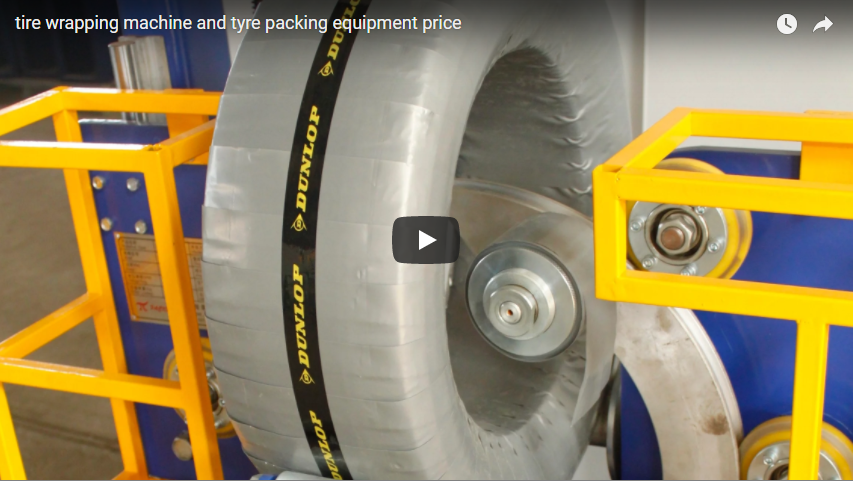
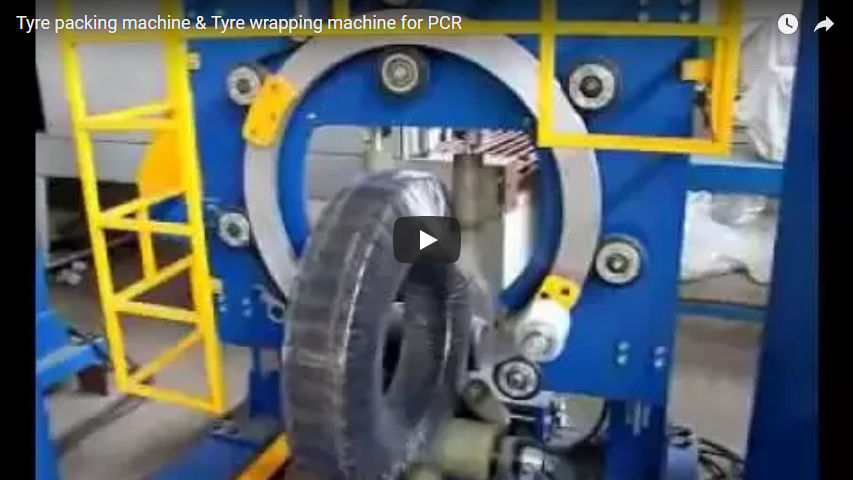
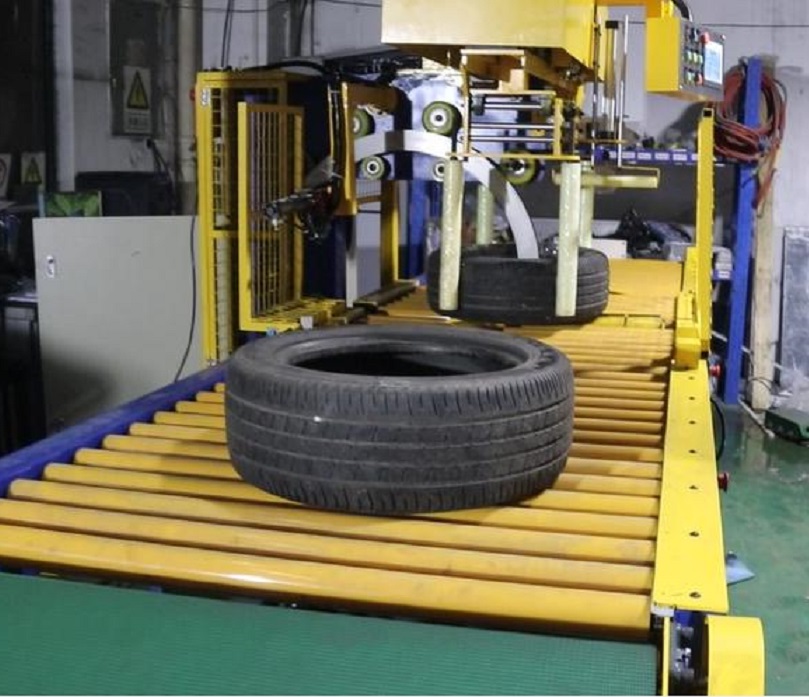
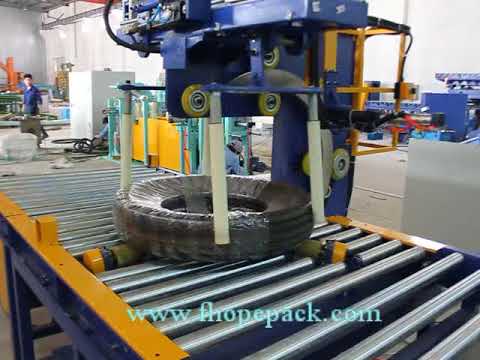
Our horizontal tyre wrapper sits over a powered roller conveyor. The conveyor feeds each tyre in flat, and an automatic positioning device centres it on its OD. In our demonstration run, two vertical rollers come down on either side of the tyre and hold it in place while it is wrapped.
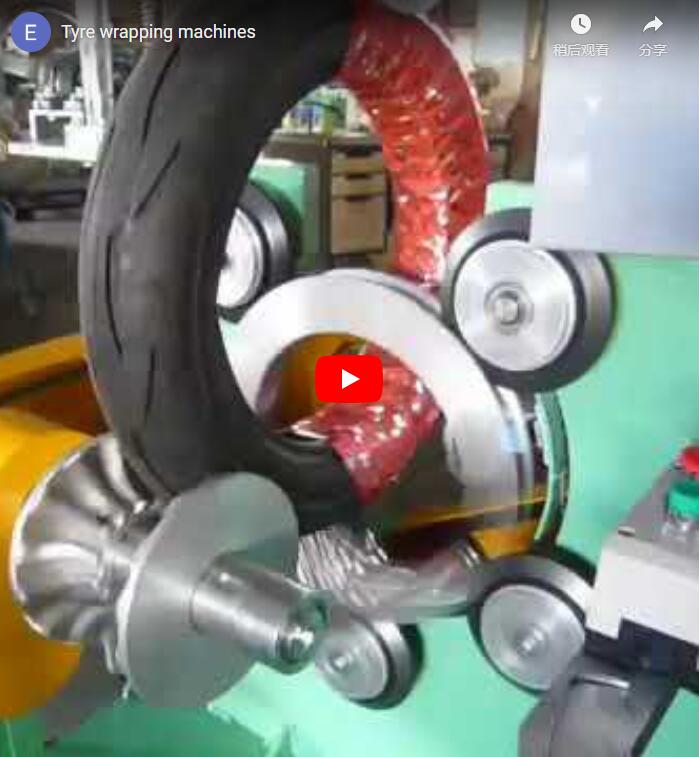
The ring then turns through the tyre eye while the tyre rotates, so film covers the tyre surface through 360 degrees as a sealed package. Film feeding and cutting are automatic. When the wrap is complete, the rollers release the tyre and the conveyor carries it out while the next tyre comes in.
Size window
| Parameter | Value |
|---|---|
| Tyre OD | 600–1,400 mm |
| Tyre ID | 300–900 mm |
| Tyre height (section width, lying flat) | 150–350 mm |
| Tyre weight | 10–100 kg |
| Packing time | 25–35 s per tyre |
| Ring speed | 10–120 r/min |
| Roller conveyor speed | 2–4 m/min |
The wrapper handles different tyre ODs on the same line, so a mixed product range does not need a changeover for each size. The ID still matters: the ring passes through the tyre eye, so your smallest ID must be 300 mm or more.
Matching cycle time to line takt
One hour has 3,600 s, so the packing time sets the wrapper’s capacity ceiling. Conveyor transfer can add to it, as the next section shows:
- At 25 s per tyre: 3,600 ÷ 25 = 144 tyres per hour.
- At 35 s per tyre: 3,600 ÷ 35 = about 102 tyres per hour.
Compare this with your line. Illustrative example: a line that delivers one tyre every 30 s needs 120 tyres per hour. The wrapper keeps up at 25 s per tyre but not at 35 s. If your largest tyres need the longer cycle, we plan a buffer conveyor or a second wrapper. We confirm the cycle for your largest and smallest tyres on a trial.
Conveyor transfer time
The roller conveyor runs at 2–4 m/min. A tyre must travel at least its own diameter to clear the wrapping position:
| Tyre OD | At 2 m/min | At 4 m/min |
|---|---|---|
| 600 mm | 18 s | 9 s |
| 1,000 mm | 30 s | 15 s |
A 1,000 mm tyre at 2 m/min needs 30 s just to move out, which is longer than the shortest packing time. So we check with you whether the cycle you quote includes infeed and outfeed, and set the conveyor speed for your largest tyre.
Film and paper rolls
| Material | Core ID | Roll OD | Roll width |
|---|---|---|---|
| Stretch film | 50 mm | 80–120 mm | 90–120 mm |
| Paper, PE film or aluminium foil | 50 mm | 100–450 mm | 90–120 mm |
Paper and foil rolls can be much larger than film rolls, so a paper roll lasts longer between changes. The roll travels with the ring through the tyre eye, so we confirm which roll size clears your smallest tyre ID. We set the overlap and tension for your material on a trial tyre.
Utilities and safety
| Utility | Requirement |
|---|---|
| Power | about 4.0 kW |
| Voltage | 380 V, 50 Hz, 3 phase |
| Compressed air | 5–7 bar |
| Operation | automatic, online |
The standards that apply depend on the destination market. For CE markets, ISO 12100 sets the risk-assessment method and EN 415-10 sets general requirements for packaging machines. We fit guarding to your layout and confirm it in the proposal.
Selection checklist for an inline tyre wrapper
- Smallest and largest tyre: OD, ID, height and weight.
- Line takt, in tyres per hour.
- Wrapping material: stretch film, paper, PE film or foil.
- Conveyor height and direction at the infeed and outfeed.
- Space for a buffer conveyor if the takt is tight.
- Compressed air at 5–7 bar and 380 V power.
Engineering FAQ
Q: What tyre sizes does the inline wrapper take? A: OD 600–1,400 mm, ID 300–900 mm, height 150–350 mm, and 10–100 kg. Your smallest ID also limits the roll size, so we check both.
Q: How many tyres per hour can it wrap? A: At 25–35 s per tyre, about 102–144 tyres per hour, which we confirm on a trial.
Q: Does it need a changeover for each tyre size? A: No. It works for different tyre ODs at the same time, within the size window.
Q: What if my line is faster than the wrapper? A: For example, a 120 tyre per hour line needs a cycle of 30 s or less. If the largest tyres take longer, we add a buffer conveyor or a second wrapper.
Q: What utilities does it need? A: About 4.0 kW at 380 V, 50 Hz, 3 phase, and compressed air at 5–7 bar.
Next step
We size your inline tyre wrapper in three steps:
- Submit your layout drawing with your tyre list and line takt to info@fhopepack.com.
- Receive a proposal within 48 hours, with the wrapper, conveyors and cycle plan.
- Book a site survey to fit the wrapper into your line.
Related reading
- Automatic horizontal tyre stretch wrapper
- Tyre packing machine range
- Video: automated tyre packing and storage line
- Video: high speed tyre packing line
- Video: automated horizontal tire wrapping line
Sources
- Size window, packing time, conveyor, film rolls, utilities: automatic horizontal tyre stretch wrapper page
- Machine in action: our automatic tyre packing machine video on YouTube
- Standards scope: ISO 12100:2010, EN 415-10:2014
Last reviewed: 2026-10-04