Executive Summary
Selecting the correct orbital tyre wrapping machine for passenger car radial (PCR) tyres depends on precise calculation of outer diameter (OD), inner bead diameter (ID), and cross-section width directly from the sidewall tyre code. Standard machines operate within defined mechanical windows: the FPT-200 covers tyre outer diameters of 510–800 mm, inner diameters of 300–700 mm, and widths up to 250 mm, matching the vast majority of passenger vehicles. Larger SUV, 4×4, and light truck tyres (such as 265/70R17) often cross boundary dimensions, requiring verification against the heavy-duty FPT-300 envelope (800–1,200 mm OD, up to 300 mm width, 100 kg load). This engineering guide outlines the dimensional formulas, kinematic cycle times, material tension controls, and mechanical clearance factors required to match your production batch with the correct packaging system.
How Does the Tyre Wrapping Process Work?
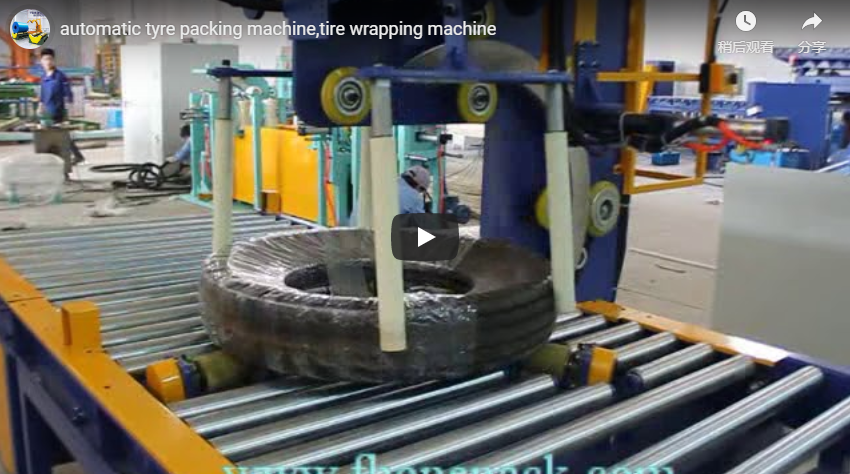
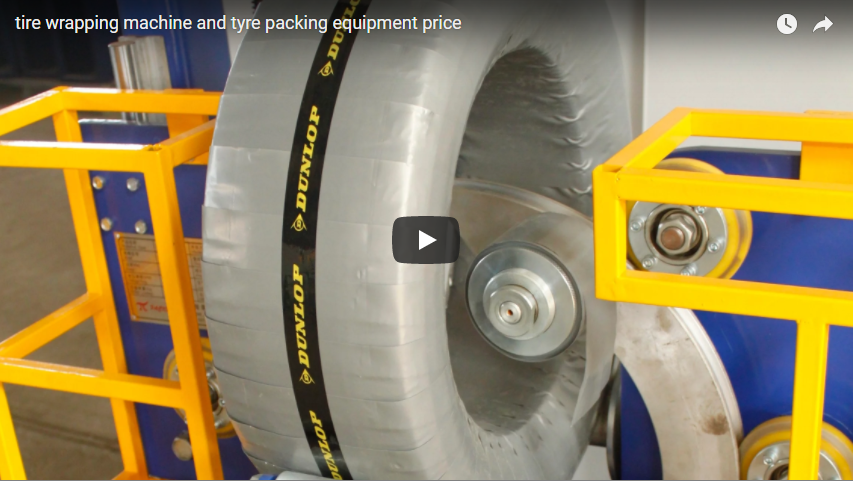
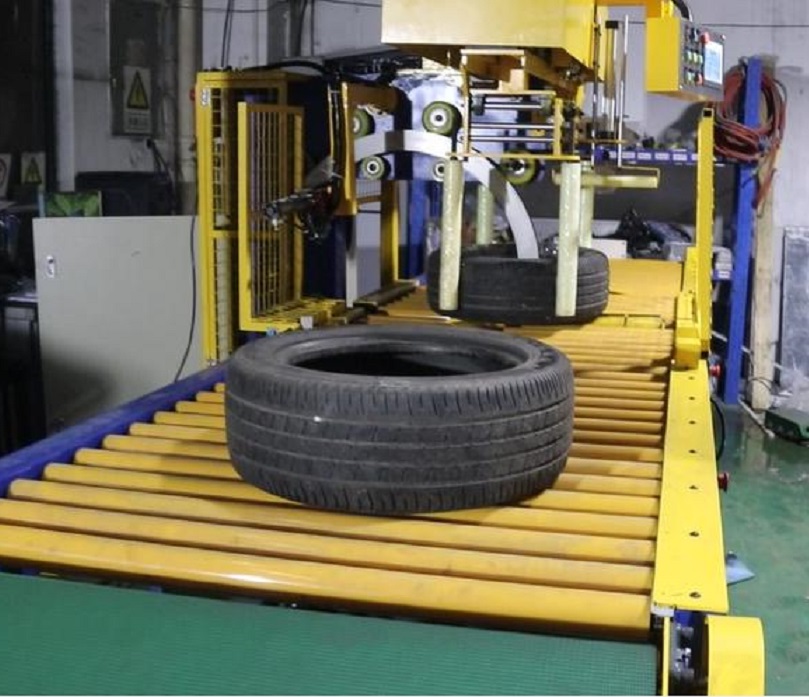
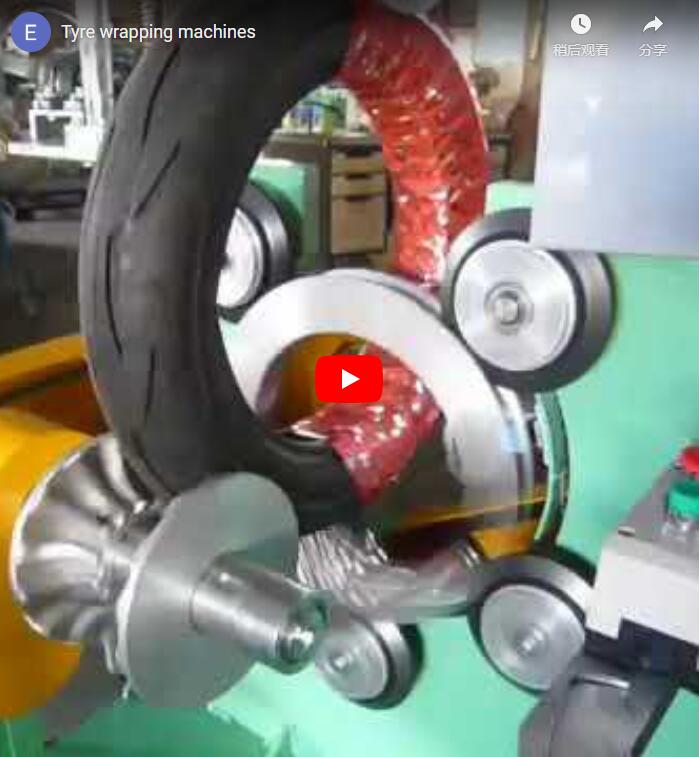
A vertical orbital tyre packing machine wraps stretch film or protective tape through the tyre center bore and around the toroidal cross-section (tread and both sidewalls). The operational kinematics follow a coordinated two-axis motion sequence:
- Tyre Infeed and Positioning: The operator or feeding arm positions the tyre vertically on two bottom polyurethane-coated drive rollers.
- Orbital Ring Shuttle: The rotating ring carries the film tension dispenser. As the ring rotates through the internal bead diameter, the drive rollers rotate the tyre around its horizontal center axis.
- Helical Overlap Application: Synchronized dual variable frequency drives (VFDs) control the rotational ratio between the ring and the support rollers, maintaining an exact overlap pitch across the tread circumference.
- Stabilization: An integrated pneumatic overhead press roller or bracket keeps lightweight or low-aspect-ratio tyres aligned on the drive rollers during rotation, eliminating vibration and axial skewing.
- Cycle Reset: Upon completing the preset wrap layers, the ring automatically stops at its home position, allowing rapid unloading and immediate reloading for the next cycle.
How to Calculate OD and ID from the Tyre Code
Standard metric tyre designations (ISO metric sizing) define section width, aspect ratio, construction type, and wheel rim diameter. For example, in 205/55R16:
- Section Width (W):
205 mm(nominal cross-section width from sidewall to sidewall). - Aspect Ratio (AR):
55%(sidewall height expressed as a percentage of nominal width). - Construction:
R(Radial construction). - Rim Diameter (RD):
16 inches(1 inch = 25.4 mm).
Calculation Formulas:
- Sidewall Height (SH):
SH = W × (AR / 100) - Outer Diameter (OD):
OD = (RD × 25.4) + (2 × SH) - Internal Bead Diameter (ID):
ID ≈ RD × 25.4(approximate opening clearance at the bead seats).
| Tyre Code | Nominal Width (W) | Sidewall Height (SH) | Calculated OD | Bead ID (Approx.) | Compatible Standard Machine |
|---|---|---|---|---|---|
| 175/65R14 | 175 mm | 113.8 mm | 583 mm | 356 mm | FPT-200 |
| 205/55R16 | 205 mm | 112.8 mm | 632 mm | 406 mm | FPT-200 |
| 225/45R18 | 225 mm | 101.3 mm | 660 mm | 457 mm | FPT-200 |
| 265/70R17 | 265 mm | 185.5 mm | 803 mm | 432 mm | Boundary / Custom Engineering |
Calculation Example (205/55R16):
OD = (16 × 25.4) + (2 × 205 × 0.55) = 406.4 + 225.5 = 631.9 mm (rounded to 632 mm).
The bead inner diameter is 16 × 25.4 = 406.4 mm (approx. 406 mm), confirming that both dimensions sit within the processing window of the FPT-200.
Which Model Fits My Tyre Specifications?
Machine selection depends on confirming that the tyre outer diameter, inner bead opening, cross-section width, and unit weight fall inside the continuous operating envelope.
| Parameter | FPT-200 (Standard PCR Window) | FPT-300 (SUV / Light Commercial Window) |
|---|---|---|
| Tyre Outer Diameter (OD) | 510–800 mm | 800–1,200 mm |
| Tyre Inner Diameter (ID) | 300–700 mm | 500–900 mm |
| Tyre Cross-Section Width | 40–250 mm | 80–300 mm |
| Maximum Tyre Weight | 30 kg | 100 kg |
| Rotating Ring Speed | 0–120 rpm (VFD controlled) | 30–110 rpm (VFD controlled) |
| Net Wrapping Cycle Time | 18–30 seconds per tyre | 25–40 seconds per tyre |
| Drive Power Rating | 1.5 kW | 2.0 kW |
Sizing and Stacking Considerations:
- Single-Tyre Processing: The width boundary (
250 mmon FPT-200;300 mmon FPT-300) is engineered for single-tyre wrapping. Bundling two205 mmtyres yields a total width of410 mm, exceeding the throat opening of standard PCR orbital rings. Multi-tyre bundling requires dedicated long-stroke horizontal wrapping systems. - Structural Weight Ceilings: Reinforced run-flat tyres, heavy all-terrain (A/T) designs, and commercial light truck tyres can exceed
30 kg. Even if the OD measures under800 mm, tyres over30 kgshould be routed to the FPT-300 to prevent premature wear on the support roller bearings and drive transmission.
What Happens if My Tyre Size Falls Between Models?
Certain large SUV and all-terrain tyres land directly on dimensional boundaries. A prime example is 265/70R17:
- OD:
803 mm(slightly exceeds the800 mmlimit of FPT-200). - Bead ID:
432 mm(falls below the500 mmstandard minimum inner diameter of FPT-300). - Width:
265 mm(exceeds the250 mmmaximum width limit of FPT-200).
Because this tyre meets neither standard envelope off the shelf, factory mechanical adjustments are required:
- Expanding the FPT-200 Frame: Modifying the roller center-to-center distance and extending the ring clearance arch to accept an
803–820 mmOD and270 mmwidth while preserving the low300 mmID capability. - Adapting the FPT-300 Shuttle Path: Customizing the film roll carriage assembly to allow inward reach into a
430 mmbead cavity on an otherwise large-diameter ring.
Submitting your complete SKU matrix prevents envelope mismatch before equipment manufacturing.
How Long Does Wrapping Take? Cycle Time Analysis
Packaging cycle time consists of net machine wrapping time plus material handling (loading and unloading). The table below compares cycle calculations on an FPT-200 running single-operator manual loading:
| Process Step | Fast Tyre (e.g., 175/65R14, Light Wrap) | Standard/Heavy Tyre (e.g., 225/45R18, Dense Overlap) |
|---|---|---|
| Net Ring Wrapping Time | 18 s | 30 s |
| Manual Load & Unload Allowance | 15 s | 15 s |
| Total Cycle Time per Tyre | 33 s | 45 s |
| Theoretical Continuous Output | ~109 tyres/hour | 80 tyres/hour |
Operational Note: Actual shift throughput depends on operator pacing, film roll replacement intervals, and line integration. Integrating an inline pneumatic roll-in/roll-out ramp or automated gravity ejector reduces handling time from 15 seconds down to 5–8 seconds.
What Materials and Overlap Settings Are Used?
The wrapping carriage accommodates multiple industrial protective films depending on transit protection criteria:
- Compatible Consumables: Polyethylene (PE) film, LLDPE stretch film, circular woven PP knit belt, anti-rust VCI film, and composite kraft/crepe paper.
- Overlap Regulation: Set between
10%and80%via inverter-controlled speed differentials between the ring motor and bottom roller motor. - Tension Control: Maintained via a mechanical friction brake roller system with micro-adjustment springs to prevent bead distortion on soft PCR sidewalls while guaranteeing tight puncture-resistant containment.
- Logo and Branding Striping: An auxiliary unpowered dispenser applies a narrow continuous printed logo band around the tyre OD simultaneously during the outer wrapping passes.
Utility and Safety Specifications
| Engineering Parameter | FPT-200 | FPT-300 |
|---|---|---|
| Standard Electrical Supply | AC 380 V, 50 Hz, 3-Phase (60 Hz / 220 V / 480 V optional) | AC 380 V, 50 Hz, 3-Phase (60 Hz / 220 V / 480 V optional) |
| Installed Power Rating | 1.5 kW | 2.0 kW |
| Pneumatic Air Requirement | 0.4–0.6 MPa (used with top stabilizer / auto-clamp) | 0.4–0.6 MPa (used with top stabilizer / auto-clamp) |
| Safety Standard References | ISO 12100:2010, EN 415-10:2014 | ISO 12100:2010, EN 415-10:2014 |
Mechanical guards, perimeter protective mesh, and emergency stop interlocks isolate the rotating ring area. Drive motors incorporate dynamic braking for rapid shutdown upon safety circuit interruption.
What Data Must You Provide for a Firm Configuration?
To confirm ring clearance, roller center spacing, and drive power, please provide:
- Complete list of tyre size codes (smallest OD/ID up to largest OD/ID).
- Maximum section width (inflated or uninflated bead state).
- Tyre weight range (minimum and maximum in kg).
- Wrapping material type (Stretch film, woven PE/PP tape, or paper).
- Target production capacity (tyres per hour or tyres per shift).
- Plant operating voltage, phase, and utility frequency (
V / Hz / Phase).
Engineering FAQ
Q: Can one vertical tyre wrapper handle both small PCR and heavy truck (TBR) tyres?
A: No. Truck and bus radial (TBR) tyres typically exceed 1,000–1,300 mm OD, 250–350 mm width, and weigh between 50 kg and 90 kg. A standard PCR wrapper lacks the ring throat opening and structural roller load capacity for truck lines.
Q: How does aspect ratio affect machine wrapping? A: Low-aspect-ratio tyres (e.g., 35–45 series) have stiff, narrow sidewalls that require steady top press-roller pressure to avoid tracking drift. High-aspect-ratio tyres (e.g., 70–80 series) are more flexible and demand careful tension adjustment on the film brake to avoid pulling the bead inward.
Q: Can the machine run without an air compressor?
A: If the wrapper relies strictly on manual tyre positioning without pneumatic top stabilization or auto-ejection kits, it can function purely on electrical power. If fitted with pneumatic stabilizing arms, an industrial supply of 0.4–0.6 MPa clean air is required.
Technical Consultation and Next Steps
To evaluate your tyre size distribution against our standard and custom wrapping rings:
- Submit Your Specification Sheet: Send your tyre code list, target shift volume, and line layout drawing to our engineering department at info@fhopepack.com.
- Dimensional Matrix Verification: Our packaging engineering team maps your min/max dimensions against our kinematic throat database within 24–48 hours.
- Application Proposal: Receive a certified dimensional validation sheet, machine outline drawing, and project quotation.
Related Documentation and Catalog Resources
- Tyre Packing Machine FPT-200 Technical Specifications
- Tyre Packing Machine FPT-300 Heavy-Duty Model Specifications
- Fully Automated Inline Tyre Packaging Systems
- Application Video: Industrial PCR Tyre Wrapping in Production
Standards and Technical References
- ISO 12100:2010: Safety of machinery — General principles for design — Risk assessment and risk reduction.
- BS EN 415-10:2014: Safety of packaging machines — Part 10: General requirements.
- ISO 4000-1: Passenger car tyres and rims — Part 1: Tyres (metric series).
- Dimensional Verification: FHOPE Orbital Packaging Machine Sizing & Tyre Dimension Calculation Archive.
- Official Demonstration: FHOPE PCR Tyre Wrapping Equipment Video Library.