Executive summary Our tire wrapping machine for standalone use stands the tyre in an opening ring and wraps film through the tyre eye while rollers turn the tyre. Three models cover tyres from motorcycle to truck size, and the tyre’s inside diameter, outside diameter, width and weight decide the model. Cycle time runs from 18 s per tyre on the smallest model to 50 s on the largest. The price follows the model and the options you pick, so we quote it against your tyre list.
Table of Contents
- How the vertical tyre wrapper works
- Choosing the model by tyre size
- Output per shift
- What moves the price
- Wrapping materials and overlap
- Utilities and safety
- Selection checklist
- Engineering FAQ
- Next step
- Related reading
- Sources
How the vertical tyre wrapper works
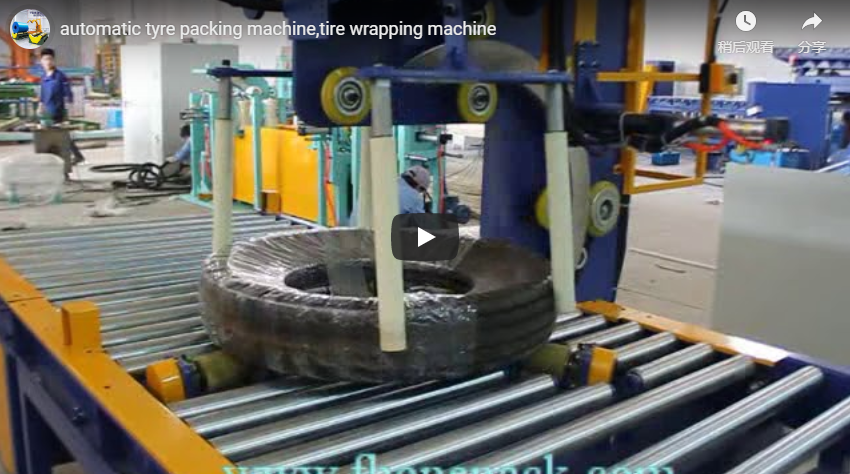
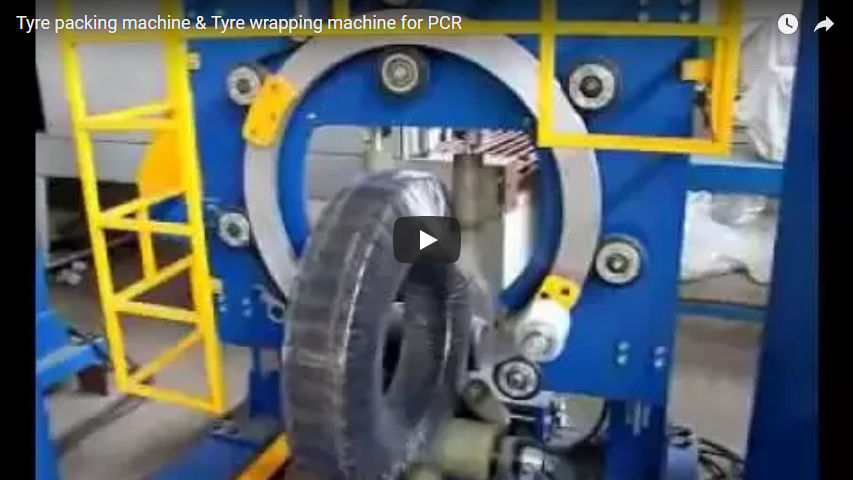
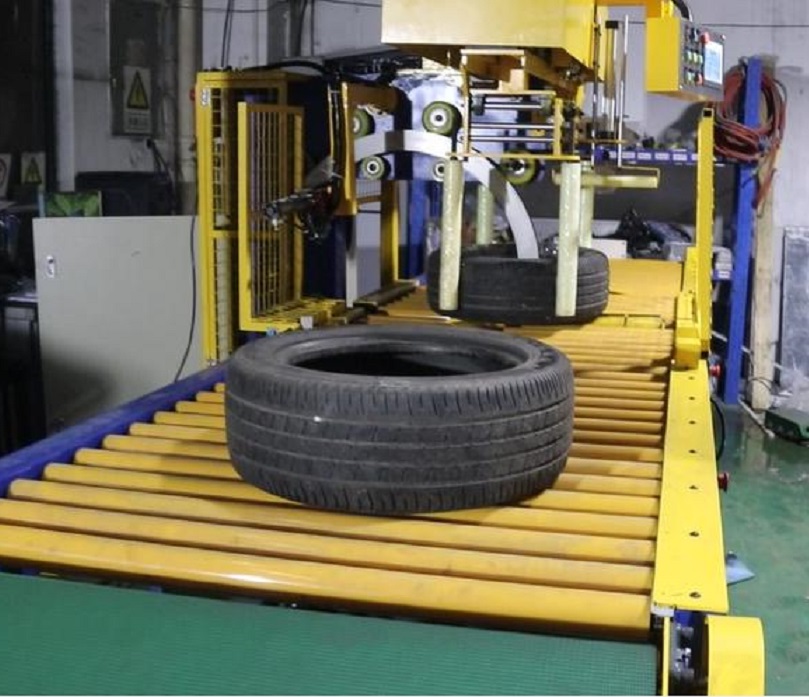
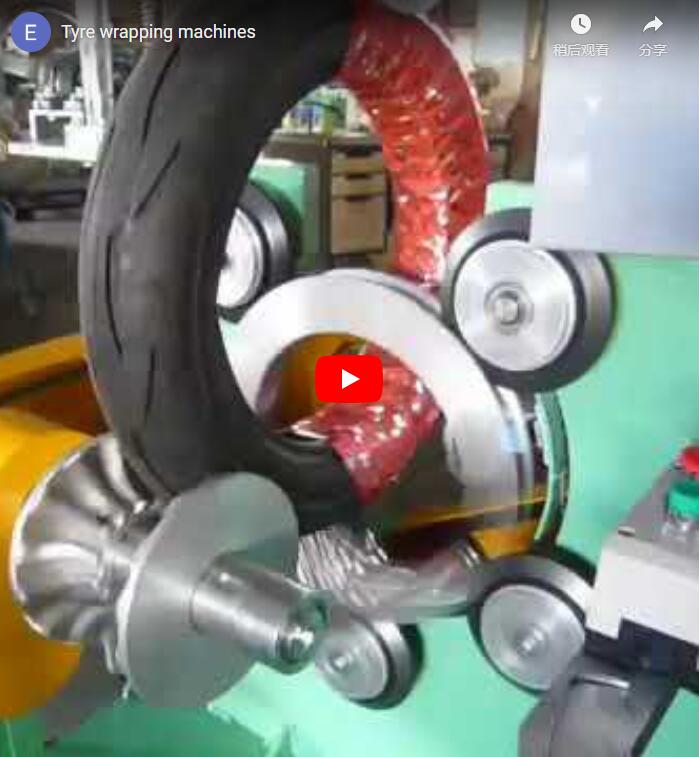
Our vertical tyre wrapper is built around a C-shaped opening ring that opens at the top, so the tyre is loaded and unloaded from above. The tyre stands upright on support rollers, and a guard frame surrounds the working area. In the video, an operator loads a car tyre by hand.
During the cycle, the ring carries the film through the tyre eye while the rollers turn the tyre, so the film covers the whole tyre section. A logo tape runs over the tyre’s outside diameter at the same time, which puts your brand on the tread face. At the end of the cycle the ring returns to its start position, and the operator lifts the wrapped tyre out.

Choosing the model by tyre size
| Parameter | FPT-200 | FPT-300 | FPT-400 |
|---|---|---|---|
| Typical tyres | car, motorcycle | larger car and light truck | truck |
| Tyre ID | 300–700 mm | 500–900 mm | 750–1,200 mm |
| Tyre OD | 510–800 mm | 800–1,200 mm | 1,000–1,400 mm |
| Tyre width | 40–250 mm | 80–300 mm | 80–400 mm |
| Tyre weight | 10–30 kg | 10–100 kg | 20–120 kg |
| Ring speed | 0–120 r/min | 30–110 r/min | 30–80 r/min |
| Wrapping time | 18–30 s per tyre | 25–40 s per tyre | 35–50 s per tyre |
| Power | 1.5 kW | 2.0 kW | 2.5 kW |
All four values must fall inside one column. Buyers most often miss the inside diameter. The ring passes through the tyre eye, so the ID must sit inside the model’s ID window, even when the OD fits a larger model.
Illustrative example: a car tyre with 400 mm ID, 650 mm OD, 205 mm width and 12 kg weight sits inside every FPT-200 window. A larger tyre with 1,100 mm OD and 60 kg weight fits the FPT-300 if its ID is 500–900 mm. If its ID is above 900 mm, it needs the FPT-400.
Output per shift
The wrapping time gives a first output estimate. One hour has 3,600 s:
- FPT-200: 3,600 ÷ 30 = 120 tyres per hour at the slowest wrapping time, and 3,600 ÷ 18 = 200 tyres per hour at the fastest. These are machine cycle limits.
- FPT-300: 3,600 ÷ 40 = 90 to 3,600 ÷ 25 = 144 tyres per hour.
- FPT-400: 3,600 ÷ 50 = 72 to 3,600 ÷ 35 = about 102 tyres per hour.
Over an 8-hour shift, 120 tyres per hour gives 960 tyres. This is a ceiling. On a standalone machine the operator loads and unloads each tyre, and film roll changes and breaks also reduce output. We time loading and unloading on a trial with your tyres before we commit to an output figure.
What moves the price
The price of a tyre wrapper follows your tyre size range and the level of automation. We quote against your tyre list using these drivers:
- Model. The size and weight window, from FPT-200 to FPT-400.
- Operating mode. Automatic or semi-automatic mode is selectable; an online horizontal wrapper with conveyors is a larger system.
- Film handling. Automatic material cutting is a feature on the FPT-300 page.
- Branding. Logo tape applied over the OD during wrapping, listed for the FPT-200 and FPT-300.
- Voltage. AC 380 V, 50 Hz is standard, and other voltages are built to order.
Wrapping materials and overlap
The wrapper accepts PE, stretch film, knit belt, PP and silver paper. The material roll sits on the ring. Overlap is set through the ring and roller speeds:
| Model | Overlap range |
|---|---|
| FPT-200 | 10–80% |
| FPT-300 | 20–80% |
| FPT-400 | 20–80% |
Inverters adjust the ring and roller speeds, giving soft start and stop. Film tension is set by a brake on the film roller, and a higher overlap uses more material per tyre. We set overlap and tension on a trial tyre.
Utilities and safety
| Item | Detail |
|---|---|
| Power | 1.5 kW (FPT-200), 2.0 kW (FPT-300), 2.5 kW (FPT-400) |
| Voltage | AC 380 V, 50 Hz, or your requirement |
| Ring height | adjustable for small to large tyres |
| Controls | touch screen with fault display |
Guardrails cover the moving parts, the ring returns to its start position automatically, and an indicator alarms when a fault occurs. The standards that apply depend on the destination market. For CE markets, ISO 12100 sets the risk-assessment method and EN 415-10 sets general requirements for packaging machines.
Selection checklist for a tyre wrapper
- Smallest and largest tyre: ID, OD, width and weight.
- Tyres per hour and shifts per day.
- Wrapping material: stretch film, PE, knit belt, PP or paper.
- Logo tape on the OD, yes or no.
- Manual loading, or an online line with conveyors.
- Voltage and frequency at your site.
Engineering FAQ
Q: Which model fits passenger car tyres? A: Usually the FPT-200, which takes 300–700 mm ID, 510–800 mm OD, 40–250 mm width and 10–30 kg.
Q: How many tyres can one machine wrap per hour? A: The FPT-200 wraps one tyre in 18–30 s, which is 120–200 tyres per hour before loading time.
Q: Why does the inside diameter matter? A: The ring passes through the tyre eye, so the ID must fall inside the model’s ID window.
Q: Can the wrapper add our brand to the tyre? A: Yes. On the FPT-200 and FPT-300, a logo tape covers the tyre OD at the same time as the wrapping.
Q: What does a tyre wrapping machine cost? A: A standalone machine is priced by model, mode and options such as logo tape. An online wrapper with conveyors is a larger system. We quote within 48 hours of receiving your tyre list.
Next step
We size your tyre wrapper in three steps:
- Submit your layout drawing with your tyre list and tyres per hour to info@fhopepack.com.
- Receive a proposal within 48 hours, with the model, options and price.
- Book a site survey to fit the wrapper to your packing area.
Related reading
- Tyre packing machine range
- Automatic horizontal tyre stretch wrapper
- Truck tyre packing machine
- Video: tyre packing machine for PCR tyres
- Video: tyre wrapping machine, new design
Sources
- Note: our page addresses end in FPT-100, FPT-200 and FPT-300, while the model tables on those pages read FPT-200, FPT-300 and FPT-400. We use the table names.
- FPT-200 data, logo tape, operating modes: car and motorcycle tyre packing machine page
- FPT-300 data, automatic cutting, eye wrapping: tyre packing machine page
- FPT-400 data: truck tyre packing machine page
- Machine in action: our tire wrapping machine video on YouTube
- Standards scope: ISO 12100:2010, EN 415-10:2014
Last reviewed: 2026-10-04