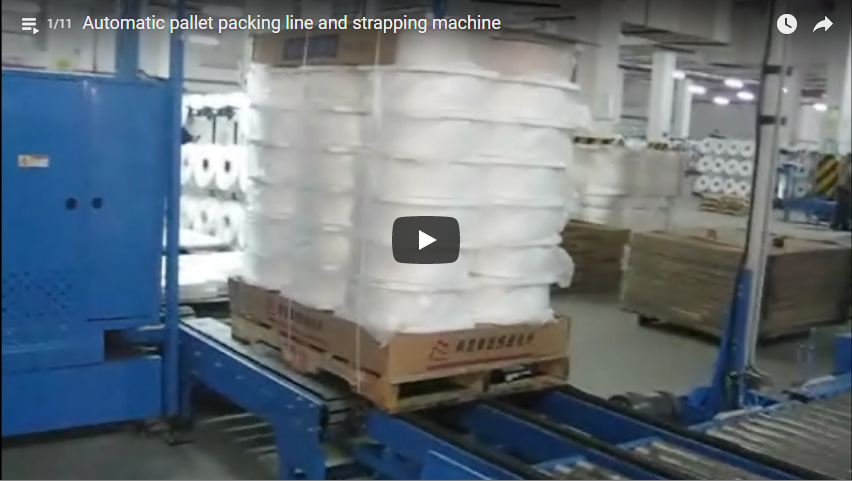
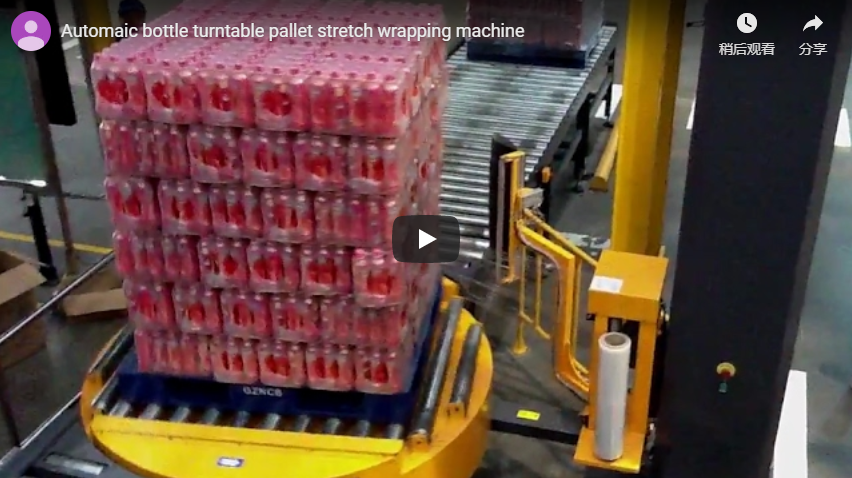
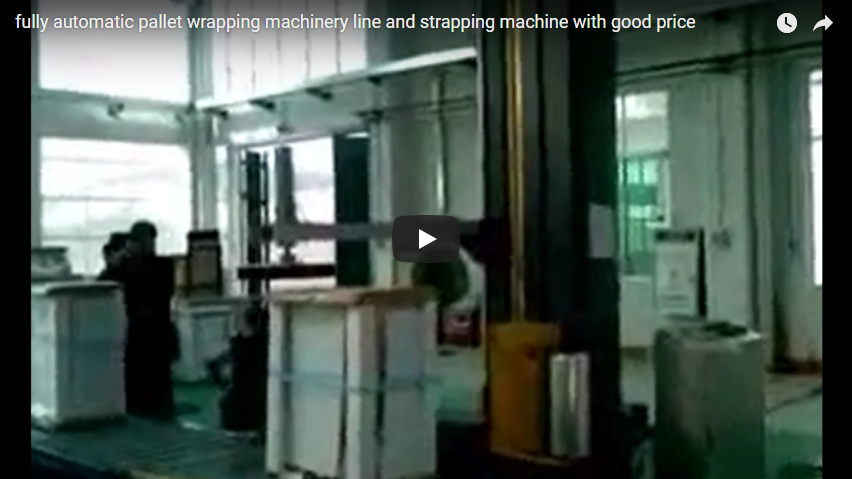
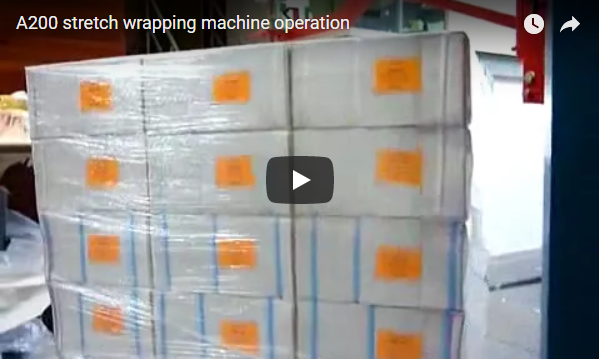
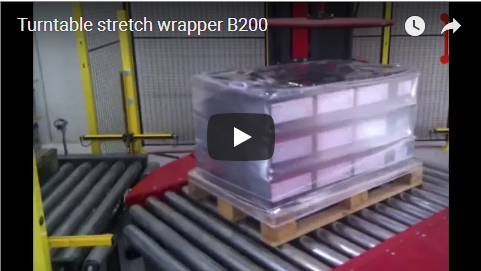
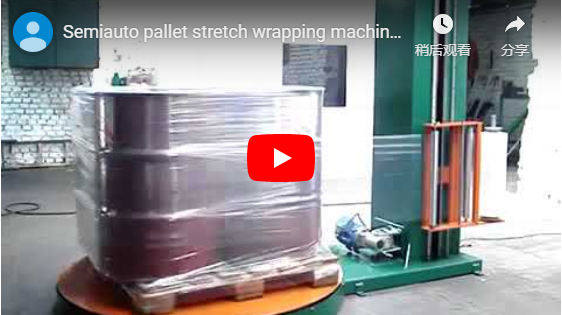
Unprotected pallet loads stored outdoors or shipped via intermodal freight face water pooling, grit contamination, and shifting top tiers. Manual polyethylene draping forces production lines to halt while operators step into forklift aisles. These manual operations cause inconsistent film margins, wasted time, and severe safety hazards around moving machinery.
An inline automatic turntable stretch wrapper with an overhead top sheet dispenser solves cargo protection challenges by applying a weather-resistant five-sided cover directly within the conveyor line. The system unrolls and cuts a protective sheet before spiraling high-tension stretch film around the payload, locking the top film edges firmly beneath the upper stretch wraps.
I have spent over fifteen years integrating heavy-duty packaging machinery on active factory floors. In this engineering guide, I review station mechanics, calculate real-world overlap percentages, evaluate cycle time budgets, and analyze film consumption for inline operations.
Table of Contents
- How does the B-series line run, station by station?
- What are the B-series machine data?
- How do turntable speed and carriage speed set the film overlap?
- What is the cycle time budget per pallet?
- How much film does one pallet take at 250% pre-stretch?
- Should you choose a top sheet dispenser or a top plate?
- What should you confirm before ordering an inline turntable wrapper?
- How is the wrapper guarded?
- What else do buyers ask about top-sheet wrapping?
- Conclusion
- Related reading
- Sources
How does the B-series line run, station by station?
The B-series packaging cell runs continuously through a fully automated conveyor sequence managed by a central programmable logic controller (PLC). Each station completes an automated task without manual operator intervention:
- Infeed Entry. A forklift or upstream automated guided vehicle (AGV) positions the pallet on the powered infeed roller conveyor. Optical proximity sensors confirm pallet orientation and square alignment.
- Top Sheet Application. As the conveyor indexes the load into position, the overhead gantry film dispenser unrolls, cuts, and drapes a low-density polyethylene (LDPE) cover sheet symmetrically across the top of the cargo.
- Primary Stretch Wrapping. The load enters the motorized turntable station. Variable frequency drives (VFD) ramp rotation up to 12 rpm. The powered pre-stretch carriage tracks vertically, securing reinforcement winds at the pallet base, spiraling up the load face, and locking down the top sheet edges with dedicated top layers (0–99 programmable wraps).
- Automatic Cut, Clamp, and Wipe. At cycle completion, an electro-pneumatic scissor gripper captures the film web. An impulse hot-wire mechanism cleanly severs the film, while an integrated trailing brush wipes the tail securely against the pallet. The pneumatic clamp holds the leading edge in standby for the subsequent pallet.
- Outfeed Discharge. The conveyor drives the unitized pallet to the outfeed buffer accumulation line for forklift removal or direct transfer to automated high-bay racking.
The conveyor line integration is fully modular. Conveyor pass-line height, roller pitch, roll width, and film thickness are calibrated to client specifications during design validation.
What are the B-series machine data?
The B-series wrapper handles heavy structural loads on high-throughput continuous packaging lines. The mechanical and electrical specifications below govern standard installations:
| Technical Parameter | Specification / Tolerance |
|---|---|
| Automation Rating | Fully automatic, continuous inline operation |
| Rated Line Throughput | ≥ 24–26 pallet loads per hour (load-dependent) |
| Maximum Load Capacity | 1,800 kg (balanced dynamic rating) |
| Turntable Assembly | 2,200 mm diameter, ~400 mm top-of-roller height, slew-bearing ring gear & dual heavy-duty chain drive |
| Turntable Speed | 0–12 rpm (adjustable via VFD), soft start / controlled decel, home-position auto-alignment |
| Film Specification | LLDPE stretch film, 25 µm (0.025 mm), 500 mm web width, 76 mm core, 500–1,500 m roll |
| Film Delivery Pre-Stretch | 250% standard (1 m yield = 3.5 m applied); field-adjustable 100% to 300% via gear sets |
| Film Carriage Drive | VFD inverter-controlled lift mechanism; vertical linear travel speed at 2.9 m/min |
| Load Height Detection | High-accuracy diffuse reflection retro-reflective photoelectric sensor |
| Reinforcement Wind Settings | Independent base, middle, and top parameters: 0–99 wraps; multi-cycle re-wrap enabled |
| System Control Architecture | Industrial PLC with touchscreen HMI; lockable main disconnect; mushroom E-stop pushbuttons |
| Installed Drive Power | Turntable: 0.75 kW; Roller conveyor: 0.75 kW; Carriage lift: 0.37 kW; Pre-stretch drive: 0.37 kW |
| Pneumatic & Electrical Supply | 3-Phase 380 V ±10%, 50 Hz; clean compressed air at 0.6–0.8 MPa (6–8 bar) |
How do turntable speed and carriage speed set the film overlap?
Turntable rotational speed and carriage elevation speed govern effective film pitch and vertical overlap. At 12 rpm and 2.9 m/min carriage speed, the machine achieves a 240 mm vertical rise per revolution, creating a 52% film overlap across a standard 500 mm web width.
Turntable rotational speed and carriage elevation speed govern the effective film pitch. At a continuous 12 rpm, each table rotation consumes:
Turntable Revolution Time = 60 s ÷ 12 rpm = 5.0 s
The carriage vertical elevator operates at 2.9 m/min (48.3 mm/s):
Vertical Carriage Speed = 2,900 mm ÷ 60 s ≈ 48 mm/s
| Mechanical Check | Engineering Calculation | Quantitative Result |
|---|---|---|
| Carriage Rise per Rotation | 48 mm/s × 5.0 s | 240 mm pitch |
| Nominal Film Width | Industrial cast/blown LLDPE | 500 mm |
| Effective Vertical Overlap | (500 mm − 240 mm) ÷ 500 mm | 52% overlap |
Overlap Principles for Unit Load Stability
Reducing carriage hoist frequency increases overlap percentage and containment force at the expense of cycle time. Raising turntable speed increases wrap density. To maintain package integrity under ASTM D4169 vibration profiles, set the vertical overlap to ≥ 50%, then program dedicated reinforcement bands at the pallet-to-load shear junction. When a top sheet is in use, the PLC overlaps it with at least 2–4 full revolutions of stretch film across the uppermost 150 mm of the load corners.
What is the cycle time budget per pallet?
A standard 1,650 mm tall ISO pallet requires a 138-second gross cycle time on the B-series wrapper under standard wrap settings. This cycle includes 98 seconds of active wrapping and 40 seconds of conveyor indexing, delivering a calculated continuous output of 26.1 pallet loads per hour.
The kinematic evaluation uses an ISO standard pallet: 1,200 mm (L) × 1,000 mm (W), height 1,650 mm (inclusive of timber skid). The load diagonal equals:
Pallet Corner Diagonal = √(1,200² + 1,000²) ≈ 1,562 mm
This diagonal sits well within the 2,200 mm turntable boundary. The baseline wrap program uses 3 base wraps and 3 top wraps:
| Cycle Phase | Kinematic Formula & Parameters | Execution Time |
|---|---|---|
| Carriage Ascent | 1,650 mm ÷ 48 mm/s | ≈ 34 s |
| Carriage Descent | 1,650 mm ÷ 48 mm/s | ≈ 34 s |
| Base Reinforcement Wraps | 3 revolutions × 5.0 s | 15 s |
| Top Cap Anchoring Wraps | 3 revolutions × 5.0 s | 15 s |
| Total Active Wrapping Time | 34 s + 34 s + 15 s + 15 s | 98 s |
| Conveyor Index, Top Cap Drape, Cut/Wipe | Sequenced conveyor positioning & cycle reset | 40 s |
| Total Gross Cycle Time per Unit | 98 s + 40 s | 138 s |
| Line Capacity (Hourly Output) | 3,600 s ÷ 138 s | ≈ 26.1 loads/hour |
The realized throughput of 26.1 pallets per hour matches the rated line throughput of 24 to 26 pallets per hour. Because top-sheet roll dispensing and cutting occur concurrently while the pallet indexes forward onto the turntable, top-capping contributes minimal overhead to the cycle. On applications requiring higher throughput, setting the PLC to a single-ascent wrap program saves approximately 34 seconds, boosting line yield beyond 34 loads per hour.
How much film does one pallet take at 250% pre-stretch?
At 250% powered pre-stretch, one 1,650 mm ISO pallet consumes 24.6 meters of unstretched film stock, weighing approximately 283 grams. Compared to a 100% friction-brake carriage, this powered pre-stretch mechanism saves up to 75% in raw material consumption per load.
The film consumption model derives directly from turntable cycles and perimeter geometry:
| Metric | Calculation | Value |
|---|---|---|
| Total Table Revolutions per Load | (34 s ÷ 5.0 s) + (34 s ÷ 5.0 s) + 3 + 3 | ≈ 19.6 turns |
| Pallet Perimeter Profile | 2 × (1.2 m + 1.0 m) | 4.4 m |
| Total Stretched Film Applied | 19.6 turns × 4.4 m | ≈ 86.2 m |
| Unstretched Film Feed at 250% Yield | 86.2 m ÷ (1 + 2.5) = 86.2 m ÷ 3.5 | ≈ 24.6 m |
| Applied Film Mass (Density: 920 kg/m³) | 24.6 m × 0.5 m × 0.000025 m × 920 kg/m³ | ≈ 0.283 kg (283 g) |
| Production Capacity per 1,500 m Master Roll | 1,500 m ÷ 24.6 m | ≈ 61 loads |
At 250% powered pre-stretch, 1.0 meter of roll stock yields 3.5 meters of tensioned film around the cargo:
Pre-Stretch Yield Ratio = 1.0 m × (1 + 2.50) = 3.5 m
Utilizing low-end friction-brake carriages (100% pre-stretch) increases raw material consumption by up to 75%. That setup requires 43.1 m of roll stock per pallet (approximately 0.495 kg), underscoring the return on investment delivered by precision powered pre-stretch heads.
Should you choose a top sheet dispenser or a top plate?
Pallet line packaging engineers often debate between installing an overhead top sheet dispenser or an overhead top plate. Both units integrate into automatic turntable systems, but they solve different operational challenges.
Select an overhead top sheet dispenser when you require:
- Five-Sided Weather Resistance: The top film protects outdoor-stored cargo against rain, moisture splash, and environmental dust.
- Barcode and Label Scanning: Transparent poly top sheets maintain full visibility for warehouse barcode tracking.
- Variable Stack Profiles: The overhead gantry handles variable load heights automatically using photoelectric sensing.
Select an overhead top plate when you require:
- Stabilization of Tall or Light Loads: Pneumatic or motorized top plates apply physical downward clamping pressure, preventing unstable or lightweight boxes from toppling during turntable acceleration.
- Internal Dust Protection: Top plates provide basic overhead coverage while physically restraining loose tiers.
- Combined Project Configurations: Certain engineering projects combine both systems, applying a top plate for physical stabilization alongside film wrapping for weather protection.
What should you confirm before ordering an inline turntable wrapper?
Before finalizing machine engineering drawings, review these essential project parameters with your integration team:
- Load Parameters: Confirm minimum and maximum footprint dimensions (L × W), overall height including the pallet skid, gross payload mass, and load overhang or underhang tolerances.
- Throughput Targets: Establish required pallets per hour during peak shift demand to decide between dual-ascent or single-ascent wrap cycles.
- Environmental Sealing Requirements: Specify top sheet gauge (e.g., 30–60 µm LDPE) and weatherproofing targets based on outdoor exposure expectations.
- Plant Conveyor Interfacing: Verify conveyor top-of-roller (TOR) elevation, line velocity, roller pitch, and upstream/downstream PLC handshake logic.
- Consumable Specs: Confirm film gauge, core diameter, and elongation properties of local machine-grade LLDPE stretch film.
- Utility Sizing: Confirm facility input voltage, total connected electrical load, and regulated dry compressed air supply.
If your project requires alternative capacities, note that related family variants like the B200 specify a 2,000 kg capacity, 1,800 to 2,000 mm turntable diameter, 3 to 12 r/min, and 200% pre-stretch. Confirm project specifications individually, because parameters differ across models.
How is the wrapper guarded?
The B series is manufactured in compliance with EN 415-6 (Safety of Packaging Machines: Pallet Wrapping Machines), EN ISO 12100:2010 (Risk Assessment), and EN 60204-1 (Electrical Equipment of Machines).
Primary hazard zones include rotating turntable machinery, the vertical hoist carriage, and the pneumatic overhead sheet cutting mechanism. Full system installations include:
- Perimeter mesh safety guarding (height ≥ 2,000 mm) with ISO 14119 interlocked maintenance access doors.
- Category 4 / PL e optical safety light curtains positioned at conveyor infeed and discharge stations, configured with selective hardware muting sensors to allow pallet passage while arresting motion if personnel enter.
- Dual-channel safety E-stop circuits, motor circuit breakers with lockable disconnects (OSHA LOTO compliant), and pneumatic dump valves to vent residual stored air pressure during an emergency stop.
What else do buyers ask about top-sheet wrapping?
Why integrate a top sheet dispenser instead of manual top sheeting?
Manual top draping introduces line stoppages, inconsistent edge coverage, and workplace safety risks. The automated dispenser provides consistent sheet placement and continuous conveyor operation, creating a tight protective wrap against dust and water splash when sealed by the upper stretch wraps.
Can the dispenser handle protective PE foam or bubble roll stock?
Yes. The powered roll-unwind carriage and pneumatic guillotine cutter handle LDPE poly sheeting, anti-static foam, or thin air-bubble film without mechanical modifications.
Conclusion
Use an overhead top sheet dispenser when cargo requires five-sided dust and splash resistance with full barcode visibility. Choose a top plate system when tall, lightweight pallets need physical downward clamping during rotation. For line speeds requiring more than 26 pallets per hour, program a single-ascent wrap cycle to reduce cycle time by 34 seconds. Powered 250% pre-stretch carriages minimize material costs, cutting film stock consumption to 24.6 meters per load compared to 43.1 meters on friction systems.
To integrate an inline wrapping cell into your facility:
- Submit Application Parameters: Forward your maximum load dimensions, gross weights, and line target rates to info@fhopepack.com.
- Engineering Simulation: Our packaging engineers model your cycle time, overlap percentage, and pre-stretch yield ratios.
- Formal Proposal Delivery: Receive an integration drawing, layout footprint, and formal quote within 24 hours.
Explore detailed equipment configurations and automation options at www.fhopepack.com.
Related reading
- Automatic pallet wrapping machine B300 (product)
- Pallet wrapper with top sheet dispenser
- PE sheet dispenser for automatic pallet covering
- Inline turntable pallet wrapper
- Rotary arm pallet wrapper with top sheet covering
- Turntable stretch wrapper B200
- Arm stretch wrapper with top sheet dispenser
Sources
- FHOPE Technical Data Sheets: Automatic Pallet Wrapping Machine B300 Series
- European Standard EN 415-6: Packaging Machines Safety — Part 6: Pallet Wrapping Machines
- International Standard EN ISO 12100:2010: Safety of Machinery — General Principles for Design
- European Standard EN 60204-1: Safety of Machinery — Electrical Equipment of Machines
Last reviewed: 2026-10-19