Executive summary Our FPSH-D line seals a stack of EPS or XPS insulation panels in PE or POF film, then shrinks the film tight in a hot-air tunnel. It packs stacks 300–1,000 mm long, 30–500 mm wide and 180–500 mm high on a conveyor running 4–9 m/min. For panels with low heat resistance, we offer a bagging machine that seals the bag without heating.
Table of Contents
- How the line works
- Panel size window
- Heat-sensitive foam
- Estimate packs per minute
- Line data
- Utilities and safety
- Selection checklist
- Engineering FAQ
- Next step
- Related reading
- Sources
How the line works
- Feed. The panel stack arrives on the infeed, by hand or from the production line. A photo eye detects it and sets its position.
- Bag and seal. The film comes off rolls and wraps the stack, with the bottom overlapped and sealed. The machine then seals the other three sides with a constant-temperature seal bar.
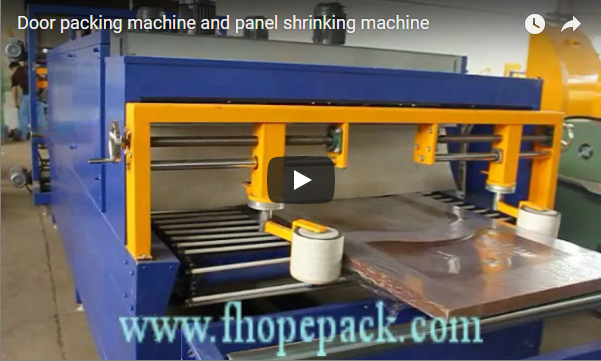
- Shrink. The bag passes through a hot-air tunnel, and the film shrinks onto the stack.
- Cool. A group of cooling fans sets the film at the tunnel exit.
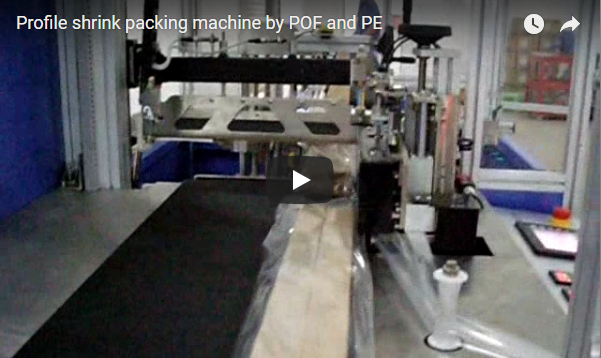
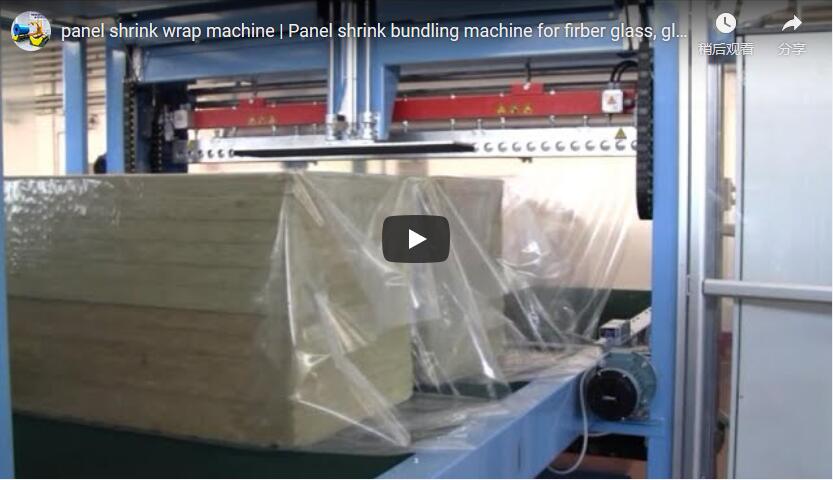
In our video, side plates close in to square the stack before it enters the bag, so the panels do not shift in the seal. In the tunnel, the loose film pulls tight onto the panel edges, so the stack leaves as one rigid pack that protects the foam corners.
Panel size window
| Stack dimension | Range |
|---|---|
| Length | 300–1,000 mm |
| Width | 30–500 mm |
| Height | 180–500 mm |
Check your largest and smallest stacks against all three ranges. A stack of 50 mm panels, ten high, is 500 mm, which is the top of the height range. Longer boards, such as full-size insulation sheets, need a line built to their length, or a panel stretch wrapping machine that wraps without heat. We confirm the size on your drawing.
Heat-sensitive foam
EPS and XPS soften with heat, so the tunnel has to shrink the film without marking the foam. The tunnel temperature is set from 100 °C to 220 °C, and the conveyor speed sets how long the pack stays inside. The thin film heats much faster than the foam, so a short pass shrinks the film before the foam warms through. We test your panels at the lowest temperature that still shrinks the film tight.
When a panel cannot take the heat, our panel bagging machine is the alternative. It makes the bag on the machine, fills the panel into it and seals it without heating, with 2 sealers and PLC and HMI control.
Estimate packs per minute
Illustrative example for 1,000 mm stacks with a 300 mm gap between packs:
| Conveyor speed | Pitch per pack | Packs per minute |
|---|---|---|
| 4 m/min | 1.3 m | about 3.1 |
| 9 m/min | 1.3 m | about 6.9 |
Packs per minute = conveyor speed ÷ (pack length + gap). This is the conveyor limit. The seal bar also needs time to close, seal and open for each pack, and the tunnel temperature may cap the speed for heat-sensitive foam. Output is set by the slowest of the three, so we confirm it on a trial.
Line data
| Item | Sealing section | Shrink tunnel |
|---|---|---|
| Length | 2,000 mm | 4,000 mm |
| Power | about 1.8 kW | about 15 kW, 4 heaters |
| Control | PLC | — |
| Working table height | about 800 mm | — |
| Temperature | — | 100–220 °C |
| Film | PE or POF with vent holes | PE or POF with vent holes |
| Conveyor speed | about 4–9 m/min | — |
Utilities and safety
The line needs compressed air at 6–8 kgf/cm² and a 380 V supply. Vent holes in the film let air escape as it shrinks, so the bag does not balloon. The seal bar is heated at all times, so we guard it and fit an emergency stop at the infeed.
The standards that apply depend on the destination market. For CE markets, ISO 12100 sets the risk-assessment method and EN 415-10 sets general requirements for packaging machines.
Selection checklist for an EPS panel shrink line
- Stack length, width and height, smallest to largest.
- Foam type and heat resistance.
- Shrink pack or non-heated bag.
- Packs per minute needed.
- Manual infeed or link to the production line.
- Film type: PE or POF.
- Local power supply and compressed air.
Engineering FAQ
Q: What stack sizes fit? A: 300–1,000 mm long, 30–500 mm wide and 180–500 mm high.
Q: Will the tunnel damage EPS? A: We set the tunnel between 100 °C and 220 °C and test your panels at the lowest temperature that shrinks the film.
Q: What if our panels cannot take heat? A: Our panel bagging machine seals the bag without heating.
Q: How many packs per minute? A: For 1,000 mm stacks with a 300 mm gap, about 3 to 7, from 4 to 9 m/min.
Q: Can it link to our production line? A: Yes. It can run automatically from the line, or with manual feed.
Next step
We plan your panel packing line in three steps:
- Submit your layout drawing with panel sizes and output to info@fhopepack.com.
- Receive a proposal within 48 hours, with the line layout and film choice.
- Book a site survey to check the line link and utilities. We also set the tunnel temperature on a trial with your panels.
Related reading
- Panel packing machine
- Automatic panel packaging line
- Video: automatic profile and panel bagging and shrinking line
Sources
- FPSH-D and bagging machine data: panel packing machine page
- Machine in action: our EPS and XPS board shrink line video on YouTube
- Standards scope: ISO 12100:2010, EN 415-10:2014
Last reviewed: 2026-10-04