Executive summary: This page is for packaging engineers, mill operations managers, and procurement teams evaluating in-line wrapping technology for cold rolled steel coils. It details how an automated wrapping station operates directly within the line flow—using an orbital wrapping frame, multi-roll film shuttles, and blocker roller stations to apply protective VCI and stretch film without off-line handling—and provides a technical verification framework to confirm supplier capabilities before procurement.
Table of Contents
- What this page helps you decide
- What in-line wrapping technology does
- How a coil is wrapped in line
- What to verify before you buy
- What the machine does
- Buyer’s verification checklist
- FAQ
- Related reading
- Next step
What this page helps you decide
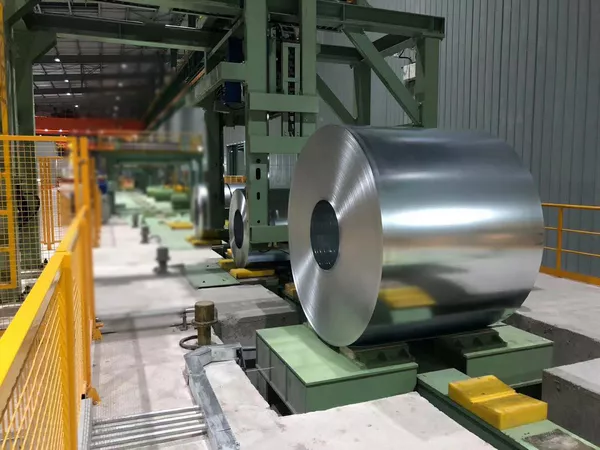
When cold rolled coils exit the mill, off-line handling adds surface damage risk, bottlenecks and crane dependency. In-line wrapping integrates the protective packaging stage into the continuous conveyor flow, applying film while the coil stays staged on the line.
This guide turns that into criteria for evaluating an in-line station against your mill’s throughput:
- Machine envelope compatibility across your OD, ID and width range.
- Cycle time and transfer speed against upstream mill output.
- Drive controls, tension feedback and safety layers.
The verification checklist at the conclusion provides a standardized, tender-ready engineering request to submit directly to machine builders.
What in-line wrapping technology does
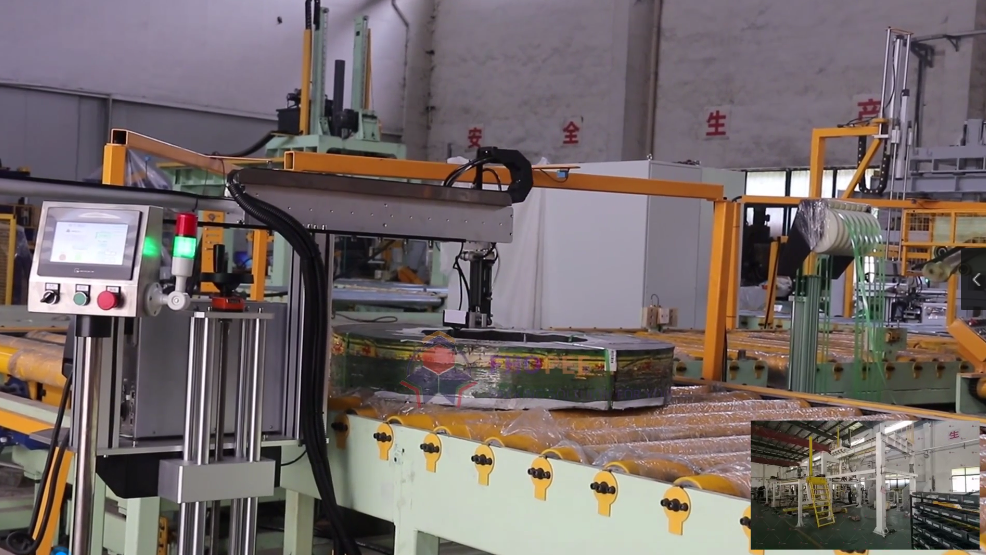
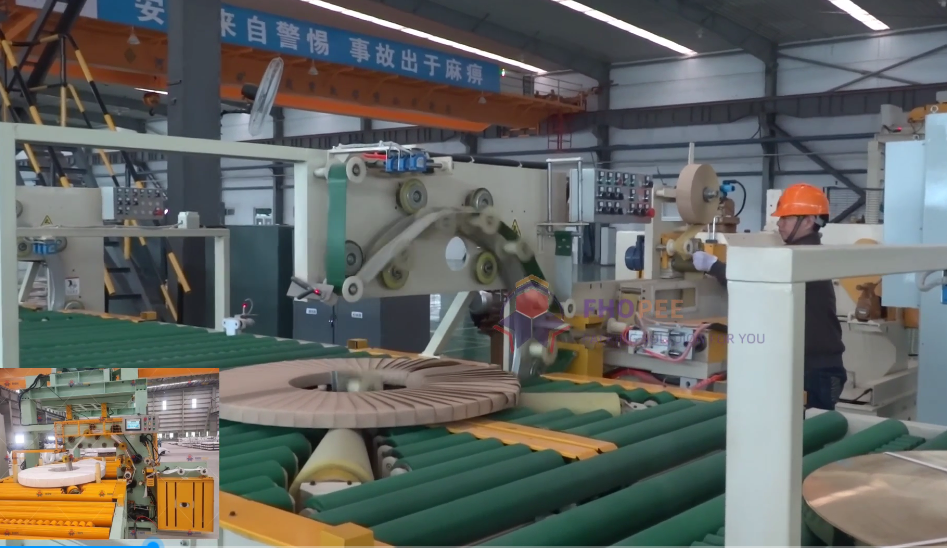
An in-line wrapping station applies full-coverage protective packaging while the coil travels on the live process conveyor. The coil advances into the station and is cradled by blocker roller stations engineered for orbital wrapping.
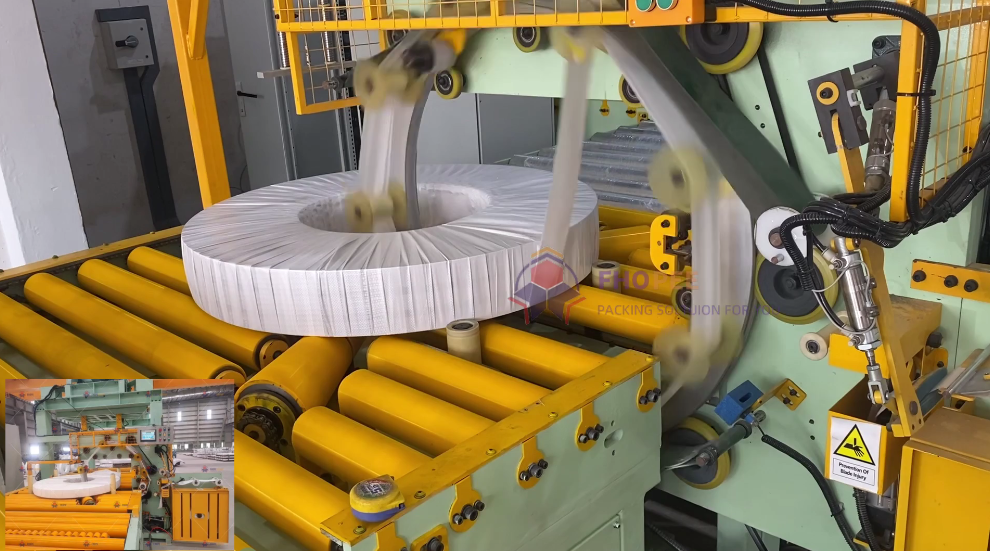
A rotating wrapping frame surrounds the coil. The film shuttle passes through the eye of the coil, drawing film from the roll carriage and applying continuous, overlapping layers while the coil stays stabilized on the driven rollers. Interlocked safety fencing encloses the rotating envelope, and the wrapped coil discharges onto the downstream conveyor.
Per manufacturer technical specifications, the wrapping station checks the coil size to move, position and wrap the load automatically. Film shuttles accommodate two or three rolls simultaneously to enable uninterrupted overlap wrapping and extend duty cycles between roll changes. Closed-loop tension controllers regulate film unwind force across both minimum-width slit coils and maximum-diameter master coils. Applying VCI (Vapor Corrosion Inhibitor) film creates an airtight, dustproof, and moisture-resistant barrier that protects cold rolled surfaces against transit oxidation and ambient humidity during storage.
How a coil is wrapped in line
The wrapping sequence coordinates the rotating ring frame, dual-roller support stations, and conveyor drives through a fixed mechanical sequence:
- Position. The infeed conveyor transfers the coil to the station centerline, where blocker rollers cradle the load in an upright, stable orientation.
- Rotate. The orbital wrapping frame accelerates along precision track guides around the workpiece profile.
- Wrap. The shuttle draws film from the roll carriage, passing repeatedly through the coil eye and over the outer diameter, applying calculated layer overlaps until full surface encapsulation is achieved.
- Finish. The rotating frame executes a controlled deceleration stop, the pneumatic cut-and-clamp unit secures the trailing film tail, and the wrapped load discharges via the exit roller conveyor.
Because the workpiece stays held on the roller centerline while the frame rotates around it, the same sequence wraps other upright workpieces on the same conveyor bed.

What to verify before you buy
Capacity, dimensional ranges and cycle speeds are project figures: they must come from the supplier in writing.
- Coil envelope: Minimum and maximum coil outer diameter, inner diameter, face width, and maximum weight limits.
- Line throughput: Coils processed per hour, including indexing, scanning, wrapping, and discharge transfer durations.
- Film delivery carriage: Usable film roll core dimensions, roll outer diameter, film gauge range, power pre-stretch ratio, and multi-roll shuttle capacity.
- Wrap recipe programming: Overlap percentage (e.g., 20% to 80%), layer counts, surface tension limits, and reinforced edge wrapping programs.
- Control integration: Fieldbus communication (Profinet, Ethernet/IP), upstream mill synchronization, and downstream material handling logic.
- Safety compliance: Physical perimeter guarding, interlocking light curtains, safety PLCs, Category 4 / PLe safety architecture, and emergency stop circuits.
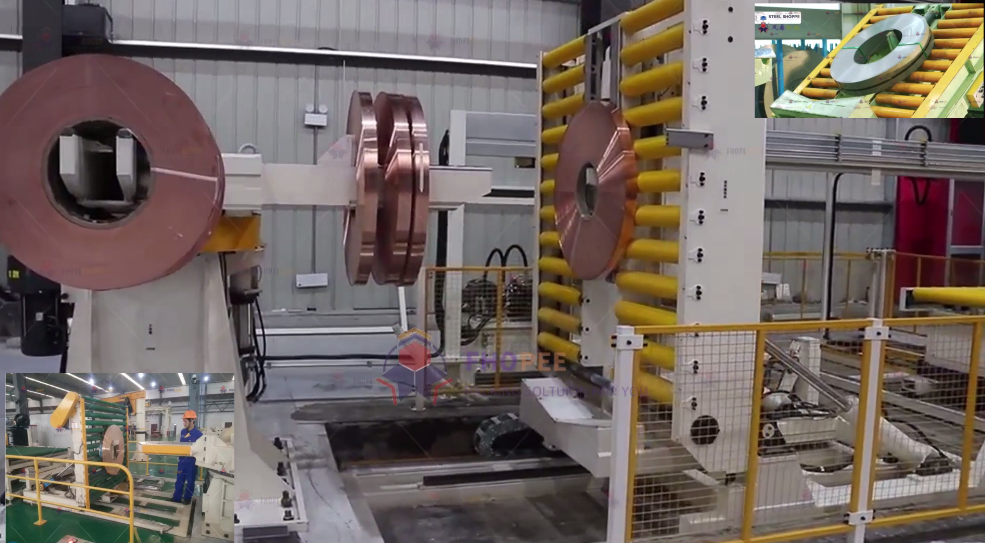
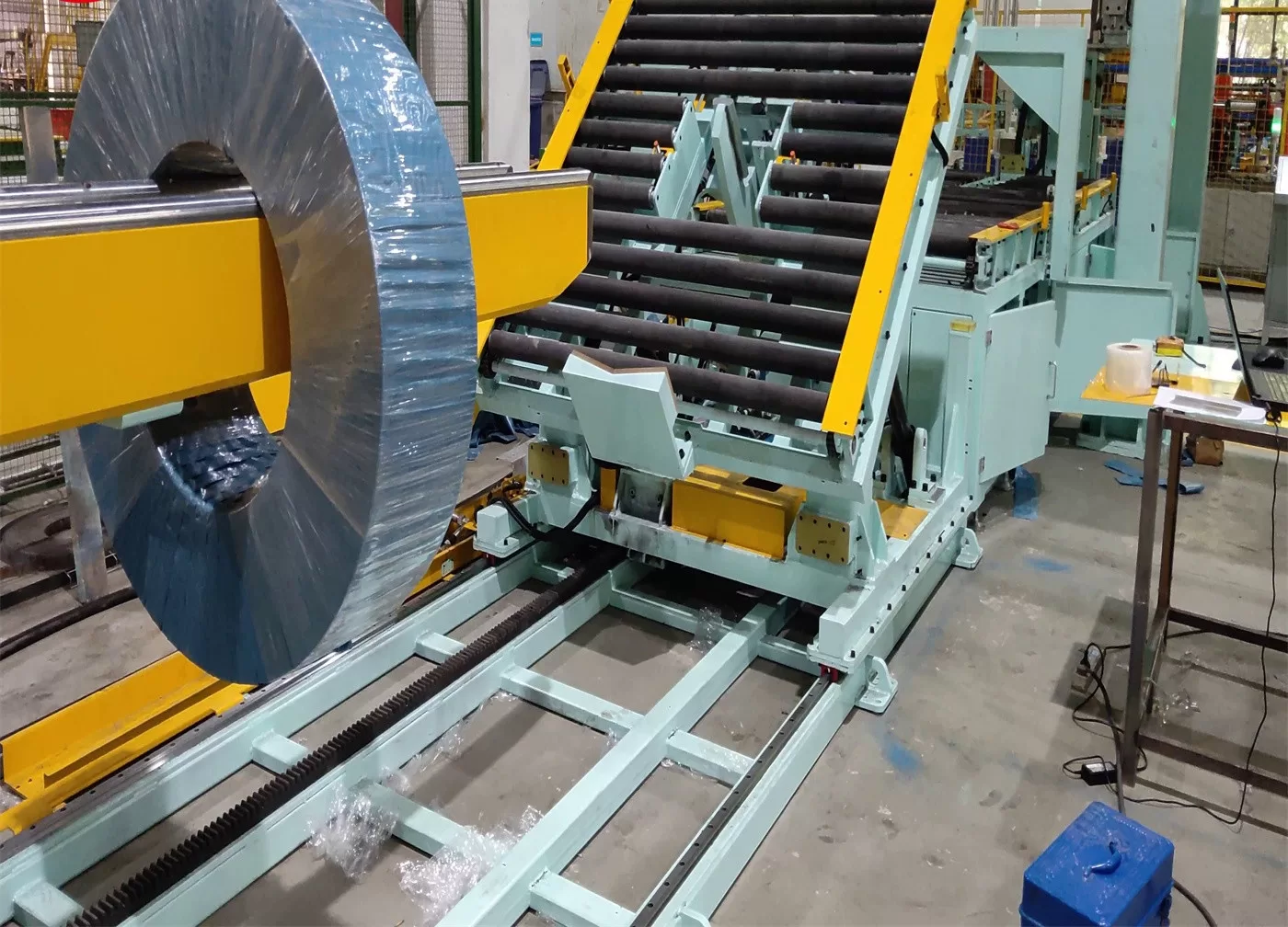
When the wrapper operates as an integrated cell within a full coil handling line, verification must cover upstream and downstream equipment compatibility. Typical automated plant configurations integrate 2-arm or 4-arm heavy-duty turnstiles (handling payloads up to 60 metric tons with arm lengths to 2000 mm), hydraulic down-enders equipped with internal mechanical failsafe locks to prevent load drops during 90-degree tilting, eye-through orbital wrappers, and automated gantry stacking cranes.
The complete cell should integrate under a central PLC platform (Siemens, Rockwell, or Mitsubishi) paired with an industrial HMI touchscreen for recipe selection, diagnostic alarms, and production logging. Variable frequency drives (VFD) provide smooth ramp control for heavy rotational masses, while safety logic (Pilz, Siemens, or Omron) complies with CE standards and ISO 13849 architecture.
What the machine does
The core wrapping cell operates via three integrated mechanical assemblies:
- Orbital wrapping assembly: A structural steel ring frame carrying the high-speed rotating orbital head, counterbalanced drive guides, and dynamic shuttle carriages.
- Film dispensing carriage: A powered multi-roll film shuttle positioned on the rotating frame, equipped with pre-stretch rollers, dancer arm tension sensors, and pneumatic end-tail clamp-and-cut mechanisms.
- Conveyor and positioning station: A heavy-duty roller conveyor with dual blocker roller stations that hold the coil upright and fixed during the wrapping cycle.
The process operates deterministically. Once the coil centers within the frame, the automated system runs the assigned wrap recipe, maintaining constant film tension regardless of roll core diameter changes. Interlocked perimeter fencing guards the rotating envelope, with optional light curtains monitoring the conveyor entry and exit.
Buyer’s verification checklist
| Specification to Request | Operational Impact on Mill Packaging |
|---|---|
| Min/max coil OD, ID, face width, and metric tonnage | Determines structural clearance within the wrapping ring and roller load capacity |
| Rated cycle time and net coils-per-hour output | Verifies station packaging tempo matches upstream rolling or slitting mill speeds |
| Film core sizing, pre-stretch ratio %, and roll changeover style | Dictates consumable film efficiency, barrier integrity, and operational uptime |
| Layer overlap %, edge reinforcing passes, and tension bounds | Defines moisture-seal quality, rust prevention (VCI), and film edge tears |
| Mill control architecture, PLC handshake, and conveyor interface | Ensures real-time tracking, recipe download from MES, and smooth line flow |
| Safety certification: Guarding, E-stops, and ISO 13849 compliance | Guarantees plant regulatory compliance, operator safety, and risk mitigation |
Send to the supplier: Please confirm for the in-line wrapping machine you are quoting: (1) the minimum and maximum coil outer diameter, width and weight; (2) coils per hour and rated cycle time; (3) film width, thickness, pre-stretch and roll change; (4) the number of layers, overlap and tension control; (5) how the machine integrates with the line control and downstream flow; (6) fitted safety devices including guarding, emergency stop and certifications.
FAQ
Does the coil rotate during wrapping? The coil stays upright and fixed on the blocker rollers at the machine centreline while the orbital frame turns around it to apply the protective film layers.
What other loads can this in-line station wrap? The same orbital motion and conveyor pass-through can wrap other upright workpieces, such as stacks of corrugated board or paper rolls, on the same bed.
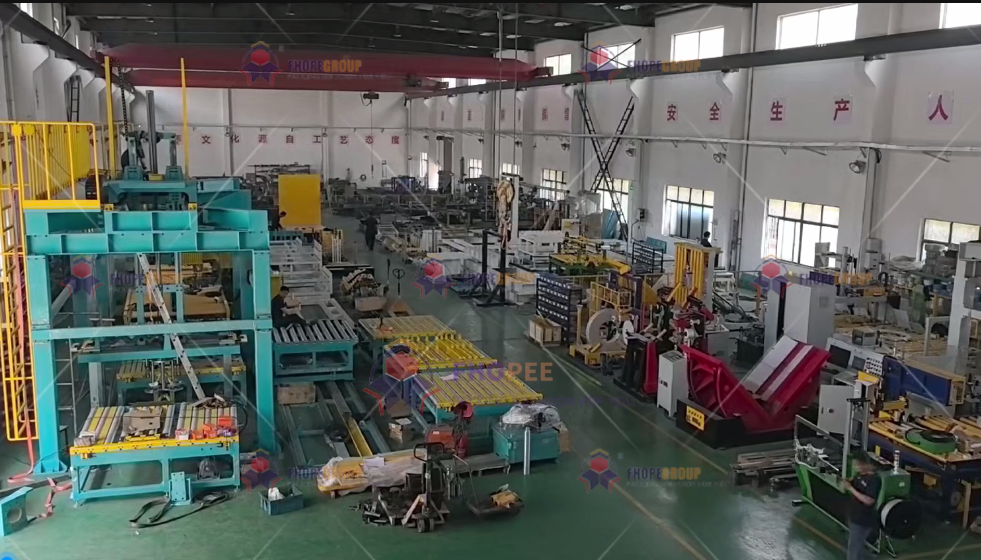
Is the wrapping station supplied as a standalone unit or full line? The in-line wrapper can be integrated as an independent retrofit into existing conveyor lines or delivered as part of a fully engineered packaging line including turnstiles, down-enders, gantry stackers, and automated banding stations.
Related reading
- In-Line Wrapping Technology for Cold Rolled Steel Coils
- Master Coil Wrapper
- Automatic Coil Packing Line
- Coil Packing Machine
- Steel Coil Wrapping Machine
- Horizontal Coiling Machine
Next step
Provide your specific coil envelope (minimum/maximum OD, width, weight), target coils-per-hour output, and environmental protection requirements (such as VCI rust inhibition or UV barrier films) to the machine builder.
Review the proposed wrap patterns, pre-stretch efficiency ratings, and shuttle configurations to establish true operating cost and cycle viability.
Evaluate how the station’s control network, safety fencing, and conveyor interfaces integrate into your plant layout. Contact our engineering team via the contact page to receive a line evaluation and formal engineering proposal.
Last reviewed: 2026-10-29