Executive summary Motorcycle tires ship best as a tight, sealed stack that shows the brand on the outside. Our automatic tire packing line straps the stack first, sleeves it in printed film, then shrinks the film in a heat tunnel so it pulls tight around the stack. In the shrink stage, a strapped, film-covered tire stack rides through the tunnel on a roller conveyor and comes out with the film closed around it. Stack size, strap count and tunnel size are set per project to your tire range.
Table of Contents
- What the machine does
- The line, station by station
- Why strap before shrinking
- Printed film
- What we size per project
- Controls and safety
- Selection checklist
- Engineering FAQ
- Next step
- Related reading
- Sources
What the machine does
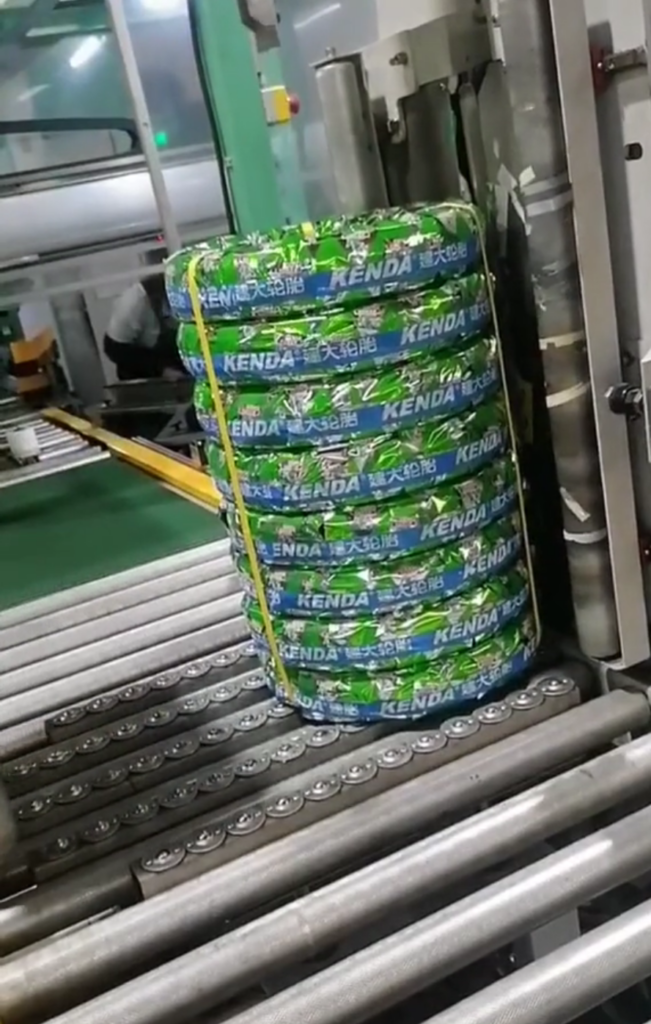
A strapped tire stack covered in printed film waits on the roller conveyor at the tunnel entry. The conveyor carries it through the thermal entry curtain into the shrink tunnel. Inside, continuous circulating heat shrinks the film down onto the stack. The stack leaves on the outfeed rollers with the film pulled close and sealed around the tires.
The line, station by station
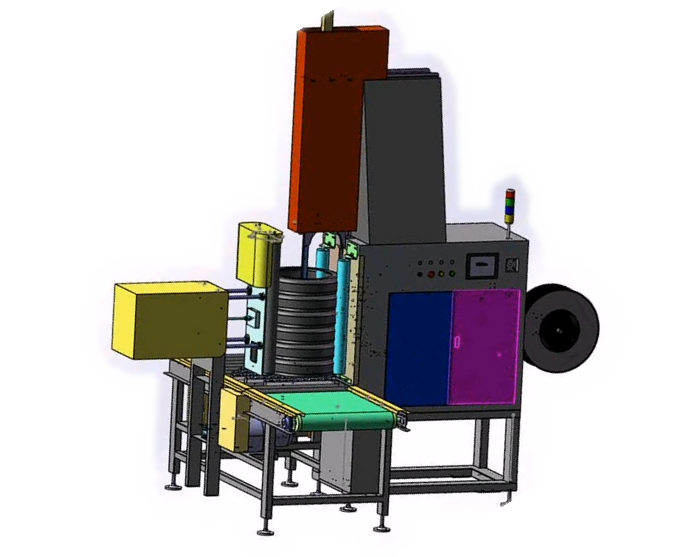
| Station | What it does |
|---|---|
| Stacking | Tires are laid flat into a stack of the set count |
| Strapping | Straps tie the stack so it holds its shape |
| Film sleeving | The strapped stack is covered in printed film |
| Shrink tunnel | Heat shrinks the film tight around the stack |
| Outfeed | Roller conveyor carries the finished pack to palletizing |
Each station hands the stack on by powered conveyor, so nobody lifts tires between steps.
Beyond standalone packaging units, complete turnkey lines integrate upstream information reading and downstream handling:
- Upstream and In-line Identification: Integrates with information reading and sending modules (such as barcode scanners or RFID tracking) to match stack specifications automatically.
- Handling & Palletizing: Direct tie-in with horizontal transfer systems and automatic tyre palletizing equipment, tailored to client factory layout.
- Drive and Speed Synchronization: Ring drives, motorized rollers and infeed/outfeed conveyors carry independent frequency inverters for variable-speed adjustment; rates are set per project against your tire range [manufacturer rating].
- Core Automation Standards: Comparable automated tire packaging lines run Siemens PLC and touch-screen HMI control with Airtec pneumatic components, Autonics optical sensors and Schneider contactors and switchgear [manufacturer rating].
Why strap before shrinking
Shrink film pulls in on every side as it cools. An unstrapped stack of rubber tires can shift sideways under that pull and come out leaning. Strapping holds the stack square first, so the film only has to seal and cover it. It also keeps the pack together if the film is torn during handling or transit.
Single tires are a different job requiring machine separation:
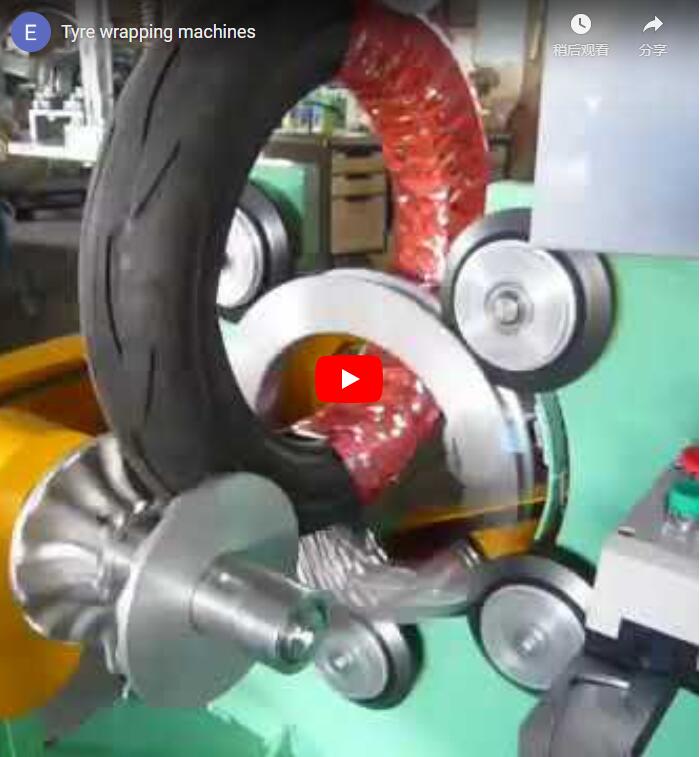
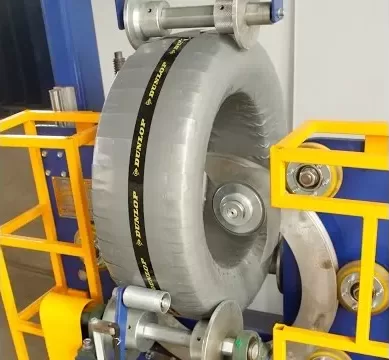
- Single-Tire Packaging: Handled by an automatic horizontal eye-through tyre stretch wrapper. This standalone machine winds protective stretch film directly through the tire eye at rotation speeds of 10 to 120 r/min, wrapping individual units weighing 10 to 100 kg within 25 to 35 sec/pcs [manufacturer rating].
- Multi-Tire Bundle Packaging: The line detailed here packs a multi-tire stack as a single strapped, shrink-wrapped shipping unit, eliminating single-unit handling overhead.
Printed film
A shrink sleeve with a repeating brand print needs no lining up on the stack, so any part of the film shows the brand uniformly. In contrast, a single large logo requires precise film registration to position the graphic relative to the stack before heating. Because shrink film contracts under heat, the original artwork must be dimensioned to compensate for proportional graphic distortion during cooling.
What we size per project
| Item | Set by |
|---|---|
| Stack height | Tires per pack and tire width |
| Conveyor width | Largest tire OD |
| Strap positions | Stack height and tire OD |
| Tunnel opening | Largest finished pack |
| Film | Thickness and print, chosen for your pack |
Pack height and total load mass follow directly from tire count. Illustrative example for a pack of 10 tires:
| Item | Example |
|---|---|
| Tire width | 90 mm |
| Tires per pack | 10 |
| Stack height, 10 × 90 mm | 900 mm |
| Tire weight | 4 kg |
| Pack weight, 10 × 4 kg | 40 kg |
A 40 kg pack exceeds standard single-operator manual handling limits and represents a two-person lift; outfeed conveyors should be engineered to feed directly onto palletizing stations or an automatic palletizer. Machine cycle speeds depend on your exact tire dimensional range (outside diameter, section width, and pack height). Provide your smallest and largest tire profiles, and our engineering team will calculate cycle times and line parameters around them.
Controls and safety
The shrink tunnel sits integrated on the conveyor line with a dedicated control panel for temperature, air circulation, and conveyor speed regulation. Operators must keep hands and tools outside the hot entry curtain while the heating chamber is energized. Finished packs must remain on the motorized outfeed accumulator long enough to cool and set structurally before palletizing or clamp-truck transfer.
System design adheres to destination-market machinery directives:
- Risk Assessment: ISO 12100 defines baseline risk-assessment principles and hazard reduction for machinery design.
- Packaging Safety: EN 415-10 governs general safety requirements for packaging machines, covering conveyor interlocks, guarding clearances, and thermal hazard containment.
Selection checklist for a tire packing line
- Smallest and largest tire OD, ID and width.
- Tires per pack.
- Packs per hour.
- Strapping only, or strapping plus shrink.
- Printed or plain film.
- Palletizing after the line, by hand or automatic.
Engineering FAQ
Q: Why use shrink film on tire stacks? A: The film shrinks tight around the stack, which seals it against dust, road moisture, and surface contamination while displaying brand print continuously on the outside.
Q: Why strap before the shrink tunnel? A: Shrinking film exerts omnidirectional inward tension as it cools. High-tension straps lock the tire stack square and true beforehand, preventing the stack from racking, slipping, or leaning.
Q: Can I use my own printed film? A: Yes, provided the film is compatible with standard shrink properties. Continuous repeating prints require no registration sensors; a single centralized logo requires optical print registration to index the sleeve before entering the tunnel.
Q: Is the shrink tunnel always needed? A: No. The line can operate as a strapping-only system if downstream distribution networks only require mechanical bundling without surface dust and weather protection.
Q: How is the line sized? A: Sizing is governed by your envelope boundaries: maximum tire OD defines conveyor roller width, while maximum stacked height and tire OD define strapping arch clearance and shrink tunnel chamber dimensions.
Next step
We plan your tire packing line in three steps:
- Submit your layout drawing with tire sizes, pack count and output to info@fhopepack.com.
- Receive a proposal within 48 hours, complete with station layout drawings, cycle time estimates, and mechanical specifications.
- Book a site survey to check floor space, power drops, pneumatic supplies, and downstream palletizing area integration.
Related reading
Sources
- Line content, strapping and shrink stages: FHOPE engineering team, 2026-10-04
- Machine in action: our motorcycle tire packing line video on YouTube
- Standards scope: ISO 12100:2010, EN 415-10:2014
Last reviewed: 2026-10-29