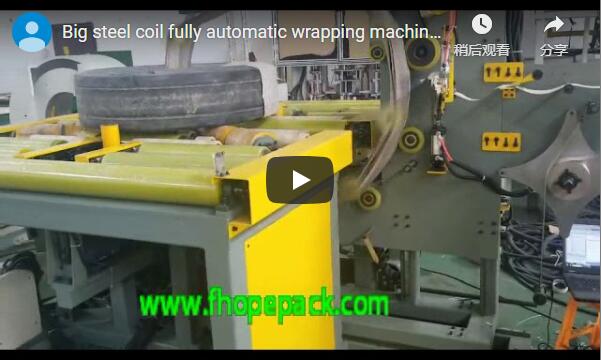
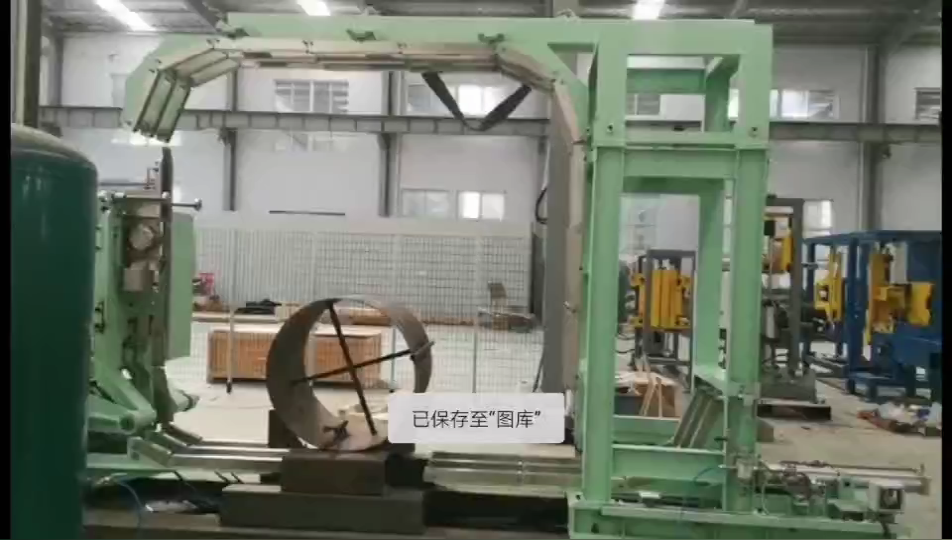
Executive summary This clip records a full-load hot commissioning run of one of our prepainted steel coil packing lines in our factory. A coil is laid flat, held by a press plate, strapped, given a protective side cover and sent on, and the run continues into the night with finished coils stacking up behind the line. Below we walk through the stations, the checks we run before a line ships, and the published range of our slit coil packing line, 20–30 coils per hour.
Table of Contents
- What the clip shows
- Why we run full-load hot commissioning
- Factory test plan, station by station
- Published line range
- Commissioning checklist for your factory acceptance test (FAT)
- Controls and safety
- Engineering FAQ
- Next step
- Related reading
- Sources
What the clip shows
| Clip time | Station | What happens |
|---|---|---|
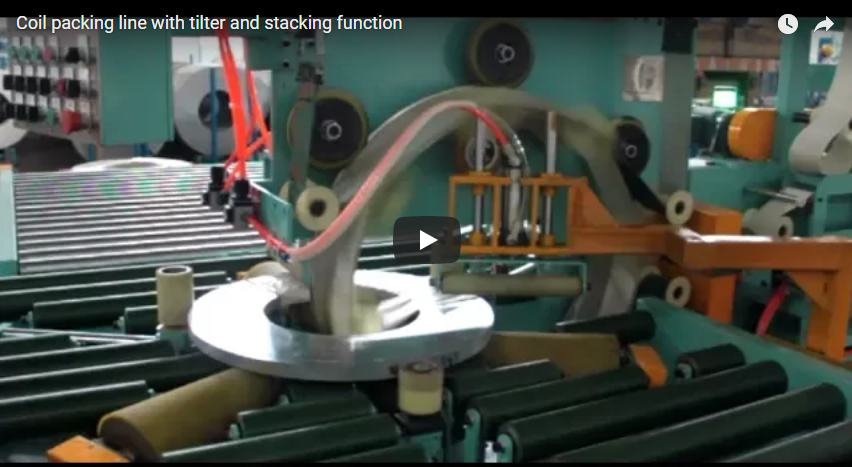
| 0–10 s | Tilting table | The coil stands upright on yellow rollers, then the table lays it flat |
| 10–22 s | Press | An overhead arm brings a yellow plate down and holds the coil |
| 22–34 s | Strapping | The upper strapping unit moves to the coil centre and applies the strap, then lifts |
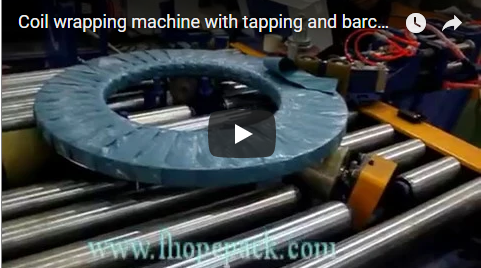
| 34–44 s | Side cover | A side arm lays white protective material round the coil |
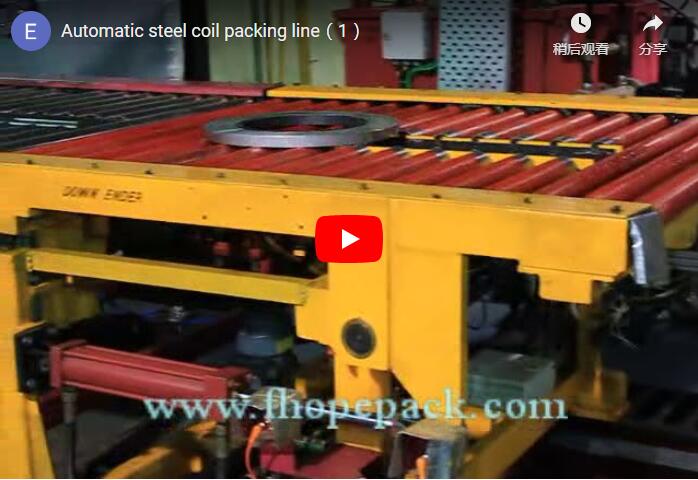
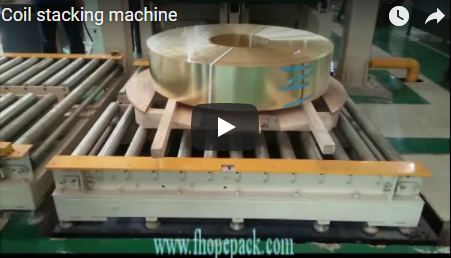
| 44–50 s | Line view | The coil moves out; the wide shot shows the full line and a stack of finished coils |
A small 3D animation in the corner of the clip shows the same machine layout. The white control cabinet carries a red signal light, and yellow guard rails surround the line. Daylight fades during the run, so the line kept cycling under load from day into night.
Why we run full-load hot commissioning
A dry run proves that each axis moves. A hot run with real coils proves that the stations work together at the rated weight:
- Real loads. The tilting table, press and conveyors carry real coils, so drive sizing and brake settings are tested at weight.
- Real consumables. Strap and protective material are fed from production rolls, so feeding, cutting and sealing are tested as they will run on site.
- Long run. Cycling for hours shows faults that one cycle hides, such as a sensor that drifts or a strap feed that slips after many joints.
- Shorter site start-up. Faults fixed in our factory are faults your crew does not meet during installation.
Factory test plan, station by station
| Station | What we check under load |
|---|---|
| Tilting table | Smooth lay-down from upright to flat; coil stays centred on the rollers |
| Press | Plate holds the coil without marking the painted surface |
| Strapping | Strap position, tension and joint quality on every cycle |
| Side cover | Material overlap and edge cover all round the coil |
| Conveyors | Stop positions repeat between stations |
| Controls | Signal light, stops and restarts after an interrupted cycle |
Prepainted coil needs extra care at every contact point, because a mark on the paint is a reject. We check press pads, roller covers and the strap path for contact marks before sign-off.
Published line range
Our steel coil packaging line for slitting strip is published with this range; every line is built to the coils of the project:
| Item | Published value |
|---|---|
| Coil weight | 100–3000 kg |
| Coil OD | 900–1400 mm |
| Coil ID | 508 mm |
| Coil width | 15–450 mm |
| Speed | 20–30 coils per hour |
| Materials | Stretch film, VCI paper, woven belt |
| Controls | Siemens S7-1200 / S7-1500 PLC, 7–10 inch HMI |
Commissioning checklist for your factory acceptance test (FAT)
- Send sample coils, or their weight, OD, ID and width, so the run uses your sizes.
- Agree the run length and the target coils per hour.
- Supply or approve the strap and protective material you will use.
- List the surface-quality criteria for prepainted coil.
- Agree the fault tests: stop, restart, material change.
- Decide who witnesses the test, on site or by video.
- Confirm the destination market for the risk assessment file.
Controls and safety
The tilting table, press and strapping unit all move with a coil in place. The line in the clip is fenced with yellow guard rails, and the control cabinet stands outside the moving zone. Access during a cycle is closed off; maintenance is done with the line stopped and isolated.
The standards that apply depend on the destination market. For CE markets, ISO 12100 sets the risk-assessment method and EN 415-10 sets general requirements for packaging machines; the tilting table is also covered by our upender practice under EN 415-10.
Engineering FAQ
Q: What is hot commissioning? A: Running the complete line with real coils and real consumables at full load in our factory, before it ships.
Q: How many coils per hour does this kind of line pack? A: Our slit coil packaging line is published at 20–30 coils per hour.
Q: What coil sizes does the published line cover? A: 100–3000 kg, OD 900–1400 mm, ID 508 mm and width 15–450 mm; other sizes are built per project.
Q: Why does the coil go flat before strapping? A: Laying the coil flat on the table lets the press plate hold it while the strap goes on through the centre.
Q: Can I witness the test remotely? A: Yes. We run the agreed test plan and record it on video when you cannot attend.
Q: Which PLC and HMI run the line? A: The published line uses a Siemens S7-1200 or S7-1500 PLC with a 7–10 inch HMI.
Q: How do you avoid marking prepainted coil? A: We inspect every contact point under load, press pads, rollers and the strap path, and sign off only when the test coils show no contact marks.
Q: Which standards apply? A: For CE markets, ISO 12100 and EN 415-10.
Next step
We plan a coil packing line in three steps:
- Submit your layout drawing with coil weight, OD, ID, width and coils per hour, to info@fhopepack.com.
- Receive a proposal within 48 hours, with the station layout and the factory test plan.
- Book a site survey so we confirm the floor space, crane access and guarding.
Related reading
- Slit Coil Packing Line for Service Centers
- Automatic Steel Coil Strapping Machine for Slit Steel Coils
- Steel Coil Packaging Line with Tilting Rack, Wrapping and Press Station
- Automatic Steel Coil Strapping, Packaging and Stacking Line
- Coil Packing Machine Packing and Handling
- Steel coil packaging line for slitting strip
Sources
- Machine in action (our factory footage): the video on YouTube
- Coil weight, OD, ID, width, speed, materials, PLC and HMI: Steel coil packaging line
- Standards scope: ISO 12100:2010; EN 415-10:2014
- Proposal timing: approved house CTA (proposal within 48 hours)
Last reviewed: 2026-10-09