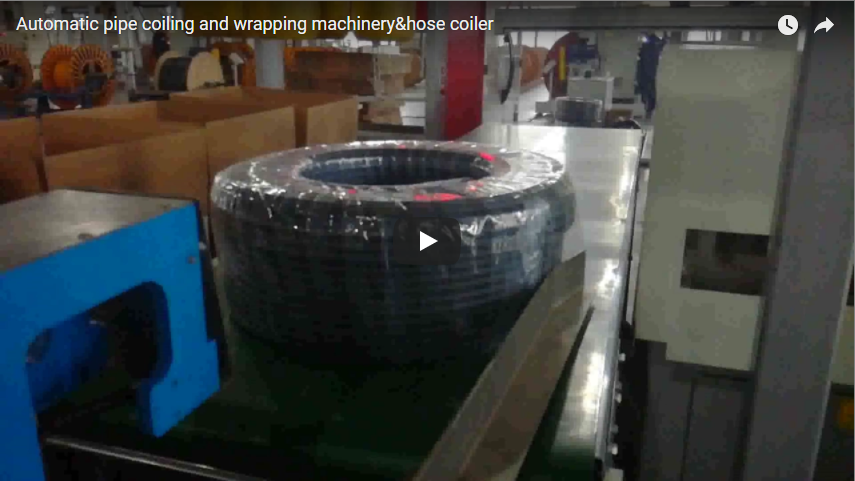
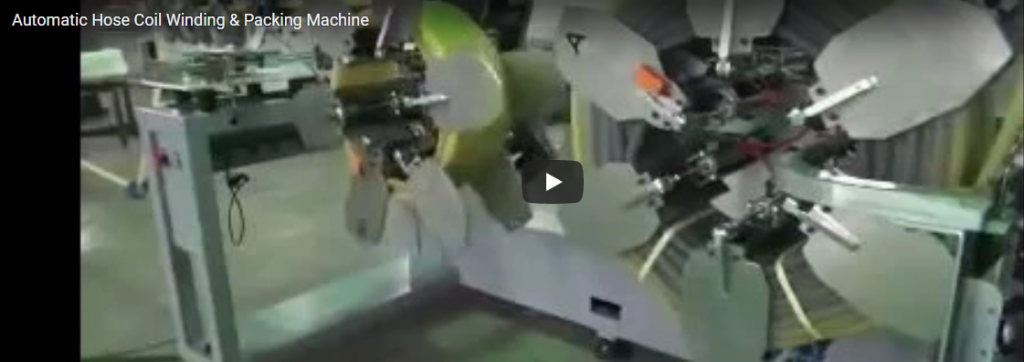
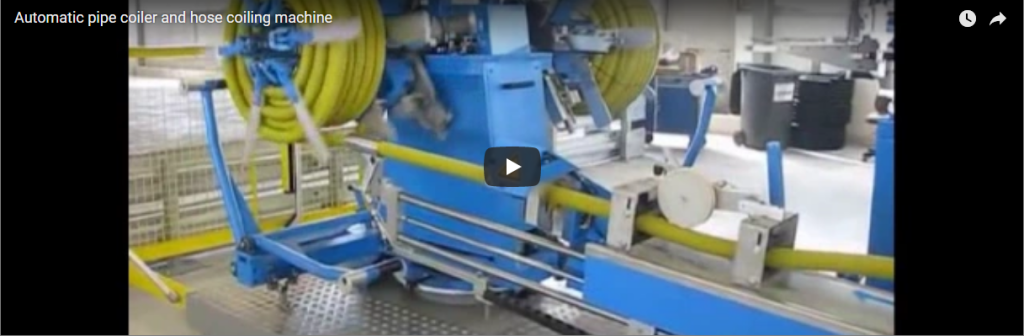
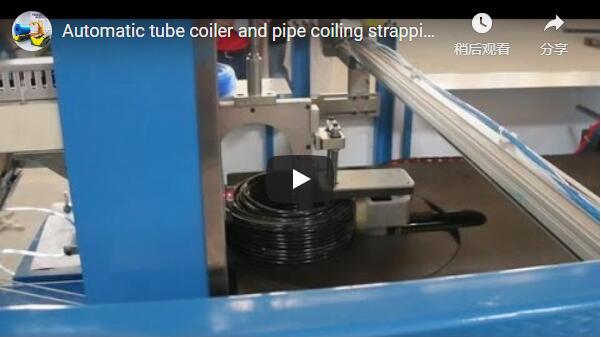
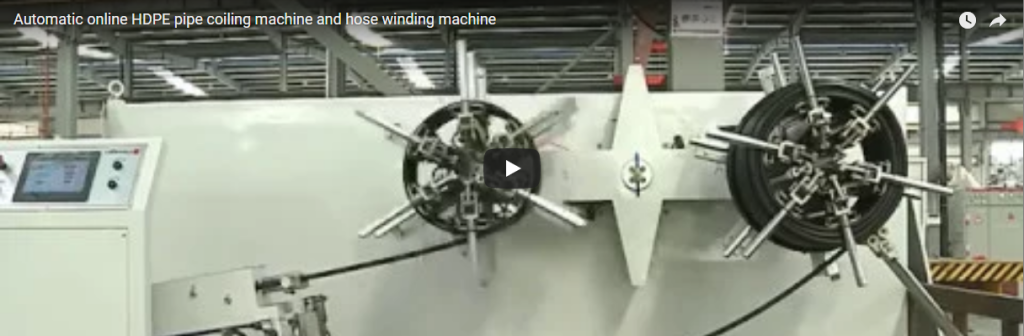
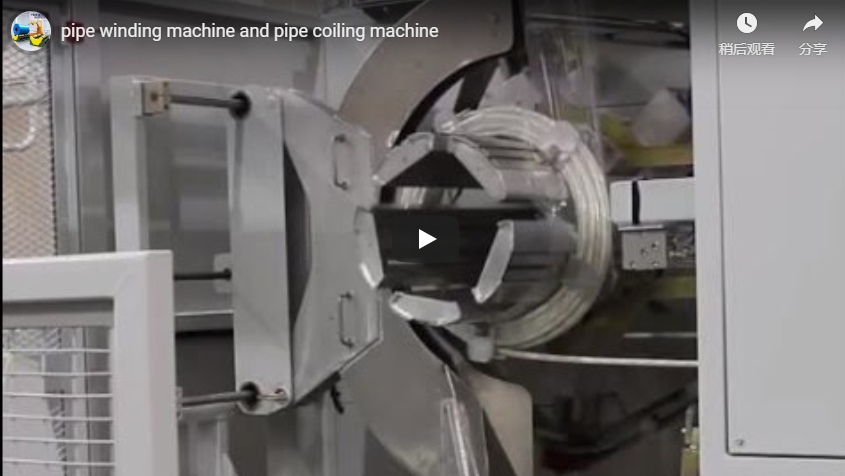
Executive summary This video shows a steel coil packaging line handling coils end to end: mechanical retrieval from a storage rack, roller-conveyor transfer, strapping/wrapping, a press-and-secure station, and weighing at a monitoring position. The footage demonstrates how mechanical handling replaces manual lifting and hand-tying, with an operator supervising rather than carrying. Coil sizes, cycle times and load ratings are not shown — confirm those with the manufacturer.
Many coil processors still pack coils the way they did twenty years ago: a forklift, a roll of film, and whatever time the crew can spare. The video on this page shows what changes when a dedicated steel coil packaging line takes over that job. Below, we walk through what the footage actually shows, what it deliberately does not prove, and what you should verify before comparing this type of line with your current process.
The machine in action: what the video shows
The video runs several minutes and shows more than one working sequence, apparently filmed at different points on the same style of line. Here is the visible flow, in order:
1. Coil storage and retrieval (from the start to roughly 100 seconds). A coil sits in an upright storage rack with vertical posts on the right side of the frame. A large white mechanical arm reaches in, grips the coil, and pulls it horizontally out of the rack while the rack tilts to release the coil safely. The arm then carries the coil toward the main processing area. A worker in a light vest stands near the equipment, observing rather than lifting.
2. Conveyor transfer (roughly 100–200 seconds). The coil is placed onto a roller conveyor with orange rollers and moves to the next station. At the wrapping position, strapping or stretch material feeds down from above, is tensioned around the coil, and the end is secured — forming a closed band around the coil. The coil then continues down the line past a yellow mesh guarding structure, and the camera pulls back to show the overall layout: feed area on the left, wrapping and securing units in the middle, and an output/staging area on the right.
3. Clamp, weigh, and wrap sequence (roughly 210–310 seconds). A large ring-shaped coil arrives on the conveyor and stops at a central station. A yellow overhead arm descends, clamps the coil, and centers it. During this sequence, a digital readout on the control panel updates continuously (values around 0.75 in the display’s unit), suggesting live weight or measurement monitoring. White strapping material feeds from a spool and wraps around the coil’s outer edge. The arm then lifts, and a worker moves the finished coil off the station by hand.
4. Press-and-secure station (roughly 315–385 seconds). A vertical press head with side clamp arms lowers onto a coil that is already partly covered in light-colored protective film, holds pressure, then rises again. The wrapped coil is conveyed forward to the exit position, resting on a wooden pallet base for removal.
5. Monitoring display (final shot). A close-up shows a digital instrument reading “50.1” — likely a weight or count readout at a quality-control position.
Direct observation notes
The following points stay close to what is visually confirmed in the footage:
- The line includes a vertical film-wrapping unit (with stretch film spool, tension rollers and guide wheels) on the left, a two-section roller conveyor in the center, and a tilting coil storage rack on the right.
- The main handling device is a large mechanical arm/clamping structure with a round pneumatic pressing plate beneath it.
- Control hardware includes a bright yellow console with buttons and indicator lights, a grey electrical cabinet with red/green/yellow buttons, a central cabinet with a touchscreen-style display, and a tower signal light (red/yellow/green) that changes with process status.
- At least two red mushroom-head emergency stop buttons are visible: one on the yellow console, one on the central cabinet.
- Yellow mesh safety guarding covers the wrapping station and parts of the working area; yellow floor markings appear near the arm’s travel zone.
- Coils shown are silver-grey, eye-to-the-side orientation, with visible center bores; estimated diameter roughly 1.0–1.5 m based on comparisons with the rack and conveyor — an estimate only.
- Digital readouts change during clamping (values near 0.75 in display units) and show “50.1” in the final close-up. The units and exact meaning are not confirmed in the footage.
- A manufacturer watermark is visible on the machine panels and in the frame corners throughout.
- Soft drink cans and bottles appear on a work surface in some frames, apparently used as size references; they are not part of the equipment.
What the video does not show
This matters if you are comparing quotes. The footage does not show:
- Coil specifications: width, thickness, material grade, or weight range (the display values are unexplained)
- Cycle time per coil, throughput, or capacity in tons per hour
- Machine power ratings, hydraulic/pneumatic pressure, or PLC/HMI brand and model
- Stretch film or strapping specifications (width, thickness, tensile strength)
- Safety certifications (CE, ISO or similar), light curtains, or door interlocks being tested
- Full end-to-end wrapping through to sealed, labeled, palletized output for every coil shown
- Maintenance procedures, spare parts lists, or warranty terms
Any of these could decide a purchase, so treat them as items to verify with the manufacturer rather than assumptions.
Why a packaging line changes the process
Based on what the video demonstrates, the practical differences from a manual process are:
| Manual coil packing | What the video shows |
|---|---|
| Forklift + hand wrapping | Mechanical arm retrieval from a tilting storage rack |
| Inconsistent strap tension by hand | Automated strapping fed, tensioned and secured by machine |
| Operators close to sharp coil edges | Operator supervises from outside the guarded zone |
| No weight record per coil | Digital readout updating during the clamp cycle |
| Walking coils between stations | Roller conveyor moves coils between positions |
None of these claims includes a number we cannot back — the efficiency gain is qualitative (“faster than manual, more consistent”) because the video contains no timing data.
Fit check: is this type of line right for your plant?
Use this checklist before requesting a quotation:
- Your coil diameter and weight range fall inside what the machine can handle — verify the rated range with the manufacturer
- You need repeatable strapping/wrapping (export prep, moisture protection, scratch prevention)
- You can allocate floor space for conveyor-length layout with a feed and exit zone
- Your team can operate basic button/touchscreen controls and respect guarding rules
- You want weight or count logging per coil (the video suggests this capability; confirm the data output format)
- You accept that some stations in the footage still use manual removal of finished coils — ask whether a fully automatic discharge option exists
FAQ
Does the line handle different coil sizes? The video shows coils of similar diameter at each station. Whether the clamp and rack are adjustable for other diameters is not shown — check with the manufacturer.
Is there a weighing function? A digital display updates during clamping and shows a separate reading in the final shot, which suggests live measurement. The units and whether it is weight or a counter are not confirmed — check with the manufacturer.
What safety features are included? Visible: mesh guarding, floor markings, multiple emergency stop buttons, a signal tower. Not visible: light curtains, door interlocks, or certification marks — check with the manufacturer.
How fast is one coil packed? The video does not provide cycle times. Ask for a measured cycle time at your coil specification.
Is the finished coil fully wrapped and palletized? The video shows film-covered and strapped coils, some resting on wooden pallets. A complete wrap-seal-label output is not shown end to end — confirm the full scope with the manufacturer.
What training does an operator need? The footage shows one worker supervising the arm sequence and another removing a finished coil. Formal training requirements are not shown; confirm with the manufacturer.
Related reading
- Automatic coil packing machinery
- Automatic coil packing line
- Steel coil wrapping machine
- Steel coil strapping machinery
- Automatic steel tube packing line
Next step
If your current coil packing still relies on hand wrapping and forklift shuttling, the sequence in this video is a reasonable picture of what an upgrade looks like on your floor. Send us your coil dimensions, weight range, and required output rate through our contact page, and we will confirm which configuration fits — including the rated specs and safety options the video cannot show.
Source and method
This article is based solely on the video above. Analysis was performed by a vision model on sampled frames of the footage. The video contains background music only — no narration or speech — so no audio transcription was used. Where the footage does not establish a fact (specs, ratings, certifications), that fact is either omitted or explicitly marked for confirmation with the manufacturer.