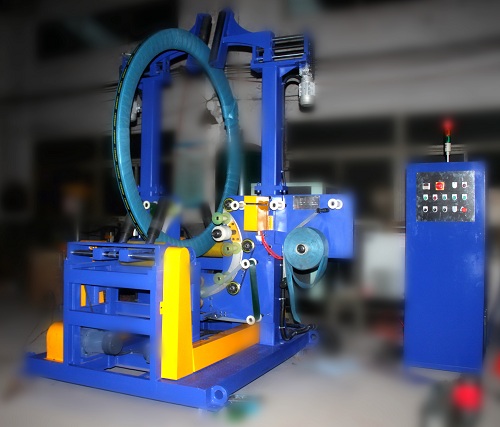
Coil Stacking Machine: Complete Guide

Summary: A coil stacking machine functions as the automated palletizing node within a complete slitting and packaging line. It utilizes servo‑controlled gantries, soft‑touch gripper arrays, and recipe‑driven algorithms to transfer wrapped coils onto standardized pallets with ±2 mm placement precision. By synchronizing with upstream wrapping, strapping, and weighing modules, the system eliminates manual handling, mitigates surface degradation, and maintains consistent throughput across variable coil geometries.

[VIDEO PLACEHOLDER]

🛠️ Core Questions

What is a coil stacking machine and how does it differ from a basic palletizer?

A coil stacking machine is a servo‑controlled gantry system that autonomously transfers wrapped metal coils from conveyor lines onto standardized pallets using pre‑programmed stacking patterns and ±2 mm positioning accuracy. Unlike generic palletizers, it integrates specialized soft‑touch grippers, hydraulic lifting mechanisms, and corrosion‑resistant packaging protocols to handle variable coil geometries without surface degradation.

Basic palletizers are engineered for uniform, rigid packaging formats such as cartons, bags, or shrink‑wrapped cases. They lack the dynamic load‑balancing algorithms and surface‑preservation mechanics required for metallurgical products. A dedicated coil stacking machine incorporates a V‑side platform to prevent lateral coil rolling during transfer, while PU‑covered rollers ensure zero marring on cold‑rolled, galvanized, or painted surfaces. The system accommodates extreme dimensional variance, processing everything from 15 mm slit coils to 30,000 kg heavy‑duty stock. Hydraulic lifting and tilting mechanisms operating at 140 bar provide controlled vertical articulation, allowing precise coil alignment before pallet placement. This specialized architecture ensures that high‑value finished goods maintain mill‑finish integrity throughout the automated handling sequence.

What are the key specifications of a coil stacking machine?

Industrial coil stacking machines are engineered to manage payloads up to 2,500 kg per coil and 6,000 kg per pallet, delivering ±2 mm placement precision through closed‑loop servo drives and programmable logic controllers. These systems synchronize with automated wrapping and strapping stations to maintain consistent throughput while accommodating diverse metallurgical surface requirements.

The mechanical architecture relies on high‑torque servo motors that drive linear gantry axes, enabling programmable stacking sequences without mechanical backlash. Positioning tolerances are maintained through absolute encoder feedback, ensuring repeatable coil placement within ±2 mm. The control system is typically built around a Programmable Logic Controller (PLC), which serves as the central processing unit for motion sequencing, safety interlocks, and recipe management. Communication with enterprise resource planning systems is facilitated via OPC‑UA (Open Platform Communications Unified Architecture), a machine‑to‑machine communication framework that enables real‑time data exchange for production tracking and quality documentation.

Parameter Typical Industry Range
Max coil weight 500 kg – 2,500 kg (standard); up to 30,000 kg (heavy‑duty)
Max pallet load 3,000 kg – 6,000 kg
Positioning accuracy ±2 mm (gantry); ±5 mm (turnstile integration)
Stacking height 1,800 mm – 2,500 mm
Gripper interface Electromagnetic (ferrous) / Vacuum (non‑ferrous)
Operating pressure 140 bar (hydraulic lifting/tilting)

Note: Specifications represent typical industrial configurations. Actual performance metrics vary based on coil metallurgy, pallet dimensions, and line synchronization requirements. Always verify load ratings with the manufacturer’s technical datasheet.

How does a coil stacking machine integrate with a complete packaging line?

Within a synchronized packaging cell, the stacking station operates as the final palletizing node, receiving fully wrapped and strapped coils from upstream processing modules. It utilizes intuitive human‑machine interfaces to execute recipe‑driven stacking sequences, eliminating manual labor dependency while ensuring standardized load stability for downstream logistics and export compliance.

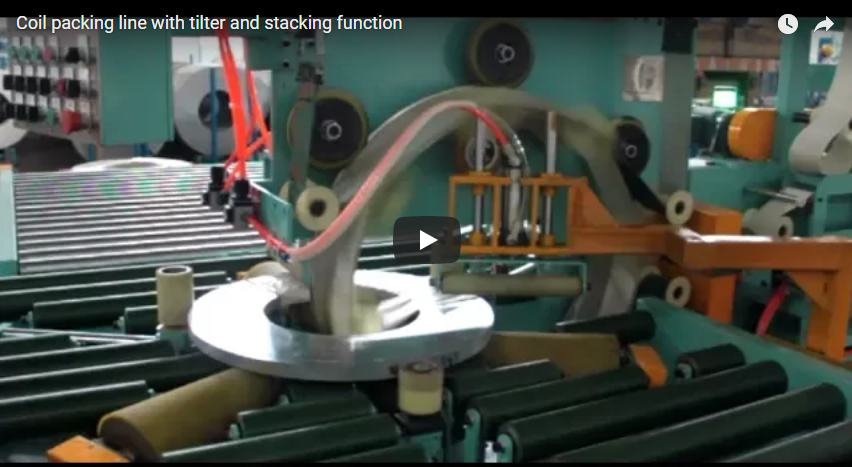
A fully automated packaging line functions as a continuous flow system where each station operates in temporal synchronization. The coil turnstile typically precedes the stacking machine, providing 180° or 360° rotation capability with multiple arms (2–4) to enable continuous loading. These turnstiles handle loads between 8–32 tons per arm and deliver coils to the stacking gantry with ±5 mm alignment tolerance. Once positioned, the stacking machine receives coils that have already undergone multi‑layer protective wrapping. The automatic steel coil packing machine applies stretch film (70–100 mm width, 20–23 μm thickness), HDPE heavy‑duty film, kraft paper moisture barriers, and woven foil for export‑grade protection. VCI (Volatile Corrosion Inhibitor) paper is frequently integrated to release protective vapors that prevent oxidation during transit. Steel or plastic strapping secures the wrap, after which the stacking machine executes the final palletization sequence. Intuitive HMIs allow operators to switch between full‑cover, side‑only, or diamond‑wrap configurations without mechanical retooling, ensuring rapid changeovers and consistent quality output.

🏗️ Advanced Questions

What stacking patterns and technologies are available for steel and non‑ferrous coils?

Coil stacking configurations utilize programmable logic controllers to execute geometrically optimized patterns such as 1‑2‑1 or 3‑2‑1 arrangements, dynamically adjusting to coil diameter and weight constraints. Advanced systems deploy PU‑covered rollers or vacuum‑based gripper arrays to preserve mill‑finished surfaces while maintaining ±2 mm alignment tolerances during high‑frequency cycle operations.

Pattern selection is dictated by coil mass, outer diameter, and pallet footprint. The 1‑2‑1 configuration places one coil at the base, two in the middle tier, and one on top, providing optimal center‑of‑gravity stability for uniform diameters. The 2‑2‑1 pattern increases base support for larger coils, while the 3‑2‑1 arrangement is reserved for narrow‑strip coils under 500 kg, maximizing pallet density without compromising structural integrity. Gripper technology must align with material properties: electromagnetic arrays are standard for ferrous steel, whereas vacuum cup systems are required for aluminum, copper, or stainless steel. To prevent edge cracking and surface scoring, gripper contact points utilize PU‑covered rollers or conformable crepe paper (50 mm width) that adapts to irregular surfaces. The PLC automatically adjusts pattern geometry based on pre‑loaded recipes, enabling mid‑batch switching without operator intervention. This programmability ensures consistent load stability during transport while minimizing material waste and handling damage.

How do narrow‑strip and wide‑strip packaging lines affect stacking machine requirements?

Line configuration dictates stacking architecture, with narrow‑strip operations prioritizing rapid cycle times and compact gantry footprints, while wide‑strip heavy‑duty lines require reinforced structural frames, higher torque servo actuators, and extended load‑bearing capacities. System selection must align with maximum coil mass, outer diameter tolerances, and required palletization density.

Narrow‑strip processing lines typically handle coils ranging from 30 kg to 4 t with outer diameters between 500 mm and 1,500 mm. These operations demand high‑frequency cycle times (15–25 seconds per placement) to achieve throughput rates of 20–40 coils per hour. The stacking gantry can utilize lighter‑duty servo drives and compact footprints, reducing capital expenditure and floor space requirements. Conversely, wide‑strip lines process coils up to 25 t with diameters extending to 2,500 mm. These applications require heavy‑duty structural reinforcement, higher‑capacity hydraulic systems, and slower cycle times (25–40 seconds) to maintain safe handling margins. Throughput naturally decreases to 5–8 coils per hour, but load stability and surface preservation remain paramount. System sizing must account for maximum pallet weight (6,000 kg), stacking height limits, and gripper force requirements. Selecting an appropriately rated stacking machine prevents mechanical fatigue, reduces maintenance downtime, and ensures consistent output matching upstream slitting and wrapping capabilities.

Factor Narrow‑Strip Configuration Wide‑Strip Configuration
Coil weight range 30 kg – 4,000 kg 4,000 kg – 25,000 kg
Outer diameter 500 mm – 1,500 mm 1,200 mm – 2,500 mm
Target throughput 20–40 coils/hour 5–8 coils/hour
Cycle time 15–25 seconds 25–40 seconds
Gantry reinforcement Standard servo frame Heavy‑duty welded steel
Floor footprint ~25 m × 8 m ~35 m × 12 m

Note: Dimensions and performance metrics reflect typical industry implementations. Actual requirements depend on coil metallurgy, pallet specifications, and facility layout constraints. Consult engineering datasheets for precise load calculations.

🔗 Related: Explore more solutions

📈 Selection Checklist

Use this technical evaluation matrix to validate coil stacking machine specifications against your production parameters. Cross‑reference each requirement with supplier technical documentation before procurement.

  • [ ] Coil weight range: Verify maximum coil mass (standard: ≤2,500 kg; heavy‑duty: up to 30,000 kg). Confirm pallet load capacity aligns with 6,000 kg limits.

  • [ ] Coil OD range: Validate minimum and maximum outer diameters (typical: 500–2,500 mm). Ensure gantry clearance accommodates largest stock.

  • [ ] Gripper interface: Match material type to gripper technology. Electromagnetic for ferrous steel; vacuum arrays for aluminum, copper, or stainless. Confirm PU‑covered roller or soft‑pad contact surfaces.

  • [ ] Pattern programmability: Verify PLC supports dynamic 1‑2‑1, 2‑2‑1, and 3‑2‑1 sequences. Confirm mid‑batch switching capability without mechanical reconfiguration.

  • [ ] Positioning tolerance: Require ±2 mm gantry accuracy for stable palletization. Validate encoder feedback systems for repeatable placement.

  • [ ] Line integration: Confirm PLC compatibility (Siemens S7, Allen‑Bradley, etc.) and OPC‑UA connectivity for ERP synchronization and recipe management.

  • [ ] Stacking height: Verify maximum lift capacity (typically 2,000–2,500 mm). Ensure 4–6 coil stacking fits within transport and storage constraints.

  • [ ] Safety architecture: Require light curtains, emergency stop circuits, overload protection, and hydraulic pressure relief valves (140 bar operating limit).

  • [ ] Throughput alignment: Match cycle time (15–40 seconds) to target coils/hour. Ensure synchronization with upstream turnstile and wrapping stations.

  • [ ] Footprint verification: Measure available floor space. Narrow‑strip lines require ~25 m × 8 m; wide‑strip lines require ~35 m × 12 m.

  • [ ] Surface protection protocol: Confirm integration with stretch film (20–23 μm), HDPE, kraft paper, woven foil, and VCI paper application systems.

  • [ ] Reference validation: Request installation records for similar metallurgical applications (cold‑rolled, galvanized, aluminum, shipbuilding plates).

For comprehensive line architecture guidance, consult the manufacturer’s technical datasheet and request a site‑specific engineering review. All specifications must be validated against your facility’s power, compressed air, and structural load requirements before final procurement.

🔗 Discover more

🛡️ Compliance Note: This equipment is designed to meet ISO and ASTM requirements. Verify specific certifications with the manufacturer before procurement.