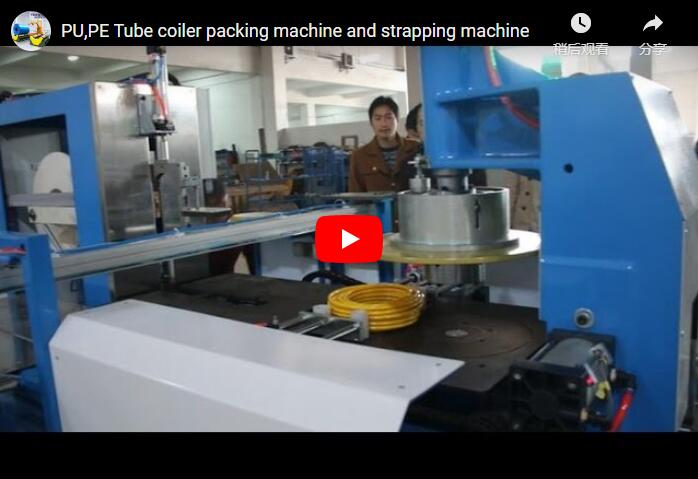
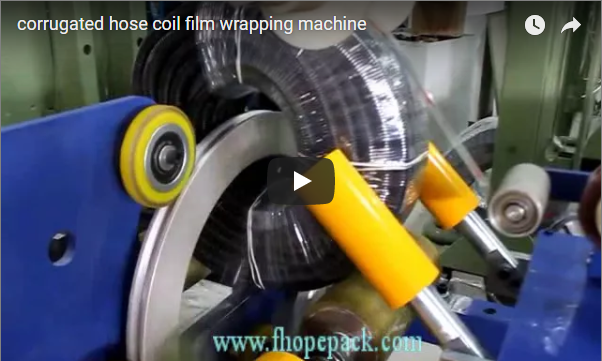
Executive summary A coil packing machine is chosen as much by how the coil gets in and out as by its size. Our range covers four loading configurations, from rolling the coil in and lowering it from above by crane to trolley loading and automated positioning. Coil weight runs from 20 kg on the economic model to 4,500 kg on the FPS-800, and the loading method should match the cranes and forklifts you already use.
Table of Contents
- Cell layout and handling
- Three ways to load a coil
- Coil windows by model
- Cycle time and output
- Protecting the coil surface
- Utilities and safety
- Selection checklist
- Engineering FAQ
- Next step
- Related reading
- Sources
Cell layout and handling
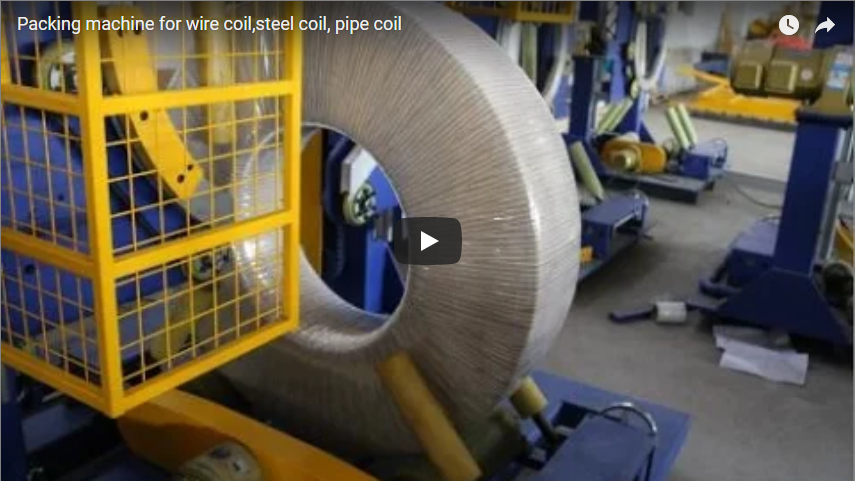
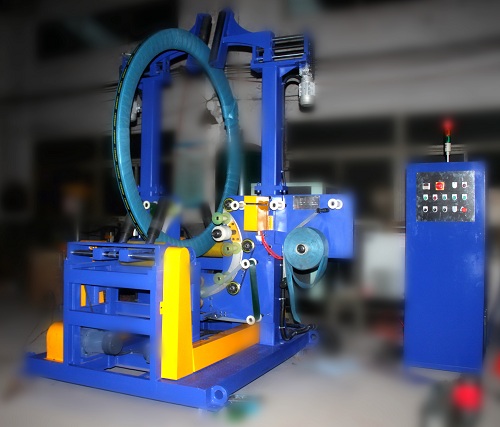
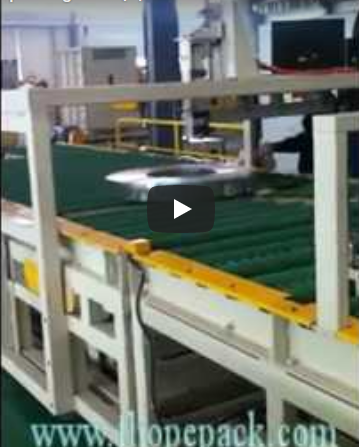
In this steel plant installation, our coil wrapper works inside a fenced cell. The coil stands on its edge, eye horizontal, on a V-shaped saddle with support rollers. The ring passes through the coil eye while the rollers turn the coil, so the film covers the whole coil section. In the video, a second saddle holds a coil already wrapped in blue film, ready to be lifted out.
The saddle is the handling interface: coils arrive on it and leave on it, so the loading method shapes the cell layout and how much crane time each coil takes.
Four loading configurations
| Loading method | Model | Best for |
|---|---|---|
| Roll in and out | economic model | light coils, low volume |
| Crane or forklift from the top | FPS-400 | heavy, large-diameter coils |
| Trolley, loaded by crane or C-hook | FPS-500 | automatic cycles with auto cut |
| Automated positioning, optional auto cut and feed | FPS-800 | heavy coils, higher output |
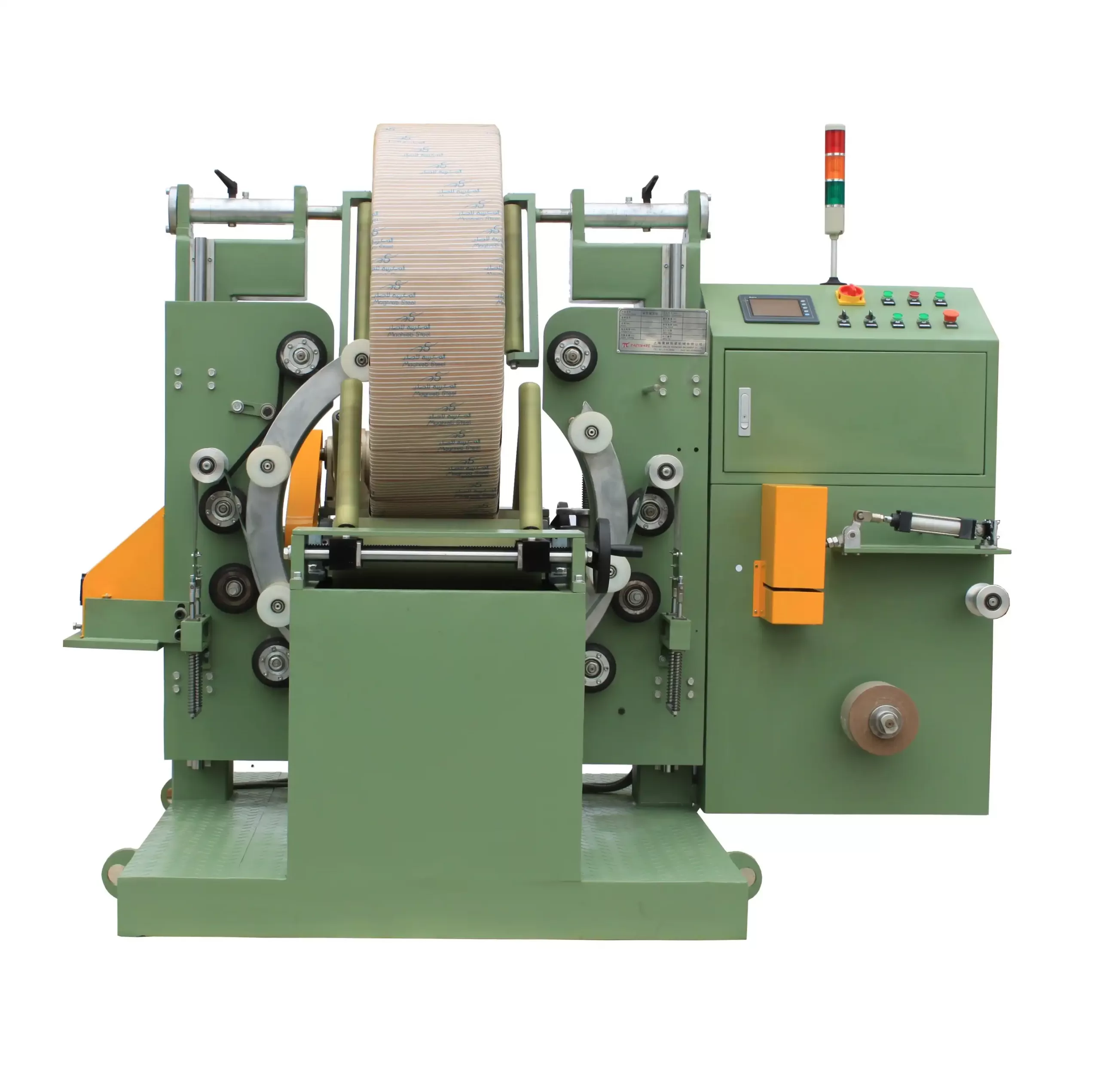
On the economic model, coils roll in and out at floor level, so it suits lighter coils. The FPS-400 opens at the top for vertical loading, which helps where floor-level loading is impractical because of weight or space. The FPS-500 uses heavy-duty trolleys to load and unload safely.
Coil windows by model
| Parameter | Economic | FPS-400 | FPS-500 | FPS-800 |
|---|---|---|---|---|
| Coil ID | 508–610 mm | 508 or 610 mm | 508 or 610 mm | 400–950 mm |
| Coil OD | 600–1,200 mm | 800–1,400 mm | 700–1,400 mm | 700–1,600 mm |
| Coil width | 100–300 mm | 100–400 mm | 200–500 mm | 400–850 mm |
| Coil weight | 20–1,000 kg | 100–2,000 kg | 80–1,000 kg | 500–4,500 kg |
| Power | 1.5 kW | 4.0 kW | 2.0 kW | confirmed in proposal |
Illustrative example: a 1,500 kg coil with 610 mm ID, 1,300 mm OD and 350 mm width fits the FPS-400, and you lower it in by crane. A 3,000 kg coil 600 mm wide needs the FPS-800.
Cycle time and output
| Model | Published cycle | Ceiling |
|---|---|---|
| FPS-500 | 20–45 s per coil | 3,600 ÷ 45 = 80 to 3,600 ÷ 20 = 180 coils per hour |
| FPS-800 | 20–45 coils per hour | 20–45 coils per hour |
These are wrapping figures, and the FPS-500 ceiling is a theoretical limit. Loading, unloading and saddle transfer add to every cycle, and a crane serving several stations is often the real limit. We time the full cycle, including handling, on your coils.
Protecting the coil surface
- Rollers. The FPS-400 and FPS-800 use PU-wrapped rollers to prevent scratches, and the economic model has coated protective and carrier rollers.
- Materials. Stretch film, crepe paper, woven belt, PVC, LLDPE, PE, paper and HDPE, depending on model.
- Two layers. The FPS-400, FPS-500 and FPS-800 can apply two materials at once, for example VCI film plus stretch film.
- Overlap. Adjustable from 10% to 90%.
Utilities and safety
| Utility | Requirement |
|---|---|
| Power supply | 380 V, 50 Hz, 3 phase (FPS-800 also 415 V, 50/60 Hz) |
| Compressed air | 4–6 bar on the economic model; others confirmed in proposal |
| Material roll | ID 50 mm, OD 100–450 mm, width 100–150 mm (economic, FPS-400) |
The FPS-400 includes guarding, limit switches and safety signage, and the economic model has an emergency stop and error light. The standards that apply depend on the destination market. For CE markets, ISO 12100 sets the risk-assessment method and EN 415-10 sets general requirements for packaging machines.
Selection checklist for coil packing and handling
- Coil ID, OD, width and weight, smallest and largest.
- How coils arrive: crane, forklift, C-hook or conveyor.
- Coils per hour, and crane time available.
- Wrapping materials, single or two layers.
- Surface sensitivity: bare, coated or polished.
- Space for a fenced cell.
Engineering FAQ
Q: Which model suits crane loading? A: The FPS-400, which opens at the top for vertical loading of coils up to 2,000 kg and 1,400 mm OD.
Q: What is the lightest option? A: The economic model, where coils of 20–1,000 kg roll in and out.
Q: How fast is the FPS-500? A: 20–45 s per coil for the wrap, which is 80–180 coils per hour before handling.
Q: Can we wrap VCI and stretch film together? A: Yes, on the FPS-400, FPS-500 and FPS-800, which apply two materials at once.
Q: What about coils above 2,000 kg? A: The FPS-800 handles 500–4,500 kg, and it can be customized.
Next step
We plan your coil packing cell in three steps:
- Submit your layout drawing with coil sizes, weights and your crane or forklift plan to info@fhopepack.com.
- Receive a proposal within 48 hours, with the model, loading method and cell layout.
- Book a site survey to fit the cell to your plant.
Related reading
- Steel coil wrapping machine range
- FPS-400 heavy-duty coil wrapper
- FPS-500 eye-through coil wrapper
- FPS-800 automated coil wrapper
- Automatic coil packing line
Sources
- Economic model: economic steel coil wrapping machine page
- FPS-400: FPS-400 page
- FPS-500: FPS-500 page
- FPS-800: FPS-800 page
- Machine in action: our coil packing machine video on YouTube
- Standards scope: ISO 12100:2010, EN 415-10:2014
Last reviewed: 2026-10-04