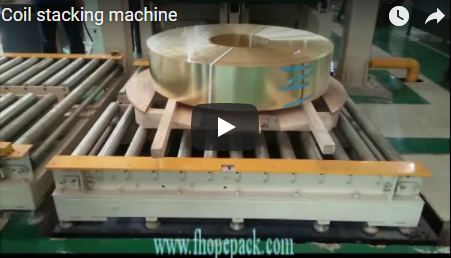
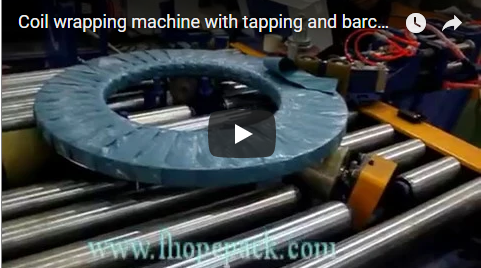
Executive summary This clip, about 72 s long, shows one of our blue-and-yellow coil lines. Wrapped coils travel flat on yellow powered rollers under an overhead station, and a blue gantry at the end grips each coil and moves it on. The strapping on a line like this decides how well the stack survives transport. Below we compare radial and circumferential strapping, give the tension and coil ranges we build for, and show how strapping fits before stacking.
Table of Contents
- What the clip shows
- Radial or circumferential strapping
- Strapping ranges we build for
- Strap material: PET or steel
- Why strapping comes before stacking
- Selection checklist for a strapping and stacking line
- Controls and safety
- Engineering FAQ
- Next step
- Related reading
- Sources
What the clip shows
| Clip time | What is on screen |
|---|---|
| 0–6 s | A wide view of our assembly hall with several coil lines |
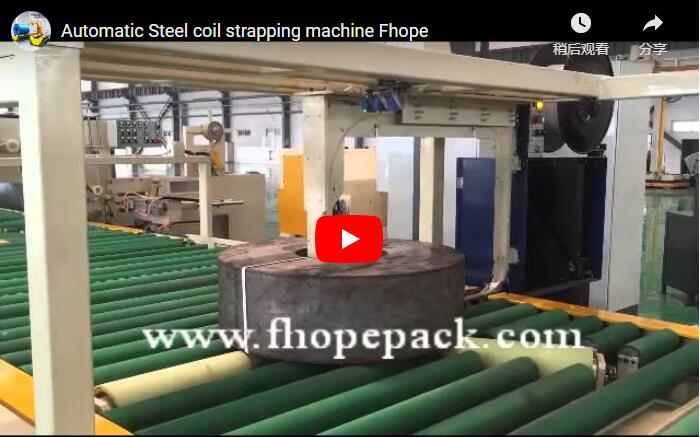
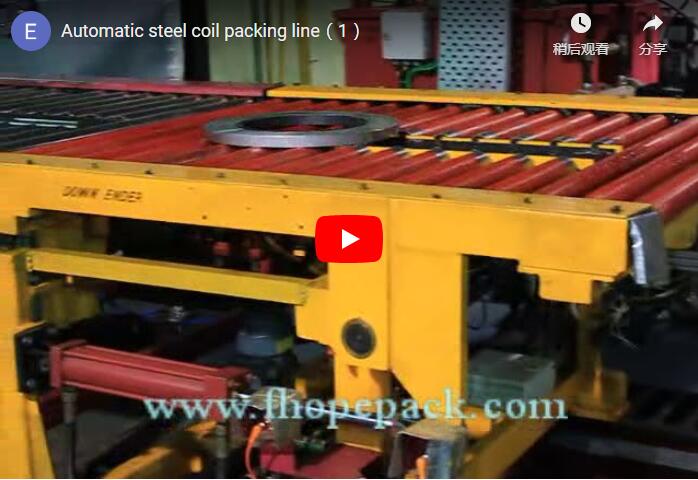
| about 12–48 s | White-wrapped coils lie flat on yellow powered rollers; an overhead station with a lowered head stands over the conveyor |
| about 54–66 s | A blue gantry with yellow gripper pads holds a coil over a silver roller section |
Times come from frames taken every 3 s. Picture-in-picture windows show other stations of the same line, including a control panel.
Radial or circumferential strapping
Two strap patterns cover most steel coils:
| Pattern | Where the strap runs | Typical use |
|---|---|---|
| Radial (through the eye) | through the coil eye and round the section | holds the wraps together; 2, 3, 4 or 6 straps per coil |
| Circumferential | round the outer diameter | stops the outer wraps from springing loose |
Many coils get both; see our radial strapping machine for the through-the-eye pattern. The pattern is set in the PLC per coil type, so the line can strap a narrow slit coil and a heavy coil differently.
Strapping ranges we build for
From our steel coil strapping machine page:
| Item | Range |
|---|---|
| Coil diameter | 500–2200 mm (customised) |
| Coil weight | up to 20 t |
| Strap tension | 500 N to 30000 N, by strapping head |
| Output | 40–60 straps per hour |
| Radial straps per coil | 2, 3, 4 or 6 |
The infeed conveyor turns the coil through 360° and centres it on the coil ID, so each strap lands in the right place. Each machine is built to the coil range of the project, so these figures can change.
Strap material: PET or steel
The strap dispenser feeds steel, polyester (PET) or polypropylene strap into the head through an accumulator.
- PET strap: lighter, does not rust, and avoids scratching coated or painted coils.
- Steel strap: highest strength, for the heaviest coils and long sea transport.
The PLC sets strap tension and sealing force, so coils of one type get the same strap every time.
Why strapping comes before stacking
In the clip the gantry is the last station. Strapping must be finished before it:
- A coil inside a stack cannot be strapped without taking the stack apart.
- Radial straps hold the wraps while the gantry lifts the coil by its outer edge.
- Stack strapping is a separate step, added after the stack is built if the stack ships as one unit.
Our automatic coil packing line stacks up to 6 coils per stack, eye to sky or eye to wall.
Selection checklist for a strapping and stacking line
- Coil ID, OD, width and weight range.
- Strap pattern: radial, circumferential or both, and straps per coil.
- Strap material and tension.
- Coils per hour, to size the number of strapping heads.
- Stack height and orientation.
- Whether the finished stack is strapped as one unit.
Controls and safety
The standards that apply depend on the destination market. For CE markets, ISO 12100 sets the risk-assessment method and EN 415-10 covers general requirements for packaging machines, which fixes guarding and the emergency-stop arrangement.
Strap tension of up to 30000 N stores energy in the strap. Guarding at the strapping heads and around the gantry is fixed in the risk assessment for each layout.
Engineering FAQ
Q: How many radial straps does a coil need? A: Our radial machines apply 2, 3, 4 or 6 straps per coil, chosen by coil size and transport route.
Q: What strap tension can be set? A: From 500 N to 30000 N, depending on the strapping head.
Q: How many straps per hour can the line apply? A: 40–60 straps per hour on our coil strapping machines.
Q: Which coil sizes can be strapped? A: Coil diameters of 500–2200 mm and weights up to 20 t, as customised solutions.
Q: How does the line put each radial strap in the right place? A: The infeed conveyor turns the coil through 360° and centres it on the coil ID before strapping.
Q: Can the line use PET and steel strap? A: Yes. The dispenser feeds steel, PET or polypropylene strap through an accumulator.
Next step
We plan a strapping and stacking line in three steps:
- Submit your layout drawing with coil range, strap pattern and stack pattern, to info@fhopepack.com.
- Receive a proposal within 48 hours, with strapping heads, gantry and conveyor layout.
- Book a site survey so we confirm floor space, strap storage and forklift routes.
Related reading
- Steel Coil Strapping, Labelling and Stacking Line: Four Performance KPIs We Track
- Automatic Steel Coil Stacking and Palletizing Gantry
- How Does a Two-Stage Automatic Steel Coil Packaging and Stacking Line Work?
- Steel coil strapping machine
Sources
- Machine in action: the video on YouTube (about 72 s)
- Coil diameter, weight, tension range, straps per hour, radial strap counts, 360° turning and ID centring, strap materials and accumulator, PLC tension and sealing force: Steel coil strapping machine
- Up to 6 coils per stack, eye to sky / eye to wall: Automatic coil packing line
- Standards scope: ISO 12100:2010; EN 415-10:2014
- Proposal timing: approved house CTA (proposal within 48 hours)
Last reviewed: 2026-10-06