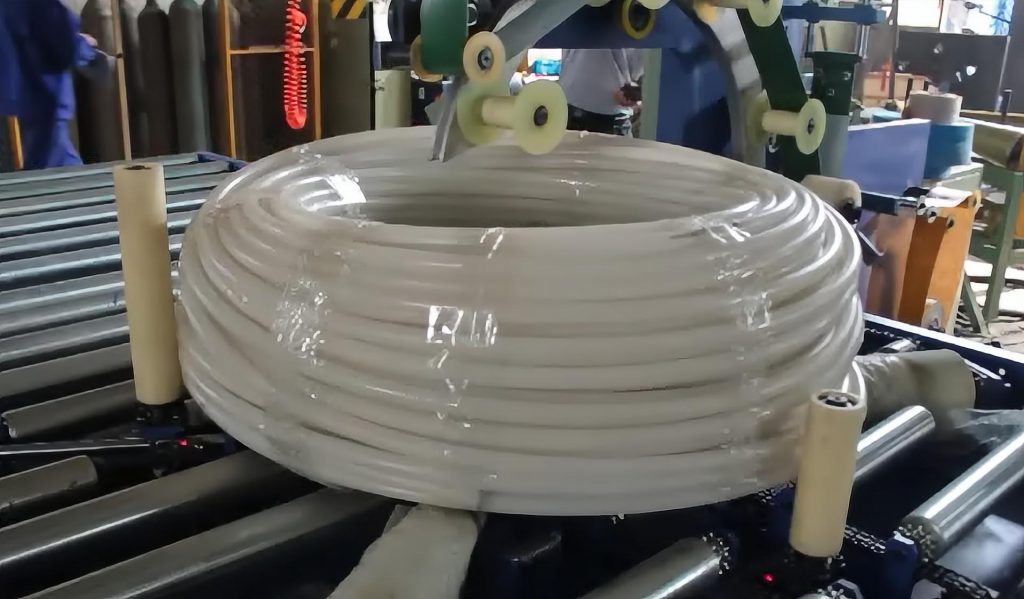
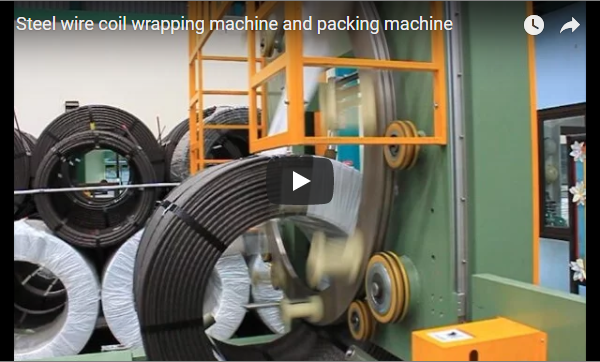
Executive summary An inline coil wrapping machine wraps a ring-shaped coil on a powered roller conveyor, seals the film tail automatically, and applies an identification label so each coil leaves the station fully protected and production-traceable. In this operational cycle, the primary wrapping sequence runs from 12 s to 33 s—delivering a net wrapping time of approximately 21 s per coil. Our equivalent industrial solution, the FPC-300 horizontal coil wrapper, is engineered for 10 to 1,000 kg coils with outer diameters (OD) from 700 to 1,200 mm. Operating at a production rate of 35 to 50 s per coil (inclusive of transfer, index, and wrap), the FPC-300 is configured specifically to match plant layout and packaging line cycle times.
Table of Contents
- What the clip shows, in order
- What an inline coil wrapping station does
- Wrapping cycle time on the clip
- FPC-300 specifications
- Takt check
- Selection checklist for an inline coil wrapping machine
- Controls and safety
- Engineering FAQ
- Next step
- Related reading
- Sources
What the clip shows, in order
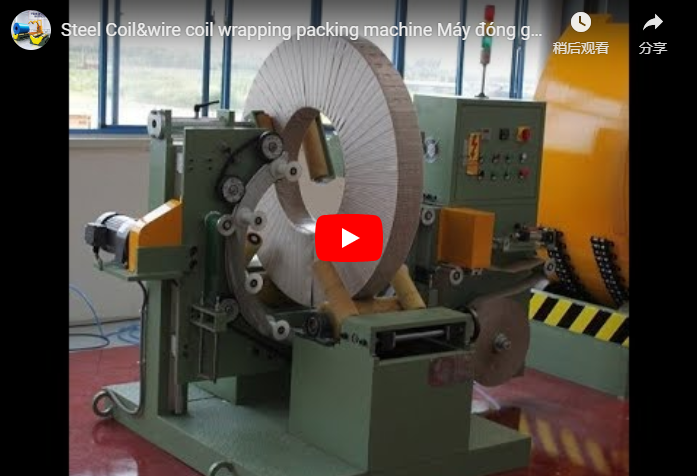
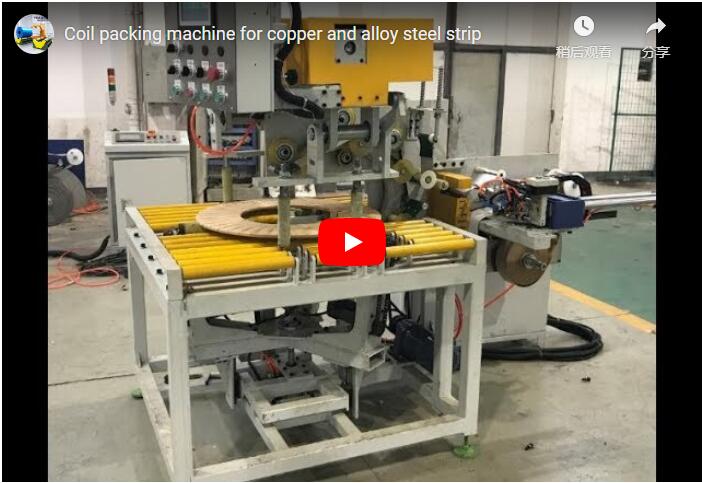
The packaging station integrates a welded heavy-duty structural steel frame, a motorized continuous-roller conveyor with side guide rollers, and an overhead vertical containment assembly. Polyurethane-coated stabilising rollers secure the coil from above, while a thermal-transfer print-and-apply mechanism feeds traceability tags from the top gantry. An operator control console with an HMI touchscreen oversees the conveyor outfeed.
- 0 to about 6 s (Pre-index clearance). The powered infeed conveyor clears and prepares the wrapping bay; optical sensors verify that the wrapping ring axis is open and the perimeter safety zone is uncompromised.
- About 9 s (Infeed transfer & centring). A dark-grey metal coil arrives at the workstation centre on motorized support rollers and is indexed to a precise mechanical stop directly aligned with the orbital ring centreline.
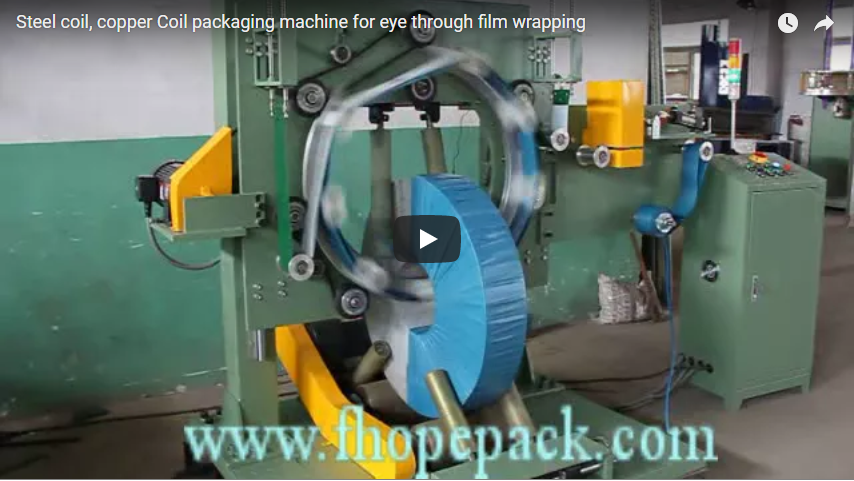
- About 12 to 21 s (Simultaneous orbital wrap & label integration). The coil rotates axially on the support rollers as the upper rubber-coated containment rollers descend to suppress vibration. The high-speed orbital shuttle rotates through the coil eye, applying stretch film while the inline label mechanism synchronizes tag dispensing under the transparent wrap.
- About 24 to 33 s (Overlap completion & tail securement). Orbital wrapping continues along the full circumference to achieve the programmed film overlap (typically 50% to 70%). The pneumatic clamp cuts the film, applies the tail tape seal, and the top containment assembly retracts.
- About 36 to 42 s (Outfeed transfer & weight capture). The encapsulated coil indexes to the outfeed conveyor segment, clearing the wrapping station and transferring onto an integrated inline load-cell scale for automated gross weight verification.
What an inline coil wrapping station does
An inline coil wrapper mounts directly into continuous manufacturing and slitting lines. Coils transfer, wrap, seal, and discharge along the conveyor bed without overhead crane handling or manual forklift intervention.
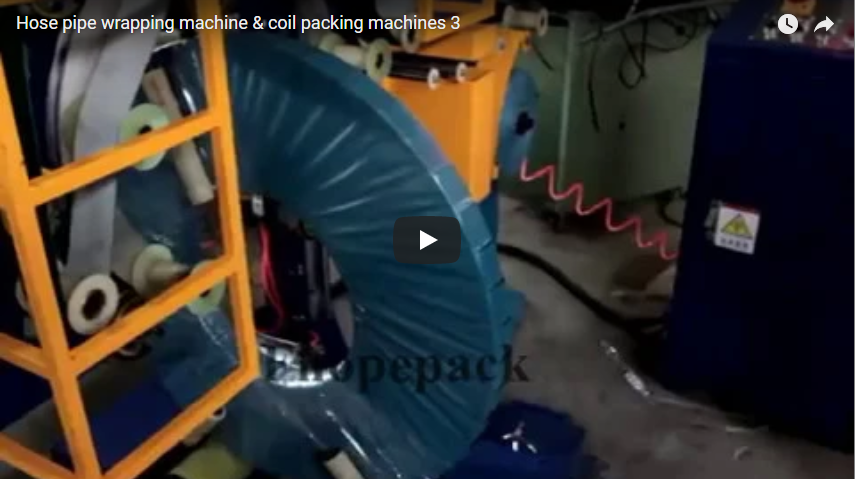
During the wrapping process, an orbital shuttle ring carrying the film carriage rotates through the open eye of the coil while driven support rollers turn the coil on its horizontal axis. The ratio between the ring rotation speed (RPM) and the coil surface linear travel speed sets the wrap overlap percentage, defining the environmental moisture and dust seal.
Four automated finishing functions convert an unwrapped slit coil into a stable shipping package:
| Step | How our equivalent solution does it |
|---|---|
| Tail fixing | Pneumatic mechanical arm clamps and cuts the film cleanly, then secures the tail to the body via high-tack tape or heated impulse sealing |
| Taping | Secondary circumferential tape head applies securing tape around the coil outer diameter (OD) to prevent unravelling in transit |
| Labelling | High-resolution thermal transfer print-and-apply module dispenses Barcode / QR / human-readable product tags directly beneath or on the protective outer layer |
| Weighing | Integrated roller-bed scale at the outfeed conveyor automatically logs weight data and transmits gross weight to the line PLC |
The industrial labelling unit and conveyor load-cell modules are configured per project to exchange real-time production data with your plant MES or ERP system.
Wrapping cycle time on the clip
| Step on the clip | Time window | Duration | Operational phase |
|---|---|---|---|
| Coil infeed & positioning | about 9 s | ~3 s | Conveyor index, optical detection, pneumatic stop alignment |
| Wrapping and labelling | about 12 to 33 s | about 21 s | Synchronized ring rotation (100 RPM max), active top clamping, film overlap |
| Outfeed & scale transfer | about 36 to 42 s | ~6 s | Conveyor discharge, weight data acquisition, station reset |
| Full cycle (Arrival to discharge) | about 9 to 36 s | about 27 s | Floor-to-floor cycle time for current coil geometry |
While the video demonstrates a rapid 21 s pure wrapping stroke, standard industrial planning for the FPC-300 establishes a baseline of 35 to 50 s per coil. This conservative engineering baseline accounts for variable film overlap settings (50% to 80%), differing cross-sectional dimensions, and safe conveyor acceleration/deceleration ramps to protect coiled strip edges.
FPC-300 specifications
| FPC-300 horizontal coil wrapper | Specification | Engineering unit |
|---|---|---|
| Coil weight capacity | 10 to 1,000 | kg |
| Coil package width | 10 to 300 | mm |
| Coil outer diameter (OD) | 700 to 1,200 | mm |
| Coil inner diameter (ID) | 400 to 900 | mm |
| Radial wall thickness constraint | (OD – ID) ≤ 600 | mm (Ring throat shuttle clearance) |
| Roller linear speed | 2 to 4 | m/min (Variable frequency drive) |
| Total cycle time | 35 to 50 | s / coil (Dimension dependent) |
| Ring rotational speed | 5 to 100 | RPM (Inverter controlled) |
| Wrapping material overlap | 10% to 90% | Adjustable via PLC recipe |
| Power supply | 380 V, 50/60 Hz, 3 Phase | 4.5 kW to 7.5 kW rated load |
Takt check
For a high-volume manufacturing target of 60 coils per hour, available line takt time is calculated as:
Takt Time = 3,600 s ÷ 60 coils = 60.0 s per coil
Operating at the standard FPC-300 cycle of 35 to 50 s, the line retains a reliable engineering buffer of 10 to 25 s per station cycle. This buffer accommodates infeed indexing, active label printing, scale settling time, and conveyor handshakes.
Engineering Rule of Thumb: If upstream slitting or stamping takt requires production exceeding 70 to 80 coils per hour, we split orbital wrapping and label/scale verification into two decoupled, tandem conveyor stations.
Selection checklist for an inline coil wrapping machine
- Coil Dimensional Envelope: Confirm minimum/maximum OD, ID, face width, and total mass. Ensure
(OD - ID) ≤ 600 mmto preserve orbital ring shuttle travel clearance. - Packaging Material Selection: Define substrate—LLDPE stretch film, VCI anti-corrosion film, crepe paper, or reinforced woven polypropylene tape—and specify required overlap percentage.
- Tail Termination Method: Select between pneumatic tail clamp with pressure-sensitive tape securement or thermal impulse heat sealing for oil-resistant bonding.
- Label Data Integration: Define label dimensions, barcode symbology (Code 128, DataMatrix, QR), and determine data interface protocols (Industrial Ethernet, OPC-UA, or I/O handshake).
- Conveyor Height & Direction: Standardize pass-line elevation (typically 750 to 900 mm), roller coating (polyurethane or rubber for surface protection), and line feed direction.
- Line Takt Verification: Factor in total transit time, sensor settle delay, pneumatic cycle times, and label application duration against upstream output.
Controls and safety
Orbital coil wrapping equipment concentrates dynamic mechanical hazards within the rotating ring shuttle, the overhead stabilization clamping cylinders, and the driven conveyor rollers.
Guarding and interlocks are set by the site risk assessment, then confirmed against the machine drawing. Nobody stays inside the perimeter during an automatic cycle:
- Pneumatic Fall-Safe Locks: The overhead containment roller assembly incorporates pilot-operated check valves to prevent vertical drops during sudden electrical or air-pressure failure.
- LOTO Procedures: Operators must lock out electrical isolators and exhaust stored pneumatic pressure using residual pressure dump valves before roll threading, tape reloading, or mechanical intervention.
Engineering FAQ
Q: Can the coil wrapper print and apply labels inline without slowing down the line? A: Yes. The high-speed thermal transfer applicator dispenses identification labels directly onto the coil surface or intermediate film layers during the orbital wrap cycle, eliminating the need for a secondary offline indexing station.
Q: How does the machine handle delicate, mirror-finish, or soft copper/aluminium coils? A: The conveyor and top stabilizer rollers are wrapped in high-durometer vulcanized polyurethane or non-marking NBR rubber. Ring acceleration, film tension (via dynamic mechanical brake), and roller rotational speeds are governed by PLC variable-frequency drives to prevent scuffing, edge crimping, or coil ovality.
Q: What determines whether the FPC-300 can accept a non-standard coil size?
A: The mechanical limiting constraint is ring eye clearance. The coil inner diameter (ID) must be at least 400 mm to allow the film shuttle to pass through smoothly, while the radial wall height must satisfy (OD - ID) ≤ 600 mm to clear the internal shuttle carriage profile.
Next step
To integrate an inline coil wrapping, taping, and labelling station into your production flow, our engineering team follows a systematic 3-step evaluation:
- Submit Your Production Parameters: Provide maximum/minimum coil OD, ID, face width, weight distribution, desired packaging materials, and line takt targets to info@fhopepack.com.
- Receive an Engineering Proposal within 48 Hours: We deliver a detailed station layout drawing, cycle-time timeline simulation, and electrical/mechanical interface requirements.
- Line Integration Alignment: Our packaging systems team reviews pass-line heights, automation signals (Profinet/EtherNet/IP), and warehouse management data protocols directly with your project engineers.
Related reading
- Horizontal coil wrapper FPC-300
- Copper coil packaging line with labelling
- Razor wire packing machine
- Wire coil wrapping machine with paper
Sources
- Equipment Specifications & Tooling: FPC-300 horizontal coil wrapper product page
- Traceability & Automation Interface: Copper coil packaging line technical brief
- Dynamic Cycle Analysis: Video motion review (3-second frame verification)
- Equipment Video Reference: YouTube: Automated Horizontal Coil Wrapper in Action
- Risk-assessment method: ISO 12100; packaging machine safety: EN 415-10
Last reviewed: 2026-11-05