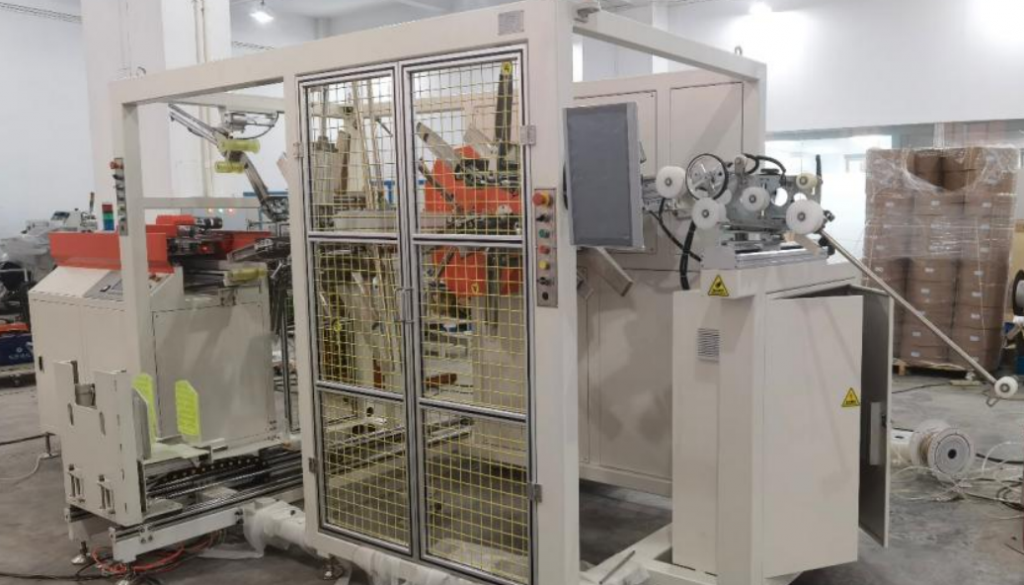
Executive summary This clip shows one of our online tire strapping machines working on a powered roller conveyor. A stack of film-wrapped tires runs into the station, two side guides hold it upright, the head above applies one vertical yellow band, and the strapped stack runs out. In the 59 s clip a red stack and a green stack go through the same cycle, about 30 s apart. Below we set out the cycle, how to size the band, and what to fix before the strapper is linked to a tire wrapping line.
Table of Contents
- What the clip shows
- The strapping cycle, step by step
- Band length per tire stack
- Where the strapper sits in a tire packing line
- Selection checklist for an online tire strapping machine
- Controls and safety
- Engineering FAQ
- Next step
- Related reading
- Sources
What the clip shows
| Clip time | What is on screen |
|---|---|
| 0–15 s | A red-and-yellow tire stack, about 9–10 tires high, stands in the station between two vertical side guides; the yellow band comes down from the head |
| 15–24 s | The band is tensioned and sealed; the strapped stack runs out to the right on the rollers |
| 30–51 s | A green-and-blue stack of about 8 tires enters and goes through the same cycle |
| 57–59 s | The second stack leaves the station with one vertical band; the clip ends at 59 s |
Each tire is film-wrapped before it reaches the strapper. The stack stays upright from infeed to outfeed and is not turned. The strapping head sits in a yellow housing above the conveyor, and the frame around the stack is grey steel.
The strapping cycle, step by step
- Infeed. The powered rollers bring the stack into the station and stop it under the head.
- Hold. The side guides close on the stack so it stands straight while the band goes round.
- Band. The head feeds the band round the stack in the vertical plane.
- Tension and seal. The head pulls the band tight, seals it and cuts it from the coil.
- Outfeed. The guides open and the rollers carry the strapped stack out; the next stack comes in.
In the clip both stacks take one band each. On lines that ship stacks loose in containers, a second band at 90° can be added by turning the stack between two cycles; we set that per project.
Band length per tire stack
Band length follows the stack height and the tire outer diameter (OD). The values below are an illustrative example, not a rating of the machine in the clip:
| Item | Value |
|---|---|
| Tire OD (illustrative) | 600 mm |
| Tire width (illustrative) | 110 mm |
| Stack height, 9 × 110 mm | 990 mm |
| One vertical band, 2 × (990 + 600) mm | 3,180 mm |
| Two bands per stack | 6,360 mm |
Add the seal overlap to each band when you size strap coils. We run the trial with your own tires, so the recipe uses your real stack height.
Where the strapper sits in a tire packing line
| Position | Why it is placed there |
|---|---|
| After the tire wrapper | Tires arrive film-wrapped and stacked, as in the clip |
| Before palletizing or storage | Strapped stacks handle as one unit on forklifts or conveyors |
| On the main conveyor, inline | The stack is not lifted off the line, so the station runs at line pace |
For single-tire wrapping ahead of this station, see our tyre packing machines. Our online tire strapping machine with a press compresses the stack before banding, which suits loose, unwrapped tires.
Selection checklist for an online tire strapping machine
- Tire OD, width and weight range, and tires per stack.
- Bands per stack: one vertical band, or two at 90°.
- Strap material, width and thickness you buy locally, and the band tension your stacks need.
- Stacks per hour the upstream wrapper delivers.
- Conveyor height, roller pitch and flow direction.
- Whether stacks arrive film-wrapped or bare.
- Destination market for the risk assessment.
Controls and safety
The head, the side guides and the powered rollers all move while a stack is in the station. Keep hands out of the station during the cycle and clear a jam only with the machine stopped and isolated. A warning label is fixed on the yellow head housing.
The standards that apply depend on the destination market. For CE markets, ISO 12100 sets the risk-assessment method and EN 415-10 sets general requirements for packaging machines, which fixes guarding, the emergency-stop circuit and access to the station.
Engineering FAQ
Q: How many bands does the machine in the clip apply? A: One vertical band per stack, on both stacks shown.
Q: How long is one cycle in the clip? A: The second stack enters about 30 s after the first, so the station handles roughly one stack every 30 s at the pace filmed.
Q: How do I work out band length? A: Use 2 × (stack height + tire OD) per band plus the seal overlap; 990 mm and 600 mm give 3,180 mm in our example.
Q: Does the machine turn the stack for a cross band? A: No. In the clip the stack stays square to the line and gets one vertical band; a second band at 90° needs the stack turned between two cycles.
Q: Can the same station strap stacks of different heights? A: Yes. The head bands round the full stack in the vertical plane, so one station runs several stack heights; we set the stop position and guide settings per tire size on trial.
Q: Do the tires have to be wrapped first? A: No. The clip shows wrapped tires, but loose stacks are usually pressed before banding, as in our press-type tire strapper.
Q: Which standards apply? A: For CE markets, ISO 12100 and EN 415-10.
Next step
We plan a tire strapping station in three steps:
- Submit your layout drawing with tire sizes, tires per stack and stacks per hour, to info@fhopepack.com.
- Receive a proposal within 48 hours, with band pattern, conveyor height and the station layout.
- Book a site survey so we confirm the link to your wrapper and the guarding.
Related reading
- Automatic Tire Strapping Machine on Online Conveyors
- Automatic Motorcycle Tire Strapping and Packing Line
- How to Do Tyre Online Packing by Automatic Line
- Tyre packing machines
Sources
- Machine in action (our footage): the video on YouTube
- Band example: our worked example, illustrative values
- Standards scope: ISO 12100:2010; EN 415-10:2014
- Proposal timing: approved house CTA (proposal within 48 hours)
Last reviewed: 2026-10-09