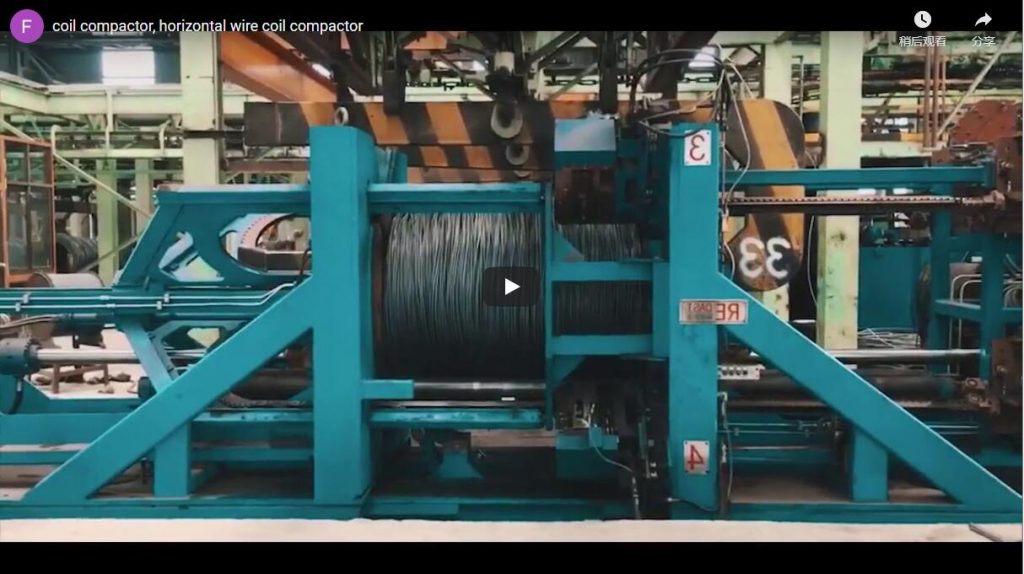
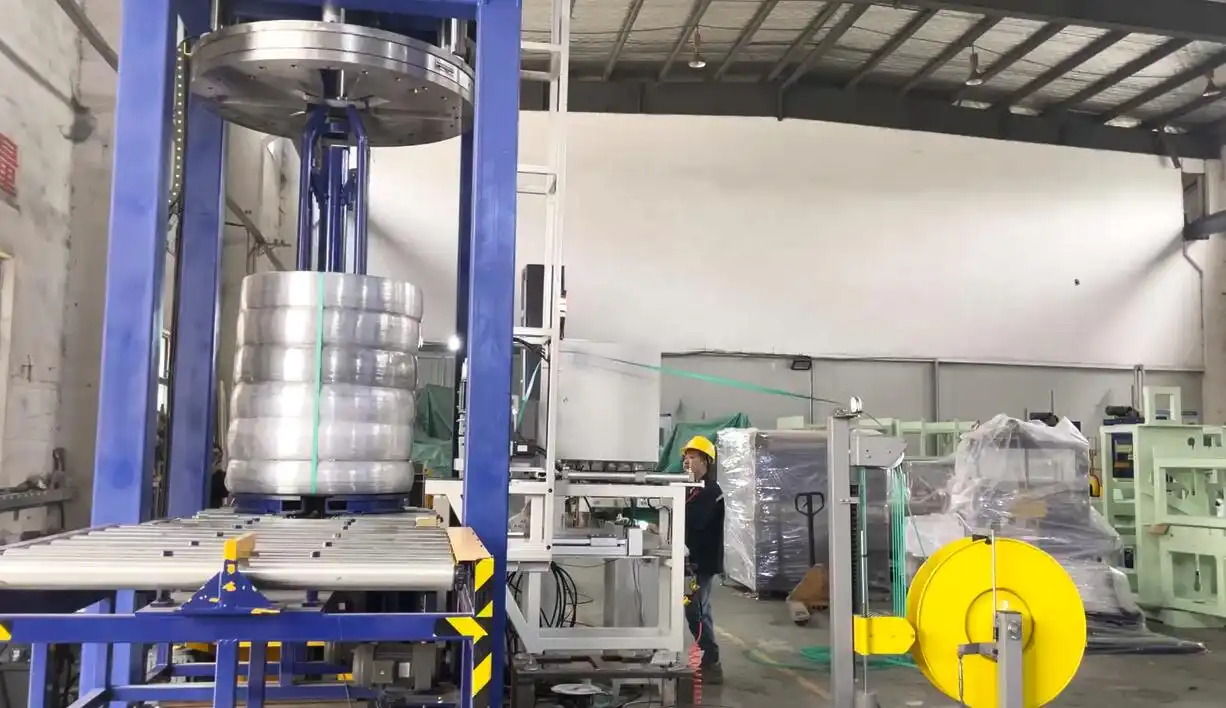
Fact source: on-site production video (
wire-coil.mp4, 87.5 seconds)
Freshly produced wire coils are often loose, bulky, and difficult to stack. During transport, weak packaging can cause coils to loosen, deform, and suffer damage and loss. How can wire coils be compacted tighter, stacked more neatly, and shipped with greater confidence? This is a common concern for metal processing, warehousing, and logistics businesses.
The hydraulic compacting machine introduced in this article is designed for exactly this purpose. All structure and process descriptions below are based on a production-site video recording and can be verified point by point.
1. On-Site Operation: One Complete Compacting Cycle (Approx. 87 Seconds)
| Time | On-Site Footage |
|---|---|
| 0–15s | Machine idle; the wire coil sits on the bottom carrier platform with the press head suspended above the coil |
| 18–24s | The top hydraulic cylinder descends, guiding the circular press plate toward the coil; the carrier platform rises slowly in sync for positioning |
| 27–36s | The press plate contacts the coil surface and applies continuous pressure; the coil is gradually compacted and visibly reduced in volume |
| 39–48s | The press plate reaches the preset position to complete one compaction, then begins its return stroke |
| 51–60s | The carrier platform shifts to the right, moving the finished coil into the transfer zone; a set of clamping arms extends from the side to receive it |
| 63–72s | A new wire coil is placed on the platform; the press head descends again and repeats the compaction cycle |
| 75–84s | After compaction, the machine pushes the finished coil out to the conveying/stacking zone, with automatic flipping and positioning |
| 87s | The finished coil leaves the work area and the machine resets |
The entire process is continuous, smooth, and free of jamming, requiring only one operator on site to monitor.
2. Equipment Overview: Appearance and Structure (Visible in the Footage)
The machine has a vertical frame structure with two main sections: the hydraulic drive system and press head assembly on top, and the wire coil carrier and conveying mechanism below.
- Main frame: White-painted welded metal columns in an H/rectangular frame design that supports the entire machine.
- Hydraulic drive system: A large silver hydraulic cylinder mounted at the top, connected to blue ring-shaped components (cushion/seal structure), with multiple vertical guide rods ensuring smooth, vertical press head movement.
- Press plate assembly: A circular metal platform, approximately 1.2 m in diameter, with a flat surface and bolted edges; multiple vertical cylindrical support tubes in the center align with the coil’s center hole to ensure even force distribution.
- Carrier platform: Constructed from metal plate and rollers; it moves along rails and can tilt to carry and transfer coils.
- Clamping and positioning structure: Brown metal components on both sides form U-shaped/arc guides that reach into the coil’s center hole from both sides for fixation and guidance.
- Electrical and control: A white side-mounted control cabinet with buttons, indicator lights, and terminals; blue hydraulic hoses are routed along the columns with centralized cable management.
- Environment: Industrial workshop with a concrete floor; rows of finished, compacted coils are visibly stacked on metal racks in the background, indicating continuous production capacity.
Note: No clearly readable model or manufacturer nameplate appears in the footage, so this article does not specify a model. Technical parameters can be provided on request as described in Section 5.
3. How It Works
The hydraulic cylinder drives the press plate vertically downward. The central positioning structure aligns with the coil’s center hole, compacting the loose wire coil into a firm, fixed shape. After compaction, the platform moves or tilts to discharge the coil, and the cycle repeats.
Hydraulic drive advantages: high pressure, smooth output, dense and consistent compaction, and minimal surface damage to the coil.
4. What It Solves for Your Production
- Save space and freight costs: compacted coils take up visibly less volume, increasing warehouse density and per-truck load capacity.
- Neater stacking: a uniform shape makes stacking easier and forklift handling more efficient and safer.
- Safer shipping: firm, stable bundles reduce loosening, deformation, and impact damage during logistics.
- Less labor dependence: one operator can run the full cycle, lowering labor costs and reducing human error.
5. Configurable to Your Needs
Machine model, rated pressure, press plate size, loading method, and automation level can all be matched to your wire coil specifications (coil diameter, weight) and production output.
For a detailed technical parameter sheet, the full process video, or an on-site trial, contact us — seeing is believing.
Contact Us
| Category | Details |
|---|---|
| Company Name | Shanghai Fhope Machinery Co., Ltd. |
| Phone | Mobile / WhatsApp / WeChat : 0086-13951501635 |
| Website/Address | Website : https://www.fhopepack.com/ Shanghai Office: B1130, Bldg 5, No.2758 Songjin Road, Shanghai Kunshan Factory: No.1428 North Road, Shipu Fengshou, Kunshan |
Trust Statement
The equipment structure and process flow described in this article are compiled from an on-site production video and can be verified point by point, with no fabricated or exaggerated claims. Specific technical parameters are subject to the technical agreement confirmed by both parties. On-site inspection and trial operation are welcome.
Update time: 2026-09-02