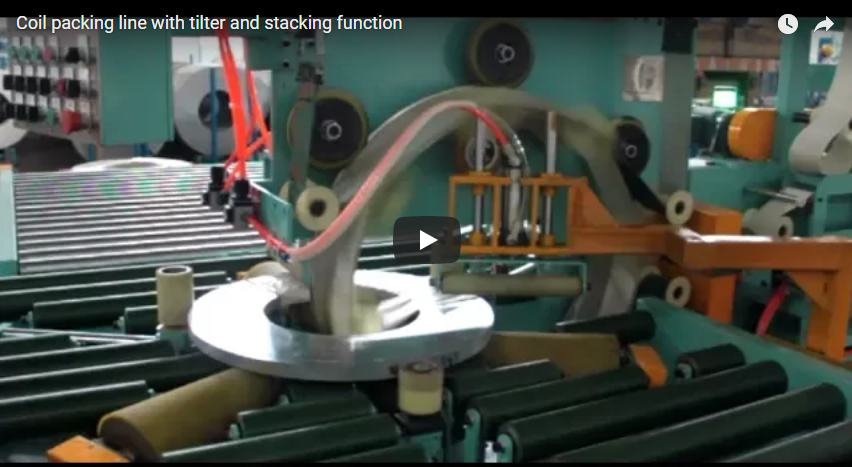
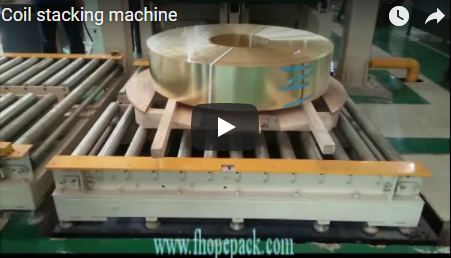
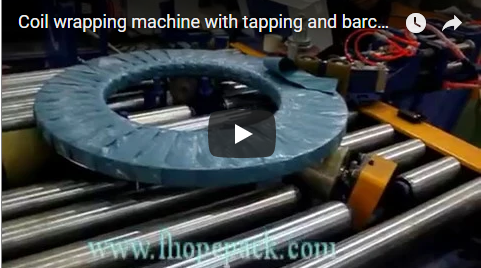
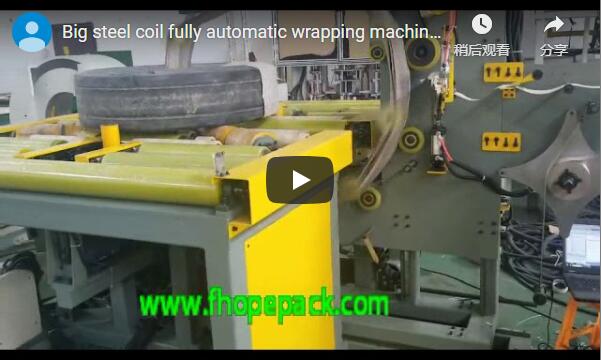
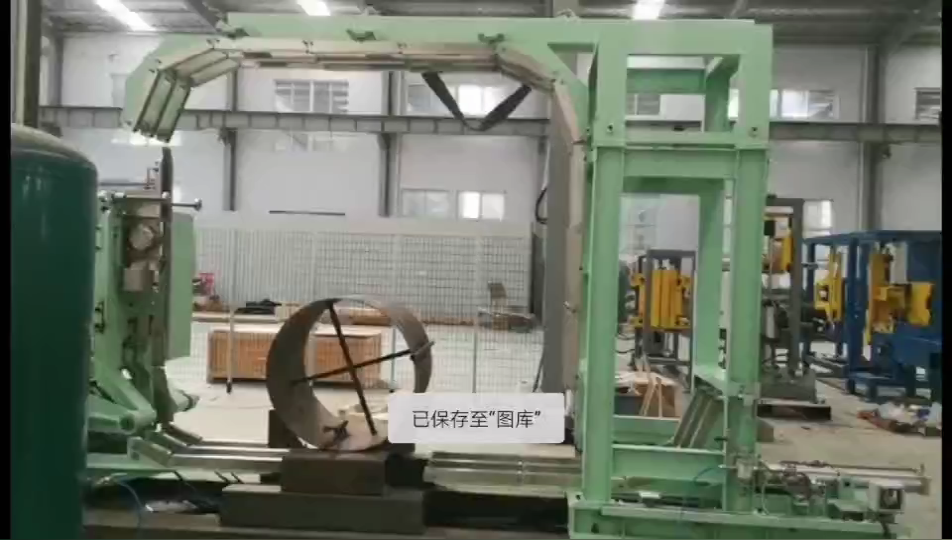
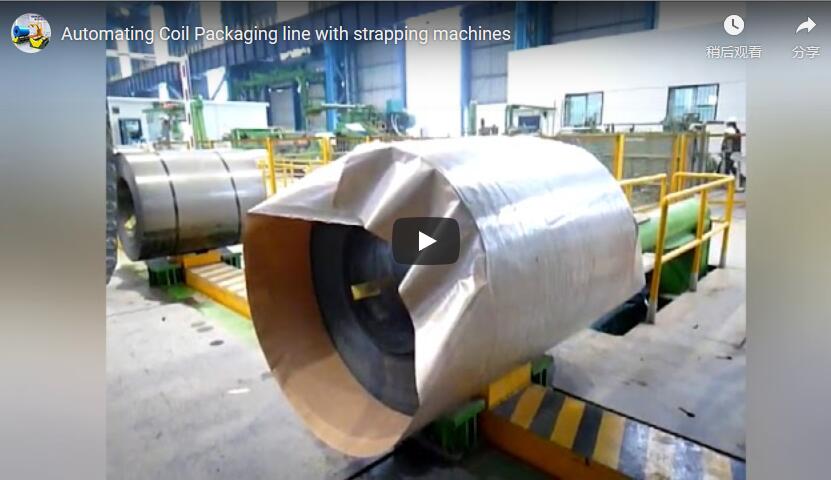
Executive summary Between the mill and the dispatch area, a steel coil has to be laid down, sealed and wrapped, and doing that with a crane hook and manual rigging is slow, tiring, and the moment most surface damage happens. An automatic steel coil packing line grips the coil, treats its end faces and wraps it on powered rollers, with no operator lifting at any step. The short clip below shows one line cycling coil to coil; the rest of this page explains what each station does, when to add it, and how the support geometry is sized for your coil range.
Table of Contents
- The line at a glance
- How the coil moves through the line
- Add-on stations and when each one pays for itself
- Coil support: the roller-pitch rule
- Controls and safety
- Selection checklist
- Engineering FAQ
- Published specification data
- Related reading
- Sources
- Next step
The line at a glance
A steel coil packing line is not one machine. It is a fixed, interlocked sequence of stations that a coil travels through once: it grips the coil, presses and seals its end faces, wraps it and releases it. The coil leaves the line oriented and protected for the next process area.
What this means on the floor: for the person who used to sling chains on a coil at every transfer, it removes most of those manual lifts. For the line supervisor, the coil position coming out of each station is repeatable, so the next station does not have to re-find the coil.
How the coil moves through the line
In the clip the sequence runs like this:
- Infeed. The coil arrives lying flat on an anti-slip motorised roller conveyor.
- Gripping and centring. A hydraulic clamping carriage grips the coil, lifts it to working height and centres it over the station; the roller bed works with the clamping force so the coil cannot sway.
- End-face treatment. The down-ender station lowers onto the coil while it is held, presses and seals the coil end face, then lifts away.
- Wrapping. The coil is set back onto the conveyor and moves to a dedicated wrapping station.
- Release. The mechanism resets and the coil leaves the station oriented for the next process area.
Add-on stations and when each one pays for itself
Not every line needs every station. Add a station only when the coil’s route or your process demands it.
| Station | What it adds | Add it when… |
|---|---|---|
| Coil tilter or down-ender | Rotates or re-orients the coil (eye-to-sky to eye-to-wall, or end-face press) | Your wrapper requires a specific eye orientation and coils arrive in another |
| Gripping and centring carriage | Hydraulic clamp with lift-and-centre motion | Coils must be positioned off the conveyor or centred without a crane |
| Wrapping station | Powered stretch-film wrap around circumference and faces | Stretch or protective wrapping is in scope |
| Strapping station | Radial or circumferential strap before dispatch | Coils must be secured for stacking or long transport |
| Weighing (optional) | Inline coil weight capture | You need weight on shipping documents, inventory or load validation |
| Signal tower | Three-colour status at the infeed | An operator needs line status at a glance |
The wrapping step accepts programmable patterns, overlap percentage and film tension per coil size and surface type, per FHOPE product literature. These are set in the control program at commissioning, not fixed at the factory.
Coil support: the roller-pitch rule
The geometry you cannot negotiate away is how the coil sits on the conveyor. The design rule keeps at least three rollers under the smallest coil the line is built for. Fewer contact points let a light or narrow coil rock between rollers and defeat the clamping alignment.
Illustrative worked example, labelled and not a specification:
| Item | Value |
|---|---|
| Smallest coil OD (illustrative) | 800 mm |
| Roller pitch (illustrative) | 200 mm |
| Rollers under the coil, 800 divided by 200 | 4 |
If your smallest coil is smaller, tighten the pitch; if your range is wide, confirm the worst case per project rather than averaging. An integrated line typically covers the medium industrial band. Coils run around 600–800 mm OD over rollers of about 100 mm, with larger coils near 1.2–1.5 m OD and 0.6–0.8 m ID. Exact OD, ID, width and weight for your line are set at project engineering, and the coil axis handling is fixed to your coil range at the same stage.
Controls and safety
The safety architecture is engineered to CE (EN ISO 13849-1 / EN 415-10) and OSHA design requirements. Standard delivery includes interlocked perimeter fencing around the hazard cell, muting safety light curtains at conveyor entry and exit, and dual-channel emergency-stop circuits at each operator position. Personnel enter the cell only when the line is stopped and isolated.
The line runs an interlocked, PLC-based sequence: the clamp, the down-ender and the conveyor cannot act out of order, so a loose coil is never carried past a moving head. A three-colour signal tower shows green while the line runs, and red or amber states with reset behaviour follow the control program. Clause applicability for your destination market is confirmed at project engineering.
Selection checklist
- Smallest and largest coil OD, ID and weight, to set roller pitch and clamp rated load.
- Required eye orientation at the wrapper, to choose the tilter or a direct horizontal feed.
- Wrap material, overlap and strapping need, to set the wrapping and strapping stations and the film program.
- Cycle time and positioning target, to agree the tolerance band with our engineering team.
- Safety scope: fencing, interlocked doors, emergency stop and light-curtain apertures, per destination-market standards.
- Control interface: PLC platform, fieldbus and remote diagnostics, agreed in project engineering.
Engineering FAQ
Q: Does the line need an operator? A: No — under normal operation the sequence runs fully automatically and requires an operator only for supervision, never for lifting.
Q: How many rollers should sit under a coil? A: At least 3 rollers under the smallest coil in your range; the 800 mm coil on a 200 mm pitch in the worked example sits on 4 rollers.
Q: How do I know the line is ready? A: A three-colour signal tower at the infeed shows green while the line runs, and red or amber states with an automatic reset step follow the control program.
Q: What does the line do to the coil end faces? A: The down-ender station presses and seals the coil end face before wrapping, and inner-wrap protection for the coil ID can be specified when you need it.
Q: Is the coil axis always horizontal? A: It is horizontal on the standard in-line feed; when your wrapper needs an eye-vertical coil or the layout requires it, a tilter option is added and the axis handling is fixed at project engineering.
Published specification data — confirm against your line
These are FHOPE’s published product statements. Confirm each one against the quoted line before you buy.
- Coil tilter rotates coils 90° (eye-to-sky to eye-to-wall) as the first station of the line, and can carry an integrated weighing system for shipping documents and inventory records.
- Stretch-film wrapping is fully automated and programmable — wrapping pattern, overlap percentage and film tension per coil size and surface type.
- Production literature cites integrated-coil-line throughput around 60 coils/h, and industry press has long pointed to tail sealing and strapping as the first bottleneck on slitting lines (The Fabricator, 2003), with stacking on the order of 40–45 s per coil in that analysis. Treat throughput as a target to confirm, not a floor.
Related reading
Sources
- Line operation: our video on YouTube.
- Machine specification: FHOPE engineering team, 2026-10-08.
- Roller and coil figures: illustrative worked example and project-range figures.
- Product literature: FHOPE steel coil packing line publications.
- Industry reference: The Fabricator, 2003 (slitting-line tail sealing and stacking analysis).
Next step
- Submit your coil range and layout drawing to info@fhopepack.com — smallest and largest OD, ID, width and weight, plus your site footprint.
- Receive a proposal within 48 hours with the station-to-station layout, roller pitch and station list sized to your range.
- Book a free site survey so building access, pit depth and power supply are confirmed on site before you order.
Last reviewed: 2026-10-08