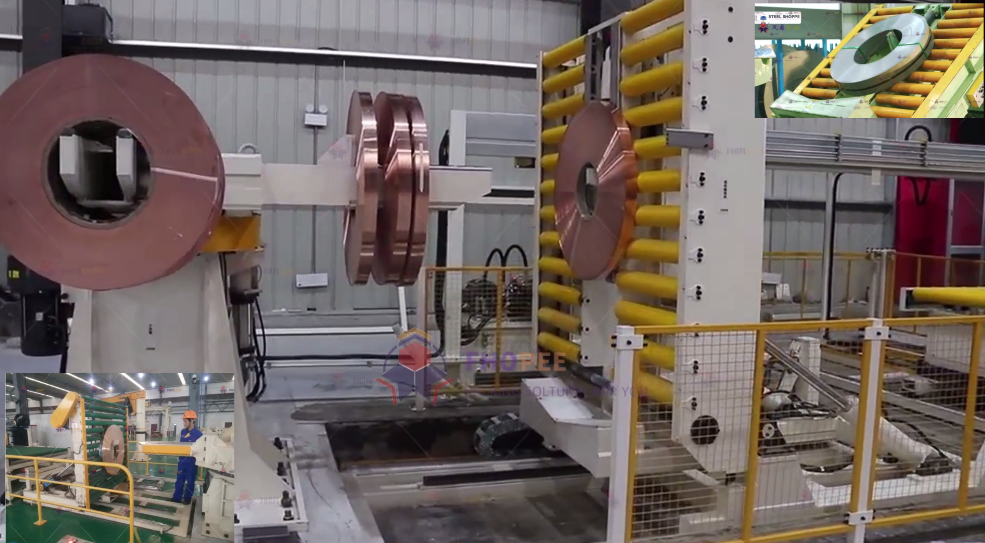
How Is an Automatic Aluminum Coil Packing Line Built? | Factory Manufacturing Tour

Executive summary This factory tour footage shows an automatic aluminum coil packing line laid out in three connected zones: coil loading, roller conveyor transport, and a packing station at the output end. A yellow overhead handling arm with a gripping head moves coils between stations, while safety barriers and a wall-side control panel frame the working area. The video shows layout and structure, not specifications — those need to be confirmed with the manufacturer.

Why a factory tour matters when you buy a packing line

Buying an automatic coil packing line is not like buying a standalone machine. It is a system decision: how coils enter, how they travel, where the heavy handling happens, and where the finished packed coil leaves the line. Photos on a product page show you the machine. A factory tour video shows you how the whole thing is built and arranged on the floor — and that is exactly what this footage offers.

The video is a walk-through of a working line, not a scripted demonstration. The camera pans across the installation from the loading area on the left, along the roller conveyors in the center, to the packing and discharge zone on the right. If you are evaluating this kind of equipment for an aluminum coil plant, a metals service center, or a downstream processing facility, the layout itself is the most useful information in the footage.

The machine in action: what the footage captures

The camera movement follows the line from end to end. Here is what you can see, in order:

Time What is visible
0–4s Wide view of the line: a yellow handling arm suspended above a conveyor with multiple bare aluminum coils; roller conveyor extends to the right
6–10s The handling arm begins its downward motion toward a coil; coils sit on the conveyor; a cutaway inset shows the control cabinet and operating console
12–16s Camera pulls back and pans: full three-zone layout — loading area with guide chutes and buffer blocks on the left, multi-section roller conveyor in the middle, packing station on the right; an overhead crane beam is visible in the background
18–22s Camera continues panning right, showing the complete “load → convey → pack → output” flow; an operator in dark clothing stands by a blue workbench observing the line

One thing worth noting: the footage is shot at a walking pace, with mostly static or gently moving frames. You will not see a complete fast-forwarded packing cycle — film winding, strapping, or sealing in motion. What you get instead is a clear read of the physical arrangement, which is what a “how is it built” question is really about.

Direct observation notes

The following observations stay close to what is verifiably visible in the frames:

  • The line’s main structure is a white-painted steel framework. Safety guarding is bright yellow painted steel plate; some base supports and conveyor legs are blue.
  • A central overhead handling arm with a yellow housing and multi-joint gripping mechanism hangs above the conveyor line.
  • The roller conveyor consists of multiple sections with silver metal rollers, arranged in a line through the center of the floor space.
  • On the left is a loading/unloading platform with yellow guide chutes and buffer blocks; a black curved guard plate is also present in this zone.
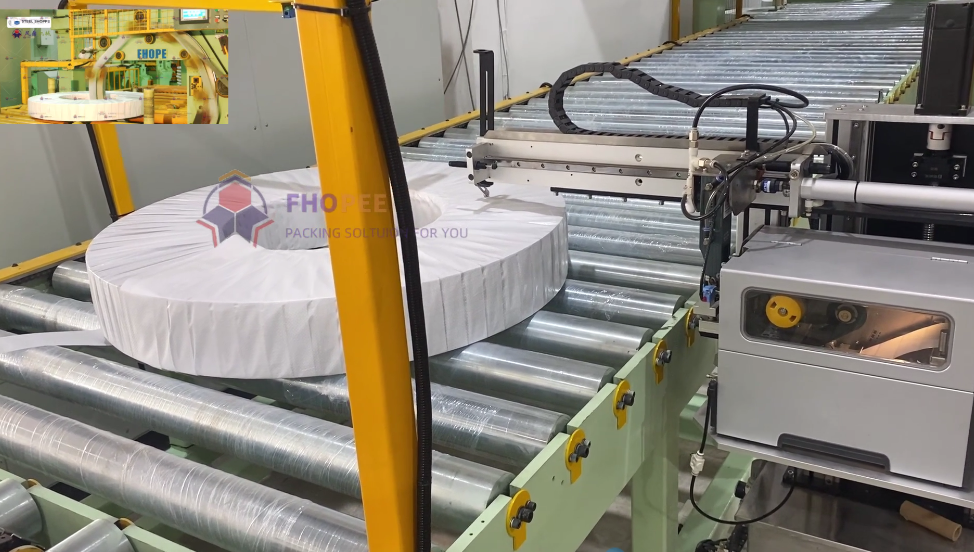
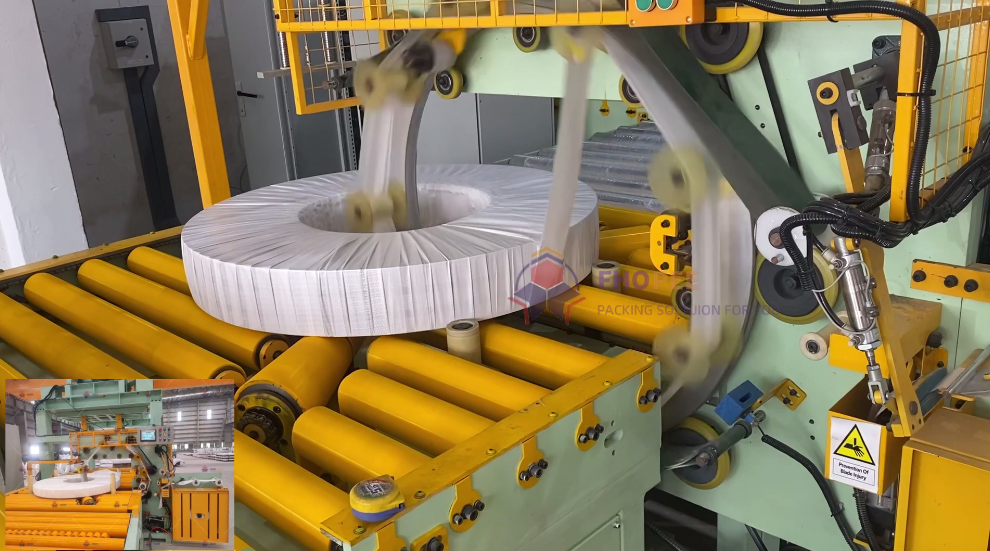
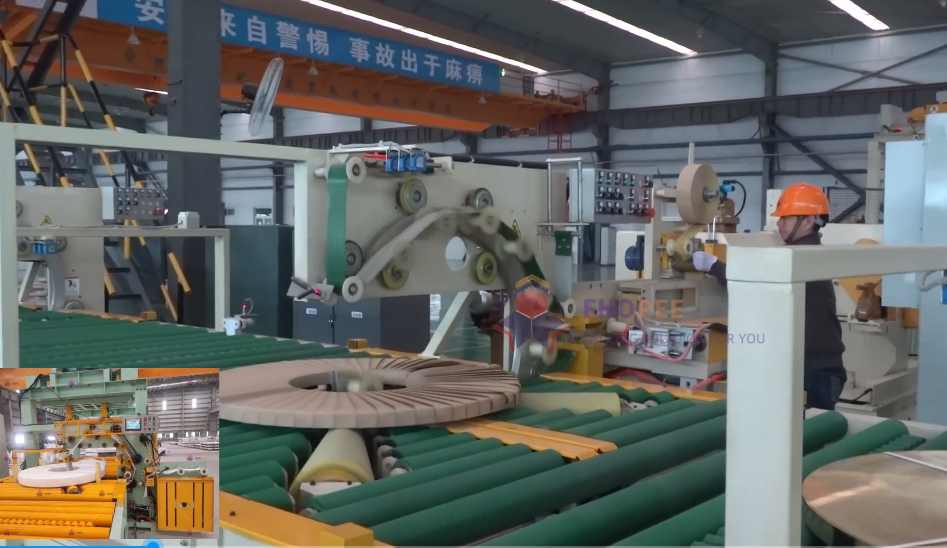
  • On the right sits a packing/sealing module with visible press cylinders; the wrapping mechanism itself is not shown operating.
  • Grey metal collection bins on wheels are arranged on the floor near the output side.
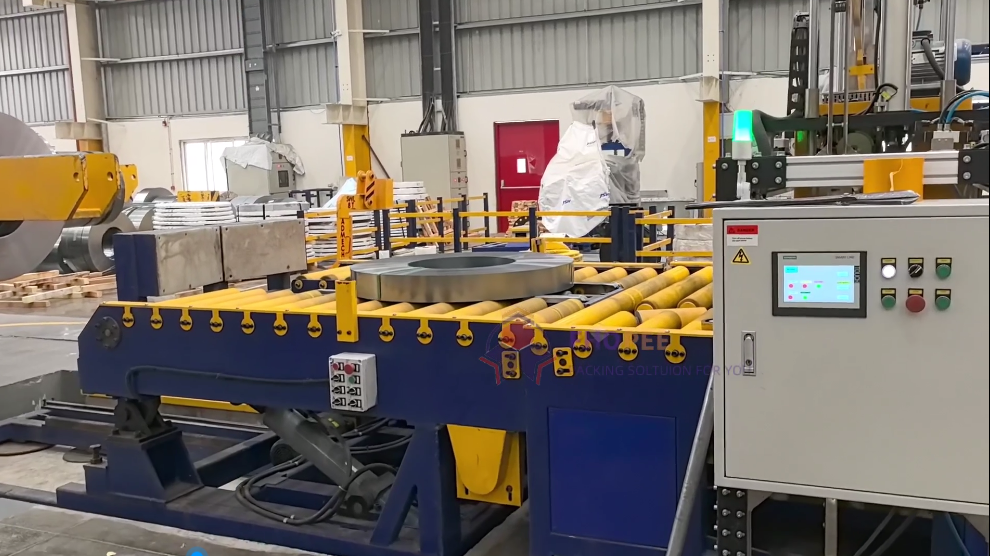
  • A vertical industrial touchscreen with round physical buttons and red/green indicator lights is mounted beside the handling arm’s column. No readable brand logos or nameplates are visible on the panel.
  • Wall signage in red Chinese characters is visible, including a large slogan that translates to “Safety in production is everyone’s responsibility.”
  • A watermark identifies the footage as belonging to the manufacturer.
  • Bare aluminum coils are silver-grey, matte, with minor surface marks; no packaging material is visible on them in the early frames.
  • No emergency stop button is clearly identifiable in any frame, and no light curtains or door interlocks are visible on the robot’s working range.

How the line is structured, zone by zone

Since the question in the title is “how is it built,” it helps to break the line into its functional zones as the video reveals them.

1. Loading and infeed zone

The left end of the line is where coils enter. The video shows a platform with yellow guide channels and buffer blocks — the kind of features that position a coil safely and absorb impact as it is placed on the line. An overhead crane beam in the background suggests coils are likely brought in by crane lifting, which is standard practice for heavy coils at this scale.

2. Conveyor and transfer zone

The middle of the line is a multi-section roller conveyor. Coils travel axially along the rollers. In one sequence, the overhead arm descends toward a coil and grips it, then moves it horizontally toward the packing station. This combination — rollers for straight transport plus an overhead handler for cross-transfer — is the backbone of the layout. It means heavy lifting is done by the machine, not by people.

3. Packing and output zone

On the right, the coil reaches the packing station, which includes press/clamp cylinders and a wrapping or sealing mechanism. The finished coil then continues downstream on the output rollers toward the collection area, where wheeled metal bins are staged.

4. Control and supervision

A single vertical control panel with a touchscreen, buttons, and status lamps sits near the center of the line. An operator is visible standing at a workbench observing the process — consistent with a supervised automatic line rather than a fully lights-out operation.

Process flow, as the layout implies

Because the frames are largely static, the exact cycle timing cannot be measured from the video. The sequence below reflects the layout and the partial motions that are visible; treat it as the intended flow rather than a timed measurement:

  1. Coil placement — a bare aluminum coil is brought to the infeed platform and positioned in the guide area.
  2. Conveying — rollers move the coil into the central working zone.
  3. Grip and transfer — the overhead arm descends, clamps the coil, and moves it across to the packing station.
  4. Packing — the coil is set down at the packing module where clamping and wrapping take place (the wrapping action itself is not captured on camera).
  5. Discharge — the packed coil exits on the downstream roller section toward the collection zone.

For exact cycle time, throughput, and whether steps can overlap, check with the manufacturer — none of these figures are observable in the footage.

What the video shows (with time references)

  • Around t≈0–4s a wide establishing shot shows a large automatic aluminum coil packing line: a yellow arm/gripper hovers above a conveyor carrying several long unwrapped aluminum coils, with a roller line at the right; red characters are visible on the background wall and insets show stacked yellow-blue structural parts and another station.
  • Around t≈6–10s the arm begins moving downward and a grasping action starts while the coils shift slightly forward on the conveyor; the view pans right to reveal more rear equipment (vertical processing cells), and an inset switches to a close-up of the control cabinet and console.
  • Around t≈12–16s the camera widens and tracks across the full line layout: an unloading/loading area with a black arched guard and yellow buffer block on the left, a multi-stage roller conveyor in the middle, and a packing/sealing station on the right; a red overhead crane beam is visible in the distance with grey metal bins on the floor.
  • Around t≈18–22s the camera finishes scanning to the right, completing the ‘feeding → conveying → packing → output’ three-stage layout; a blue workbench stands at the right with a person in black observing, the wall carries the large red slogan ‘安全生产 人人有责’, and a bottom-right inset shows a control panel (blurred, illegible).

What the video does not show

This is just as important as what it does show. The footage does not include:

  • Coil specifications — thickness, width, weight range, or coil dimensions (the size ratios visible on screen are estimates only)
  • Throughput figures — coils per hour or cycle time
  • Power and utility data — motor ratings, pneumatic or hydraulic pressure, air consumption
  • Control system details — PLC brand, HMI model, or any on-screen parameters (the panel display is not readable in the video)
  • Packaging material details — film, paper, or strapping type, thickness, and sealing method
  • Total line length, footprint, and headroom requirements
  • Safety certifications — no CE marks or safety-rating labels are visible
  • A complete packing cycle in motion — no continuous footage of winding, strapping, or sealing
  • Maintenance procedures, alarm codes, or spare parts information

None of these should be assumed from the video. They belong on your checklist when you request a quotation.

Buyer questions this footage helps you answer — and the ones it doesn’t

What the video genuinely helps with:

  • Does the line use overhead handling or floor-level handling for cross-transfer? (Overhead, visible.)
  • Is the layout linear and expandable? (Three-zone linear layout, visible.)
  • Is the working area guarded? (Yellow barriers are present, visible.)
  • Is it supervised by an operator? (Yes, one operator visible.)

What you must confirm separately:

Question Why it matters Where to get the answer
Coil weight and diameter range Determines the arm’s gripping capacity Request the technical datasheet
Wrapping material options Affects material cost and protection level Confirm with the manufacturer
Cycle time and throughput Basis for ROI calculations Request measured figures
Safety interlock package No light curtains visible in the video Ask what guarding options are available
Installation footprint and height Must fit your building Request the layout drawing
After-sales support and spares Long-term availability Discuss terms directly

Application fit: who is this kind of line for?

Based on the coil size, the linear layout, and the level of automation visible, this type of line suits plants that:

  • Handle aluminum coils regularly and want to remove manual carrying from the process
  • Need consistent packing quality across shifts, where manual wrapping varies from worker to worker
  • Have floor space for a linear, single-pass layout with room for conveyor sections
  • Already use crane or forklift infeed and can integrate the line into existing material flow

If your product range includes very small coils, mixed sizes on the same line, or non-coil products, confirm with the manufacturer whether the gripper and guides shown here can accommodate them or whether a different configuration applies.

Safety observations worth discussing before purchase

The video shows yellow perimeter barriers and anti-collision posts at the conveyor infeed, which is a positive starting point. However, the footage also shows that the handling arm’s working range does not appear to have light curtains or interlocked doors, and no dedicated emergency stop is clearly visible on camera. This may simply mean the safety package is located outside the camera’s view — but it is a point to raise explicitly with the manufacturer. Ask specifically about:

  • Light curtain or safety scanner coverage around the arm
  • Emergency stop placement and count
  • Guarding standard applied (and relevant certification for your market)

Related reading

If you are researching this equipment further, these pages cover the machine types shown or related lines:

Frequently asked questions

Is the packing process itself shown in the video? No. The video shows the line’s layout, the overhead handling arm moving toward a coil, and the packing station’s structure, but the actual wrapping or sealing action is not captured. Check with the manufacturer for a video of the packing cycle or a live demonstration.

How do coils get onto the line? The video shows an infeed platform with guide channels and an overhead crane beam in the background, which is consistent with crane-fed loading — but the loading action itself is not shown. Confirm the recommended infeed method with the manufacturer.

What coil sizes can this line handle? Not observable in the footage. The visible coils are large cylindrical aluminum rolls, but exact diameter, width, and weight ranges must be confirmed with the manufacturer.

Does the line run unattended? One operator is visible observing the line, suggesting a supervised automatic operation rather than fully unattended running. The degree of automation and required staffing should be confirmed with the manufacturer.

Is the control system programmable for different coil sizes? The control panel shown has a touchscreen and physical buttons, but no settings or parameters are readable in the video. Ask the manufacturer how size changeovers are handled and whether recipes are stored.

What safety features are included? Yellow perimeter barriers and anti-collision posts are visible. Light curtains, interlocks, and emergency stops are not clearly identifiable on camera — request the full safety specification before purchase.

Pre-purchase verification checklist

Before requesting a quotation, use this list to close the gaps the video leaves open:

  • Coil weight, diameter, and width range for the gripper and conveyor
  • Measured cycle time and hourly throughput
  • Wrapping/strapping material type and consumption per coil
  • Complete safety package: light curtains, e-stops, interlocks, certification
  • Line footprint, total length, and required headroom
  • Power, air, and any hydraulic requirements
  • Installation, commissioning, and training scope
  • Spare parts availability and service response terms

Next step

A factory tour video answers “how is it built” — but your decision needs the numbers the camera cannot show. If the layout in this footage matches your plant’s needs, the next step is a conversation about your coil dimensions, throughput targets, and building constraints. Visit our contact page to request a quotation, a datasheet, or a live packing demonstration for your specific coil sizes.


Source and method: this article is based on analysis of the embedded factory tour video. The footage was analyzed frame-by-frame using a vision model on sampled frames; the video contains background music only, with no narration or speech, so no transcript was used. All observations above come from what is visible in the frames; items not observable are explicitly marked for confirmation with the manufacturer.