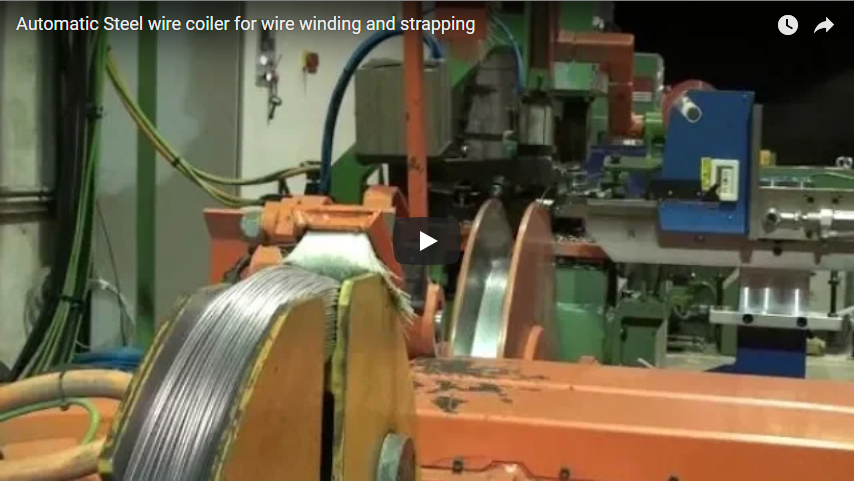
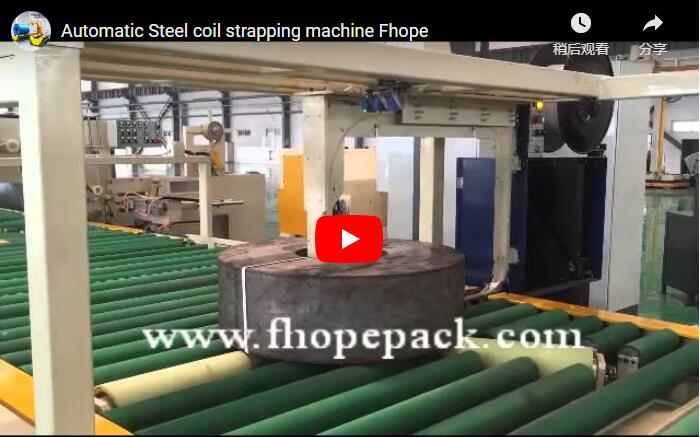
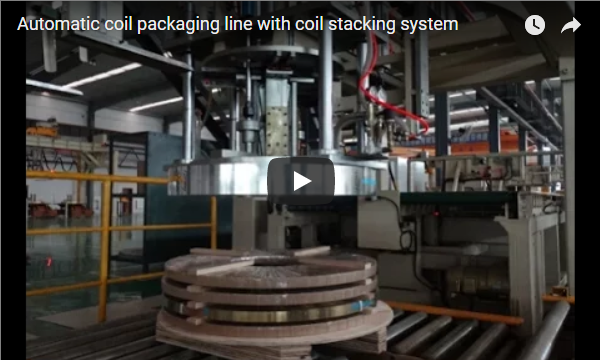
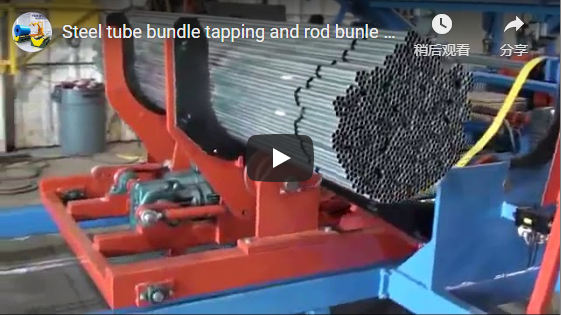
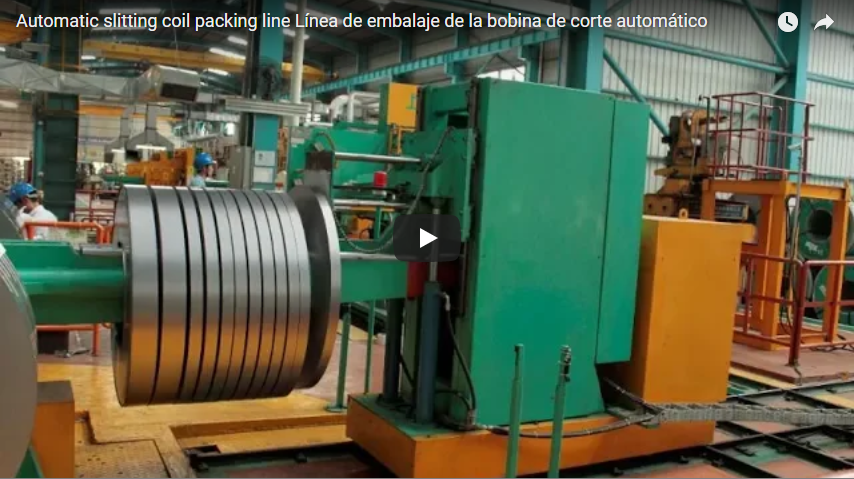
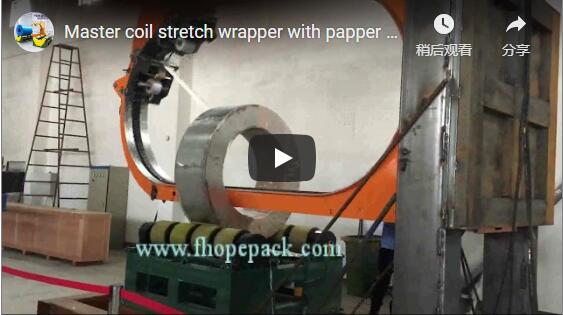
Executive summary This video shows an automatic packaging line moving slit steel coils through handling, wrapping, strapping/pressing, and final stacking. Coils travel on roller conveyors, are gripped and centered by a gantry-style clamp, wrapped with flexible material, pressed and secured, and finally appear stacked in finished piles. Specific capacities, coil weights, and cycle times are not shown — verify those with the manufacturer.
Slit coils are heavy, awkward, and easy to damage. Between the slitting line and the warehouse, each coil traditionally passes through several manual steps: lifting, banding, wrapping, and stacking. Every one of those steps is a chance for a dropped coil, an inconsistent wrap, or an injured worker. The line shown in this video replaces that chain with a connected, automated process — and watching it end to end is the fastest way to understand what “automatic coil packaging” actually means in practice.
This article walks through the footage in order, separates what is directly observable from what is inferred, and lists the questions a buyer should ask before specifying a line like this.
The line in action: what the video shows
The video is a montage of static shots and picture-in-picture insets rather than one continuous take, but the process logic is clear:
- 0–6s — Infeed and staging. A large slit coil rests in a holding fixture on the left of a blue-painted steel frame. A yellow roller conveyor runs through the center of the frame. A control cabinet with a color touchscreen and a button stack (red emergency-stop, green start, function keys) stands at the right, with green/red/amber indicator lamps above it.
- 6–8s — Transfer. The coil moves from the staging fixture onto the center of the roller conveyor, changing from an upright orientation to lying with its axis horizontal.
- 8–12s — Wrapping. An overhead arm with a flexible belt/film wrapping head circles the coil, laying down at least one full wrap of white, semi-transparent packaging material.
- 14–28s — Pressing and securing. The scene shifts to a second, light-green machine section. Multiple pneumatic/hydraulic actuators move in sequence — upper press heads close down, side clamps gather in — tightening and securing the wrap or banding around the coil.
- 30–44s — Clamp, lift, and position. A gantry-style unit over a yellow roller line performs a repeated “lower → clamp → lift/rotate” sequence. The coil sits on a rotating support, is gripped at its outer edge, raised free of the support by a central lifting device, and held while wrapping material is pressed against its surface.
- ~46s — Finished stacking. A wider shot of the workshop shows completed coils — wrapped in white strapping, some with faint red printed marks — stacked in tall piles of roughly five to six layers, with more identical green-and-yellow machines lined up down the bay.
For buyers who think in stations, here is the same sequence as a table:
| Stage | What the footage shows | Equipment observed |
|---|---|---|
| Infeed | Coil staged in a fixture, upright | Blue steel frame, holding fixture |
| Transfer | Coil repositioned onto conveyor, axis horizontal | Yellow roller conveyor |
| Wrapping | Overhead arm circles coil with flexible film/band | Wrapping head with tension pulleys |
| Securing | Press heads close, side clamps tighten | Pneumatic/hydraulic actuators |
| Handling | Gantry clamps coil, lifts, rotates into position | Column/gantry with dual clamps + central lift |
| Stacking | Finished coils piled 5–6 layers high | Workshop floor, no palletizing machine shown |
Direct observation notes
The following points stay close to what the footage actually shows, with only grammar-level editing:
- The main machine frames are painted blue (first section) and light green (second section), with visible welds and bolted connections.
- The conveyor is a yellow roller line with evenly spaced rollers; roller diameter appears to be roughly 0.15 m with a length of about 1.2 m, based on relative comparison in the frames.
- Coils are silver-grey metal with some oxide/oil-film sheen; estimated outer diameter is roughly 1.2–2 m depending on which reference object is used, with coil height roughly 0.3–1 m across different shots. These are visual estimates only.
- The control cabinet has a color touchscreen showing a graphic flow screen, a red mushroom-head emergency-stop button, green start and grey function buttons, and three indicator lamps (green running, red fault, amber standby).
- Yellow-and-black striped guarding appears in the background of the first section; yellow floor lines mark the working area; warning labels (yellow triangles) are visible on both machine sections.
- Legible text in the footage includes “FHOP” and “PEE” on the blue machine body, “1800PE” on a yellow machine in an inset, and Chinese warning text reading “警告” (warning) and “注意安全” (pay attention to safety) on a yellow triangle label on the green column. Other nameplates and parameter text are unreadable.
- No light-curtain sensor array, no gate interlock action, and no independent emergency-stop on the second machine section were observed — only a static warning label.
What the video does not show
The gaps matter as much as the footage, especially if you are budgeting or specifying:
- Coil specifications — thickness, width, steel grade, weight range, and min/max coil diameter are all invisible.
- Throughput and cycle time — the video is a frame montage; no seconds-per-coil figure can be read from it.
- Power and utilities — motor kW, hydraulic pressure, air supply requirements, and PLC/HMI specifics are not shown.
- Safety certifications — no CE, UL, or ISO marks are legible.
- The complete unload-and-palletize loop — finished coils are seen stacked, but the transfer from machine to stack is not filmed continuously.
- Model number and documentation — no readable nameplate, manual, or layout drawing appears.
Any of these that matter to your project should go on your checklist to confirm directly with the manufacturer.
Why an automatic line changes the packaging step
Based on what is visible, the line addresses the three classic pain points of manual coil packaging:
- Personnel risk. Slit coils can weigh several tons. In this footage, no worker ever touches a coil — people appear only in a background office area. The heaviest interaction (clamping, lifting, rotating) is done by the gantry unit.
- Consistency. The wrapping arm lays material in a repeatable pattern, and the press-and-clamp stage applies the same closing action every cycle. Hand-wrapped coils vary from operator to operator and shift to shift.
- Flow. Coils move from station to station on the roller conveyor without crane transfers between steps. In a manual process, each crane pick is a pause; here the conveyor carries the coil continuously through wrap and secure stations.
The trade-offs are also worth naming. A line like this is built around a defined coil size envelope — out-of-family coils may need fixture changes or re-parameterization. The footage shows no vision inspection or rejection station, so damaged or misaligned coils would need human attention. And hydraulic/pneumatic systems with many hoses, as seen here, require scheduled professional maintenance.
Application fit: where a line like this belongs
The footage shows bare mill-finish slit coils, which points to typical upstream contexts:
- Slitting service centers that need to turn slit mults into shippable, stacked units quickly.
- Cold-rolling or galvanizing/painting line back-ends, where finished coils flow continuously into packaging.
- Tube, wire, and construction-goods plants that receive or ship large volumes of slit feedstock.
If your coils are non-standard — very thin, very wide, eye-to-sky versus eye-to-wall orientation changes, or mixed diameters on one line — treat that as a primary qualification question rather than an assumption.
Buyer verification checklist
Before requesting a quotation, work through this list. None of these answers are in the video:
- Coil weight range and min/max OD/ID the line is designed for
- Cycle time per coil at your coil size
- Wrapping material compatibility (your film/strap suppliers, thicknesses, strengths)
- Fixture changeover procedure for different coil diameters
- PLC/HMI platform and data interfaces (e.g., for MES integration)
- Safety package: guarding, light curtains or area scanners, interlocks, e-stop coverage
- Utility requirements: power, compressed air, hydraulic spec
- Spare parts availability and service response time
FAQ
Does the video show the full process from infeed to stacking? It shows every major stage — staging, transfer, wrapping, pressing/securing, gantry handling — and ends with a shot of stacked finished coils. However, the transfer into the stack itself is not filmed as one continuous take, so the complete closed loop should be confirmed with the manufacturer.
What coil sizes can the line handle? Not determinable from the footage. The coils shown are large (visual estimates put the outer diameter in the 1.2–2 m range), but no rated capacity or size envelope is stated. Verify with the manufacturer.
Is any operator interaction shown? Yes — a gloved hand is briefly seen at the control panel in the wrapping segment, and the touchscreen displays a graphic flow interface. Otherwise the process appears to run without material handling by people.
What safety features are visible? A red mushroom-head emergency stop on the control cabinet, indicator lamps, yellow-black barrier striping, floor marking lines, and warning labels (including an electrical-hazard triangle on the green column). No light curtains or gate interlocks are observable in the footage — confirm the full safety design separately.
Can the line integrate with an existing conveyor or MES? The line clearly uses roller conveyors between stations, and the control cabinet has a graphical HMI. Specific integration interfaces are not shown; ask the manufacturer about available fieldbus or data protocols.
Is the “1800PE” marking a model number? The text “1800PE” is legible on a yellow machine in an inset shot, but the video does not confirm it as a model designation. Treat it as unverified and confirm naming with the manufacturer.
Source and method
This article is based solely on the linked YouTube video. The footage was analyzed frame-by-frame using a vision model on sampled frames; the video contains background music only, with no narration or speech, so no ASR was performed. All quantitative claims in the body are visual estimates or explicitly marked as items to verify with the manufacturer.
Related reading
- Automatic coil packing line overview
- Steel coil wrapping machines
- Steel coil strapping machinery
- Automatic packing lines
Next step
If the process shown here matches your packaging bottleneck, the practical next move is a coil-spec conversation: send your coil weight, diameter range, and target cycle time, and ask for a line layout and quotation matched to those numbers. Start via the contact page.