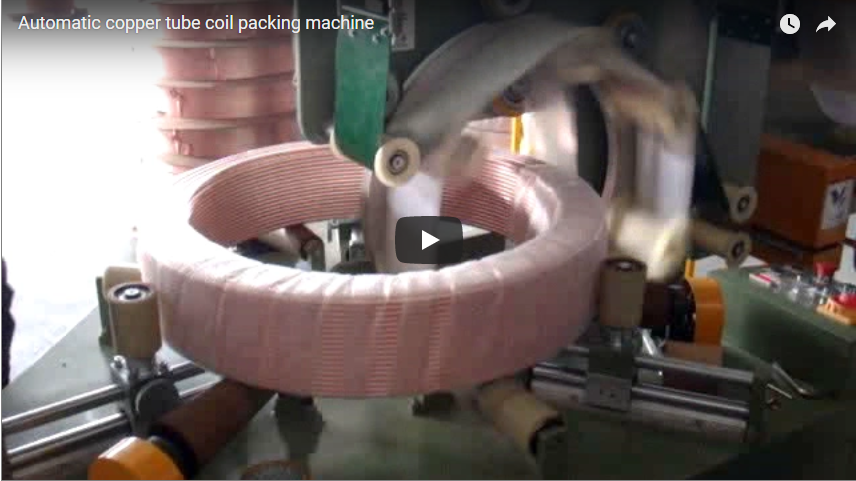
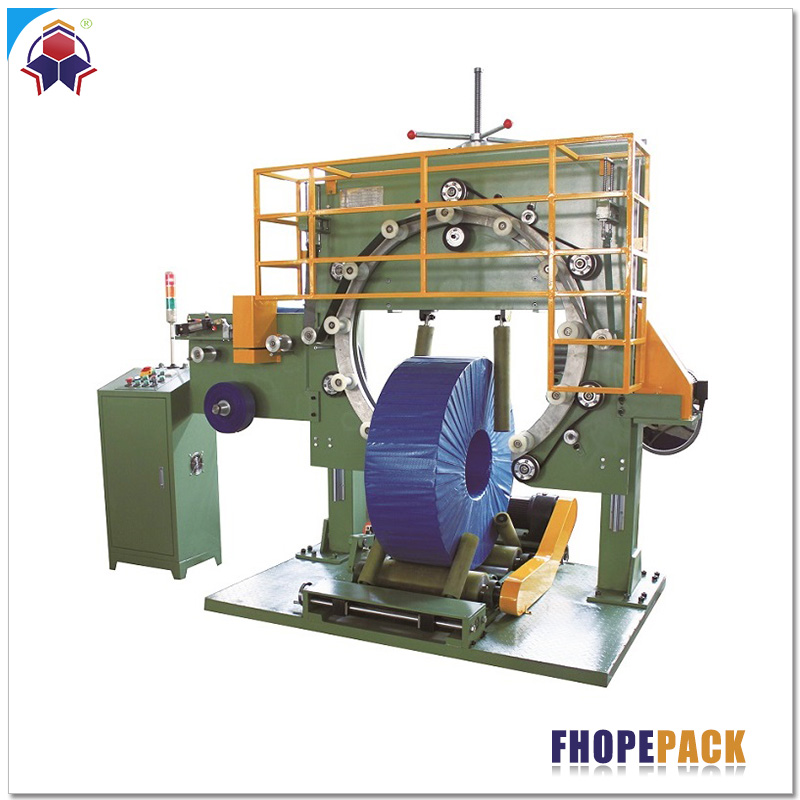
Executive summary This engineering guide examines the configuration of automated packaging lines for slit and master coils in steel and copper processing. We analyze the five core inline stations—radial/circumferential strapping, orbital eye-through wrapping, 90° hydraulic tilting, flat-coil circumferential wrapping, and gantry stacking. Each automated module replaces high-risk, labor-intensive handling, reduces cycle times, and prevents transit damage. System sizing depends directly on coil outer/inner diameter, face width, metallurgical sensitivity, and floor space constraints.
What Each Station Replaces
An automated coil packaging line integrates discrete manual operations into a continuous, PLC-synchronized transfer sequence. Each station replaces hazardous physical labor with programmable mechanical control.
| Station | Manual Operation Replaced | Automated Mechanism & Operational Benefit |
|---|---|---|
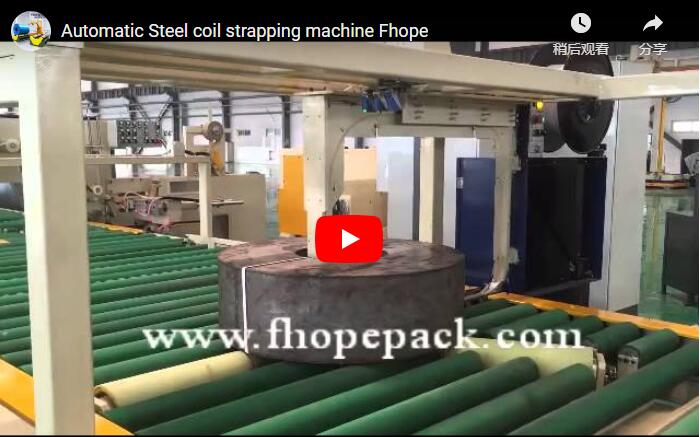
| Strapping Station | Manual pneumatic hand-tool tensioning and notched metal jointing. | Automated radial indexing head feeds 16–32 mm PET or high-tensile steel strapping through the coil eye with 2,500–6,500 N programmable tension. |
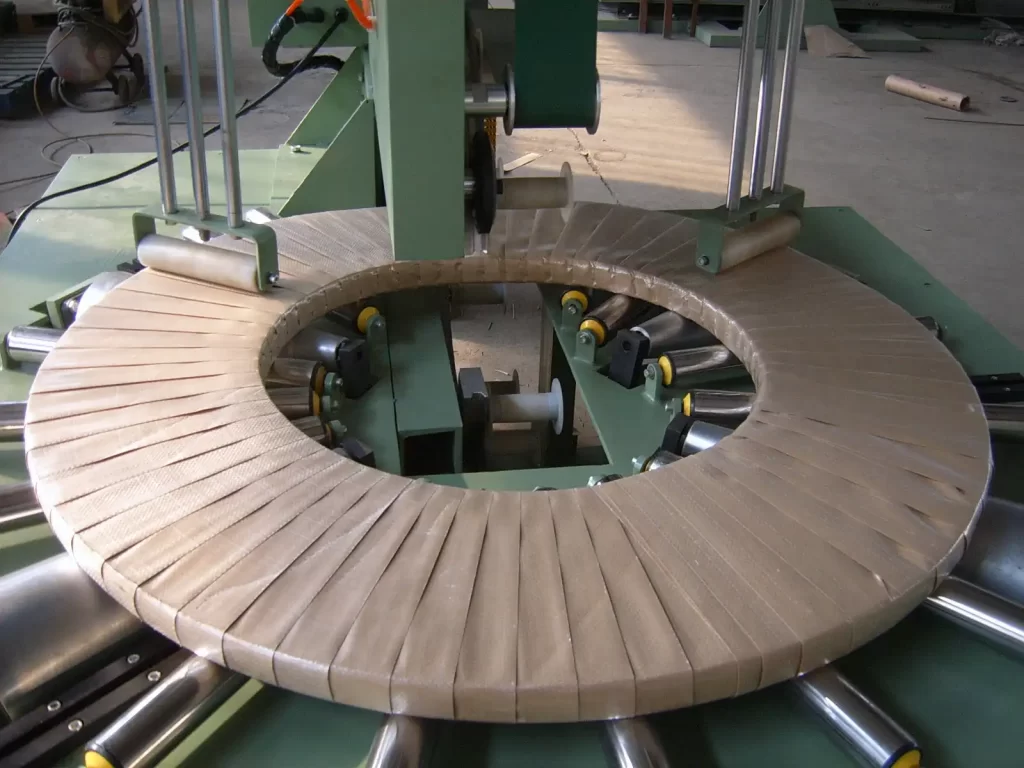
| Eye-Through Orbital Wrapper | Operators passing film rolls by hand through the inner diameter (ID). | A high-speed rotating C-ring or closed-loop shuttle applies VCI film and stretch film through the eye at 40–80 RPM, ensuring continuous 30%–70% overlap. |
| 90° Tilter / Downender | Hazardous overhead crane maneuvers using C-hooks or nylon web slings. | Dual-cylinder hydraulic cradle reorients coils between eye-to-sky (vertical) and eye-to-horizontal axis without edge buckling or telescoping. |
| Flat-Coil Wrapper | Manual sheet wrapping of eye-to-sky coils on wooden pallets. | Rotating turntable or overhead rotary arm wraps horizontal palletized coils, sealing against moisture ingress and transit shifting. |
| Gantry Stacking Station | Forklift manual restacking, spacer insertion, and pallet loading. | 3-axis Cartesian gantry or heavy-duty scissor-arm grab automatically picks, centers, and stacks finished coils onto pallets according to pre-set recipes. |
By substituting high-risk, variable manual work with rigid automation, the line eliminates surface scuffing on delicate copper alloys, prevents catastrophic telescoping in high-yield slit steel, and removes personnel from high-mass suspended load zones.
The Labour Impact
Transitioning from manual shop-floor packing to a central automated processing line fundamentally shifts labor allocation. The following operational model evaluates a typical 2-shift slit coil manufacturing facility producing 120–180 coils per shift.
| Line Parameter | Manual Packing Cell | Automated FHOPE Line | Operational Impact |
|---|---|---|---|
| Direct Crew per Shift | 6 operators | 2 operators | -4 operators per shift |
| Daily Direct Labor (2 Shifts) | 12 operators | 4 operators | -8 operators daily |
| Productive Machine Hours | Variable (fatigue-dependent) | Continuous pacing (90–150 s/coil) | +35% to +60% consistent throughput |
| Total Labor Hours Reallocated | Baseline | 64 operator-hours / day freed | Scaled into slitter operation / QC |
| Packaging Consumable Waste | 18%–25% (uncontrolled film tension) | < 3% (precision gear pre-stretch) | 200%–250% fixed stretch ratio |
These metrics represent documented field installations. Actual labor reductions vary depending on average slit width, inner diameter dimensions, packaging recipes (e.g., dual-layer VCI plus woven fabric versus single stretch film), and upstream slitter output. The decisive advantage remains constant: operators transition from handling heavy coils to monitoring HMI diagnostics, loading consumables, and managing outbound logistics.
How We Choose the Stations
System engineering requires matching coil metallurgy, geometric envelopes, and mill logistics to the appropriate station sequence. Copper and silicon steel coils require high-precision surface protection, while structural carbon steel demands maximum strapping retention force.
[Slitter Recoiler]
       │
       ▼
[Turnstile / Transfer Car]
       │
       ▼
[Station 1: Automated Strapping] ──► Through-eye radial or circumferential retention
       │
       ▼
[Station 2: Orbital Eye-Through] ──► 6-face sealed protective wrapping (VCI/Stretch)
       │
       ▼
[Station 3: 90° Hydraulic Tilter] ──► Eye-horizontal to Eye-to-sky reorientation
       │
       ▼
[Station 4: Gantry Stacker] ──► Auto-palletizing with timber runner placement| Station Selection Factor | Engineering Dependency | Implementation Solution |
|---|---|---|
| Strapping Architecture | Coil slit width, transport shock vectors, customer specification. | Radial Strapping: Feeds strap through the open eye for narrow slit coils. Circumferential: Retains outer wrap on master coils. Combined: 3 radial + 1 circumferential for offshore export. |
| Wrapping Kinematics | Atmospheric corrosion exposure, export duration, coil orientation. | Eye-Through Shuttle: 6-face full environmental encapsulation for vertical/horizontal coils. Flat-Coil Rotary Arm: Pallet-level rainproof top/side wrapping. |
| Tilter Drive Mechanism | Upstream delivery attitude (mandrel vs. skid) and coil mass. | Electromechanical Screw: For rapid, cleanroom copper coils under 5,000 kg. Dual Hydraulic Cylinder with Counterbalance: Heavy steel up to 30,000 kg. |
| Stacking Configuration | Daily SKU variance, stack pattern recipes, floor footprint. | Cartesian Overhead Gantry: High stability, small footprint, handles up to 10,000 kg. Robotic Articulated Arm: Multi-pallet sorting flexibility for complex slit orders. |
For sensitive copper strips, conveyor rollers feature 5 mm vulcanized polyurethane (85–90 Shore A hardness) or engineering plastic sleeves to prevent surface marking. Hydraulic clamps utilize proportional pressure-reducing valves to eliminate coil out-of-round deformation during lifting and tilting.
Selection Checklist
Prior to finalized line quotation and layout drafting, review this parameters matrix:
- Coil Dimensional Envelope: Outer diameter (OD_min to OD_max), inner diameter (ID_min to ID_max), minimum slit width (W_min), and maximum face width (W_max).
- Mass Range: Minimum and maximum payload (kg) per single slit coil and combined master package.
- Throughput Demands: Required cycle time per coil (seconds) and target coils-per-hour output from upstream slitting lines.
- Material Metallurgy & Surface Sensitivity: Cold-rolled carbon steel, hot-dip galvanized, high-gloss polished copper, or grain-oriented electrical steel (determines roller coating specifications).
- Strapping Specifications: Preferred strapping material (PET vs. high-tensile steel), strap width (16, 19, or 32 mm), and number of radial ties (e.g., 2, 3, or 4 radial straps at 90°/120° intervals).
- Protective Wrapping Media: Primary layer (VCI crepe paper, anti-rust film) and secondary outer layer (LLDPE stretch film, HDPE woven cloth), including required pre-stretch percentage.
- Material Handling & Orientation: Upstream feed condition (eye-horizontal on turnstile vs. eye-to-sky on conveyor) and downstream palletizing requirements.
- Pallet Specifications: Wooden skid dimensions (L × W × H), maximum target stack height, and automated timber spacer insertion requirements.
- Facility Clearances: Available floor area, bay crane clearance, hook-height limits, and safety perimeter boundaries.
- Compliance & Safety Standards: Regional machinery directives (CE, UL/CSA, OSHA), required safety light curtain muting, and Category 4 / PLe safety architectures.
Safety
Coil packaging automation handles significant suspended masses and mechanical tension vectors. Safe installation and maintenance require rigid operational protocols:
- Perimeter Guarding and Light Curtains: Maintain active safety fencing around the high-speed orbital wrapper, hydraulic downender, and 3-axis stacking gantry. Entry interlocks must trigger an immediate Category 0 stop.
- Lockout / Tagout (LOTO): Never enter the machine envelope to clear strapping jams, change stretch film rolls, or conduct routine lubrication without isolating the primary electrical breaker and locking out the pneumatic/hydraulic pressure-dump valves.
- Anti-Drop Engineering: The hydraulic tilter incorporates dual pilot-operated check valves directly manifold-mounted to cylinder ports, preventing cradle drop in the event of line rupture. The gantry hoisting axis utilizes mechanical drop-safety brakes.
- Machinery Directives: For European installations, the integrated line conforms to ISO 12100:2010 (Risk Assessment & Reduction) and EN 415-10:2014 (Safety Requirements for Modular Packaging Machines). All control circuits adhere to ISO 13849-1 (PLd/PLe).
Engineering FAQ
Q: Which stations are mandatory versus optional for a compact layout? A: Only the strapping and wrapping stations are strictly mandatory for core packaging integrity. If your coils exit the slitter already in an eye-to-sky orientation on skids, the 90° tilter can be omitted. Conversely, if your customers demand palletized horizontal delivery from an eye-horizontal slitter, the 90° tilter and stacking station become mandatory.
Q: What is the geometric clearance rule for eye-through orbital wrappers?
A: The wrapping shuttle must clear the coil eye without contact. The minimal usable coil inner diameter must satisfy:
ID_coil ≥ Shuttle_Width + Dynamic_Clearance (typically ≥ 150 mm)
Simultaneously, the outer rotating ring must accommodate:
Ring_ID ≥ √((OD_coil)² + (Width_coil)²) + 2 × Margin_Clearance
Q: Can one line process both cold-rolled steel and mirror-finish copper? A: Yes, via dual-recipe HMI programming. When switching to copper, the PLC automatically lowers strapping tension to prevent edge cracking, engages polyurethane-sleeved roller beds, and activates pneumatic soft-landing cylinders on the downender and stacking grippers.
Q: How does automated stretch wrapping prevent internal corrosion compared to hand wrapping? A: Hand wrapping suffers from inconsistent overlap and variable operator tension, creating capillary channels for moisture ingress. Automated orbital wrapping maintains a uniform 50% overlap under constant 200% power pre-stretch. When paired with an inline VCI film dispenser, it creates a hermetic micro-environment that halts condensation-driven oxidation during maritime transport.
Q: What is the maintenance cycle for the automated strapping head? A: Standard preventative maintenance requires blowing out strap debris and cleaning feed rollers every 50 operating hours. Cutter blades, sealing heating elements (for PET friction weld), and gripper teeth require inspection and recalibration every 200,000 strapping cycles.
Next Step
We engineer custom coil packaging solutions tailored to your mill layout, production bottlenecks, and packaging standards:
- Submit Your Technical Data: Send your coil dimensional schedule (OD, ID, width, mass), hourly throughput targets, and current plant CAD layout to info@fhopepack.com.
- Receive 3D Concept & Commercial Proposal Within 48 Hours: Our engineering division delivers an integrated line drawing, cycle-time simulation, consumption calculation, and budget breakdown.
- On-Site Plant Survey & Interface Review: FHOPE technical specialists inspect floor bearing capacity, civil foundations, crane access channels, and electrical integration requirements prior to manufacturing sign-off.
Related Reading
- Steel Coil Packaging Line: Five ROI Metrics
- Steel Coil Strapping, Labelling and Stacking Line
- Slit Coil Tilting, Wrapping and Stacking Line
- Automatic Coil Packing Lines — Product Page
Sources
- Machine Design Specifications: FHOPE Engineering Technical Archive, 2026-10-10
- Reference Installation Video: FHOPE Automated Steel & Copper Coil Packaging System
- Standards: ISO 12100:2010 (Safety of Machinery — General Principles for Design); EN 415-10:2014 (Safety of Packaging Machines — Modular Packaging Lines); ISO 13849-1 (Safety-Related Parts of Control Systems)
- Operational Baseline: Factory acceptance testing data and customer field validation metrics
Last reviewed: 2026-10-27