Executive summary: Stop turning coils by hand, and the real question becomes how turnover, feeding, and wrapping behave as one line. This roughly 39-second factory demo of an automatic coil turnover, feeding, and wrapping line for slit steel coils shows a flat coil fed in on a yellow roller conveyor, held upright by the line’s turnover station, and then wrapped by an open-ring wrapping head — all on FHOPE-marked equipment. What the clip does not prove is the rated load, the exact turnover angle, wrapping tension and coverage, or how much manual handling is actually removed: in several frames, workers stand right beside the machines, and at least one worker’s hands are on a coil. Confirm those figures with the manufacturer before you specify the line.
This guide is written for plant engineers, production managers, and procurement teams evaluating an automatic coil turnover, feeding, and wrapping line to replace hand turning of heavy slit steel coils. It walks through what the video shows frame by frame, what it does not show, and the specific questions to put to the manufacturer before committing to equipment. Coils are heavy, awkward to grip, and easy to damage once their edges are exposed, so the difference between a vendor’s line on paper and a line on video matters more than the marketing says.
What the video shows
The footage is a short demo of a coil processing line in a workshop, and it is put together as a composite multi-panel clip: several synchronized inset views (in the corners of the frame) show the same areas from other angles, including the roller conveyor with coils, a worker at a control console, and the wrapping machine. So each frame often shows both a main view and one or more inset views of the same equipment. The 39-second clip was sampled into 14 still frames roughly every 3 seconds, so the phases below map to the recorded sequence.
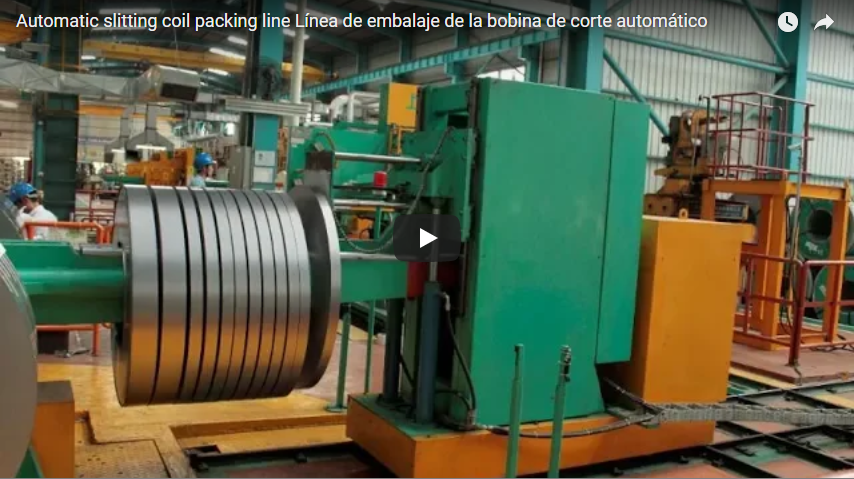
- Infeed on the yellow roller conveyor (f_001–f_007): a flat slit steel coil sits on the line’s yellow roller conveyor in the foreground, and the conveyor is shown carrying a coil workpiece during this stretch. Three blue-film steel coils sit palletized at the side of the line, and further coils rest on the floor or on pallets in the background. The coil is flat, horizontally oriented, and not yet at the wrapping station.
- Turnover station holds a coil upright (f_006–f_009): a blue-framed turnover station with a yellow clamping device is visible, and in one frame a steel coil is held upright inside the clamp — the end state of the turnover step, where the coil changes from flat to vertical so it can be wrapped around its circumference. This is the “turning” part of the line: the coil stops being turned by hand and is instead positioned by the machine.
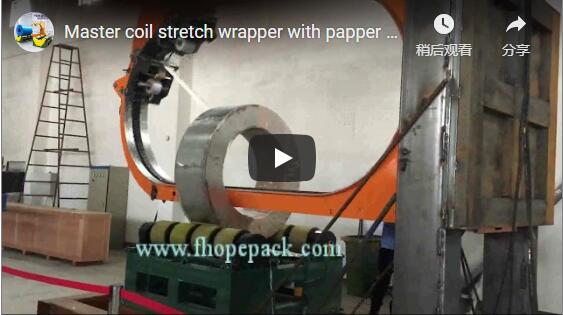
- Open-ring wrapping of the vertical coil (f_012–f_013, f_900): an open-ring wrapping head with a rotating arm is shown working around a vertical coil that is already upright, applying the wrapping. The final sampled frame shows the ring structure of the wrapping machine and an inset with a worker.
The repeatable message of the footage is that a flat slit steel coil can be conveyed in, stood upright by a turnover station, and wrapped by an open-ring wrapping head in a single facility. Every number attached to that sequence — load capacity, coil size range, turnover angle, wrapping tension, coverage, cycle time — is absent from the visible material.
Direct observation notes
These points stay close to the visual evidence, with only light framing:
- The machine line is FHOPE-marked: the letters F-H-O-P-E are legible on the machine in most sampled frames, including a nameplate-style reading. A few partial letter fragments seen in single frames (for example “PAC” on a panel side, and a “UNIVERSAL”-looking fragment in one inset) are not treated as separate brands.
- The three physical steps are all present in the footage: infeed on a yellow roller conveyor, a turnover station that holds the coil upright in a clamp, and an open-ring wrapping head that wraps the vertical coil. No overhead crane or lifting device appears anywhere in the frames.
- The clip is a composite of several camera views, not one continuous wide shot; treat the assembled sequence as a demo, not a live production audit.
- Every sampled frame is static. A still frame cannot by itself prove smooth, continuous, or high-speed turnover or wrapping motion; the conveyor is shown carrying a coil, which is the closest the stills come to visible movement.
- No coil is captured mid-turn and no coil is shown suspended by a lifting device. The upright clamped coil and the vertical wrapped coil are end states, not motion proof.
- Workers are visible in several views, and their protective equipment is inconsistent: one worker in dark workwear stands at the turnover station with no helmet and no reflective vest, and their hand is on the coil; an inset view shows two workers, both wearing safety helmets, watching the line; another inset shows a worker without a helmet. The footage does not establish a consistent PPE or safety-zone practice.
- The control panel has a screen and buttons in the wrappers’ area, but no readout is legible at video resolution, and no numeric nameplate or model number appears anywhere.
What the title promises vs what the footage proves
| Claim (title / manufacturer block) | Visible in footage? | Verdict |
|---|---|---|
| Automatic coil turnover to wrapping position | Turnover station holds a coil upright in its clamp | Mechanism witnessed; continuous turn motion verified with manufacturer |
| Automatic feeding without manual handling | Flat coil rides the roller conveyor through the infeed | Feeding witnessed; “no manual handling” qualified — a worker’s hand rests on a coil |
| Automatic wrapping with consistent coverage and controlled tension | Open-ring head wraps a vertical coil | Wrapping witnessed; coverage/tension figures verified with manufacturer |
| Integrated turnover + feeding + wrapping workflow | All three stations visible in the composite view | Stations witnessed; continuous flow verified with manufacturer |
| Improved packaging quality vs manual | No A/B test or measurement appears in the footage | Verify with manufacturer |
| Reduced manual handling of heavy coils | Workers still stand beside the machines; manual contact visible | Verify with manufacturer |
The video convincingly demonstrates the physical line and its three stations. It does not demonstrate the engineering numbers behind the machine’s claims, which is exactly where a purchasing decision should ask for data.
What the video does not show
For a specification decision, the following are not observable in the footage and must be confirmed with the manufacturer:
| Missing information | Why it matters |
|---|---|
| Coil size and weight range (max/min) | Whether the line accepts your slit coil mix |
| Turnover angle and how the upright position is set | Whether the wrapper takes the coil exactly where your process needs it |
| Rated load capacity and duty rating | Continuous production use, not just a short demo |
| Wrapping tension and coverage settings | The real content of the “consistent coverage, controlled tension” claim |
| Cycle time per coil | Throughput planning for your line |
| How coils are picked up and fed (roller only, or rail/pusher) | Where “automatic feeding without manual handling” really applies |
| Quantified reduction in manual coil handling | The basis of the “stop turning coils by hand” benefit |
| Integration with your downstream packing steps | Whether it fits an existing packing line |
| Safety interlocks, guarding, and PPE requirements | Workers appear without consistent equipment; the safety case is unshown |
The clip never shows two coils in succession, a different coil size, or the line running through a second full cycle. Treat the footage as a demonstration of one sequence, and ask the manufacturer to show a longer run for production realism.
How the automatic coil line works, as filmed
Watching the sampled frames in order, the sequence is: a flat slit steel coil sits on the yellow roller conveyor during the infeed phase; the line’s turnover station then holds the coil upright in its clamp; and an open-ring wrapping head wraps the now-vertical coil while a worker watches from beside the machines. Because every frame is a still, the video demonstrates the end states of each step rather than the smoothness or speed of the motion. Ask the manufacturer for the drive and control details of the turnover station and the wrapping head, the pickup and feeding mechanism between stations, and a live demonstration running your own coil sizes to confirm the motion quality the stills cannot show.
Where worker safety stands in the footage
The title frames the line around replacing hand turning, so it is worth being precise about what the footage can and cannot support. Workers are present in several views near the turnover station and the wrapper, and protective equipment is inconsistent across the views: one worker has no helmet and has a hand on a coil, while an inset shows two workers who do wear helmets. No safety guarding, no interlock, and no marked operator zone is visible in any frame. The real safety case — interlocks, guarding, emergency stop, load monitoring, PPE policy, and a risk assessment for coil handling — has to come from the manufacturer’s documentation and should be reviewed before any claim that the line removes manual coil handling is accepted.
Buyer’s verification checklist
Use this as a short pre-order checklist:
- Confirm the coil size and weight range (max/min) the line accepts.
- Confirm the turnover angle and how the upright position is set.
- Ask how coils are picked up and fed between stations (roller, pusher, or rail).
- Request rated load capacity and duty rating for continuous operation.
- Ask for measured cycle time per coil.
- Request wrapping tension and coverage settings for your coil edge protection.
- Request the quantified reduction in manual coil handling.
- Confirm compatibility with your downstream packing steps.
- Review safety interlocks, guarding, emergency stop, and PPE requirements.
- Ask for a trial or a longer demo run with coils matching your own dimensions.
FAQ
Does the video prove the line runs automatically without workers? No. It shows the three stations and the machine performing turnover and wrapping, but workers are visible beside the machines in several frames, and one worker’s hand is on a coil. Fully hands-off operation must be confirmed with the manufacturer.
What coil sizes and weights can the line handle? No dimensions, weights, or load ratings are readable in the footage. Provide your coil sizes and weights to the manufacturer for a capacity check.
Is the coil really turned upright for wrapping? The footage shows a coil held upright in the turnover station’s clamp and then wrapped in a vertical position by the open-ring head, which supports a turnover-and-vertical-wrap sequence. Whether every coil orientation change is automatic must be confirmed with the manufacturer.
Does it remove manual coil handling completely? The conveyor and stations do the physical steps on camera, and that supports less manual handling. The extent of the saving — and any remaining manual steps such as strapping or palletizing — must be confirmed with the manufacturer’s figures.
Can wrapping tension and coverage be set? The wrapper is visible, but no tension or coverage settings appear in the footage. These are adjustable in practice only if the manufacturer’s spec says so; request the settings and a sample.
Is it safe to operate? The footage does not demonstrate a safety regime — worker PPE is inconsistent and no guarding or interlock is visible. Request the interlock, guarding, emergency-stop, and certification documents before finalizing a decision.
Where can I confirm the specifications and get a quote? Use the contact page below and send your coil dimensions, weight range, and target cycle time so the manufacturer can supply the load, feeding, tension, and safety data that the video does not show.
Related reading
- Coil upender
- Steel coil wrapping machine
- Coil packing machine
- Automatic coil packing line
- Pallet inverter
Next step
If an automatic coil turnover, feeding, and wrapping line matches your coil-handling requirements, the fastest next step is a short technical exchange: send your coil dimensions, weight range, and target cycle time, and ask specifically for the load, feeding, turnover-angle, tension, and safety data this video does not show. Visit the contact page to start the conversation or to arrange a longer demo run with coils close to your own.
Published: 2026-09-16