Executive summary Our heavy coil upenders turn a coil 90 degrees in a V-shaped cradle, from eye-horizontal to eye-vertical or back. The FPCT series steps up to 50 t, and each turn takes 50–100 s depending on size. We size the machine from your heaviest coil, which we work out from its OD, ID and width.
Table of Contents
- How a coil upender turns the coil
- Work out your coil weight
- Pick the capacity step
- Turning time and output
- Utilities and safety
- Selection checklist
- Engineering FAQ
- Next step
- Related reading
- Sources
How a coil upender turns the coil
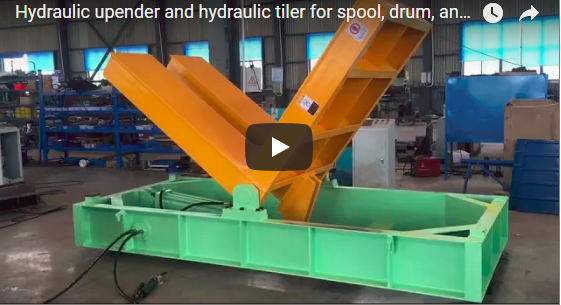
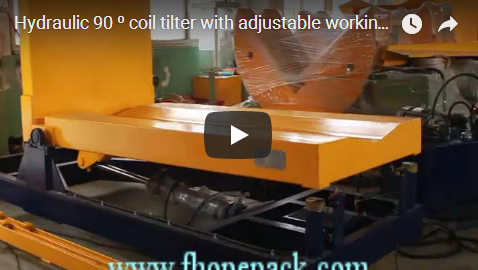
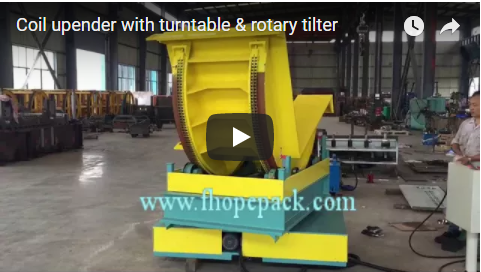
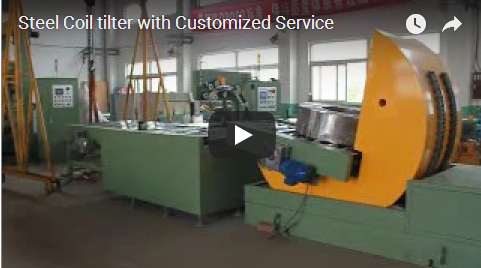
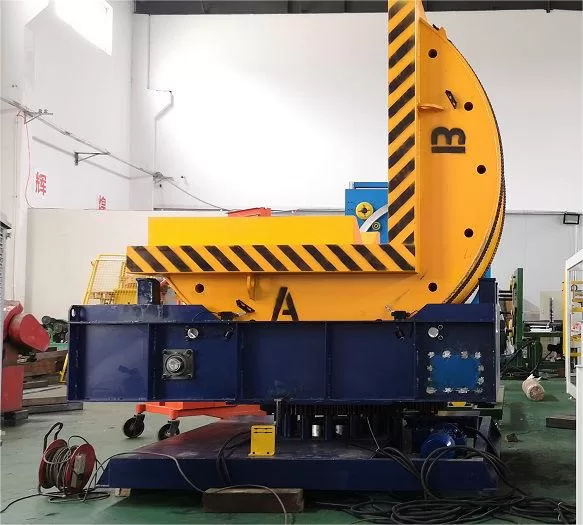
A crane or coil car sets the coil in the V-shaped cradle. The cradle has two faces at right angles, so the coil rests on one face, and the whole cradle rotates 90 degrees on its base. At the end of the turn, the coil rests on the other face with its eye turned through 90 degrees. The table is made to suit your coil size.
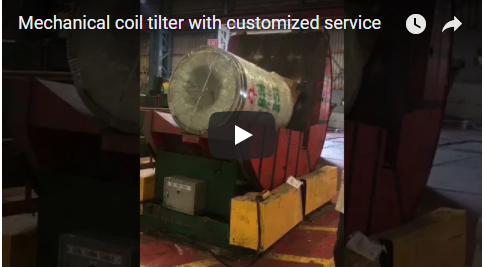
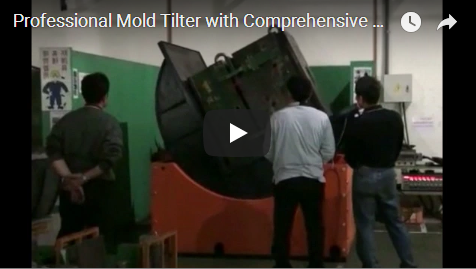
In our video, the crane lowers a large coil into the cradle, and the cradle turns through 90 degrees while the operator runs it from a control cabinet clear of the swing.
Work out your coil weight
For a steel coil, weight = π ÷ 4 × (OD² − ID²) × width × 7.85 t/m³.
| Example coil | OD | ID | Width | Weight |
|---|---|---|---|---|
| A | 1,200 mm | 508 mm | 1,000 mm | about 7.3 t |
| B | 1,800 mm | 610 mm | 1,250 mm | about 22.1 t |
Coil A: π ÷ 4 × (1.44 − 0.258) × 1.0 = 0.93 m³, times 7.85 = about 7.3 t. Coil B: π ÷ 4 × (3.24 − 0.372) × 1.25 = 2.82 m³, times 7.85 = about 22.1 t.
Pick the capacity step
| Model | Max load | Power | Turning time |
|---|---|---|---|
| FPCT-02 | — | 1.5 kW | 50–70 s |
| FPCT-05 | — | 1.5 kW | 50–80 s |
| FPCT-10 | 10 t | 3.2 kW | 60–90 s |
| FPCT-20 | 20 t | 4.5 kW | 60–90 s |
| FPCT-30 | 30 t | 6.5 kW | 60–90 s |
| FPCT-50 | 50 t | 11 kW | 60–100 s |
The page lists maximum loads only for the four larger models. The unit in our video is marked 15T, between the listed steps. Coil A at about 7.3 t fits the FPCT-10. Coil B at about 22.1 t is over the 20 t step, so it needs the FPCT-30. We always size to your heaviest coil, not the average one.
Turning time and output
Illustrative example on the FPCT-30 with 120 s of crane handling per coil:
| Step | Fast | Slow |
|---|---|---|
| Turn | 60 s | 90 s |
| Crane in and out (illustrative) | 120 s | 120 s |
| Total cycle | 180 s | 210 s |
| Coils per hour | 20 | about 17 |
Crane handling usually takes longer than the turn itself, so a coil car or conveyor feed raises output more than a faster upender would.
Utilities and safety
The power supply is built to your requirement, and the table and machine size are designed to your coil and load size. The FPCT series carries a 2-year warranty.
An emergency stop sits on the base and the operator works from a control cabinet away from the cradle. The standards that apply depend on the destination market. For CE markets, ISO 12100 sets the risk-assessment method.
Selection checklist for a heavy coil upender
- Coil OD, ID and width, smallest to largest.
- Heaviest coil weight.
- Turn direction: eye-horizontal to eye-vertical, or back.
- Loading by crane, coil car or conveyor.
- Coils per shift needed.
- Local power supply.
Engineering FAQ
Q: How do we work out coil weight? A: π ÷ 4 × (OD² − ID²) × width × 7.85 t/m³ for steel.
Q: How heavy a coil can the largest upender turn? A: The FPCT-50 is rated for 50 t.
Q: How long does one turn take? A: 50–100 s depending on the model.
Q: Our heaviest coil is 22 t. Which model? A: The FPCT-30, because 22 t is over the 20 t step.
Q: Can the table be made for our coil? A: Yes. The table and machine size are designed to your coil and load size.
Next step
We plan your coil upender in three steps:
- Submit your layout drawing with your coil list and loading method to info@fhopepack.com.
- Receive a proposal within 48 hours, with the capacity step and cradle size.
- Book a site survey to check crane reach and foundations.
Related reading
- Coil upender 10T
- Coil upender 20T
- Coil upenders
- Video: multipurpose automatic coil tilter with slide table
- Video: steel sheet 180-degree turning and upending process
Sources
- FPCT series data: coil upender 10T page
- Same table: coil upender 20T page
- Machine in action: our heavy coil upender video on YouTube
- Steel density: 7.85 t/m³, standard value for carbon steel
- Standards scope: ISO 12100:2010
Last reviewed: 2026-10-04